
About Prince of Persia: The Sands of Time
A young Persian Prince unleashes the Sands of Time inside the Sultan of Azad’s palace and joins Farah, a princess from a rival kingdom, in trying to contain the disaster. Acrobatics, traps, sword combat and the Dagger of Time connect traversal and fighting to a resource system that can reverse mistakes.
Prince of Persia: The Sands of Time is the original 2003 action-adventure game in Ubisoft’s Sands of Time continuity, separate from the later remake project and other Prince of Persia entries. The Prince, youngest son of King Sharaman of Persia, joins his father’s army as it conquers the Indian Maharajah’s city. After that campaign, he reaches the Sultan of Azad’s palace, where he takes a magical dagger and opens the Hourglass containing the Sands of Time. The unleashed sand transforms people in the palace into hostile creatures, leaving the Prince and Farah, daughter of the Maharajah, among the survivors. The story follows their attempt to cross the sealed palace and undo the disaster. Its rooms, baths, courtyards, towers and machinery form a continuous route through the crisis.
The Prince’s movement turns that palace into a connected obstacle course. He runs along walls to cross gaps or reach switches, jumps between ledges, climbs columns and ladders, swings from poles, and uses ropes and beams to carry momentum across rooms. The player reads each space for footholds, bars, wall markings, pressure switches and mechanisms that open a route or change the room. Some passages require a sequence of acrobatic actions rather than one jump, while traps make timing part of the route: blades, spikes and moving poles occupy the same corridors that the Prince must traverse. Pulling or pushing blocks can hold a floor switch or provide a step, joining environmental puzzles to the movement system.
The Dagger of Time links those physical risks to a rewind ability. Holding the rewind command turns back recent action, allowing the Prince to undo a fatal fall, a trap hit or a combat mistake, provided a Sand Tank remains available. A full time circle represents the maximum rewind window, so the power is bounded rather than an unlimited reset. The Dagger’s other powers use separate Power Tanks: Delay slows the action, Restraint freezes an enemy, and Haste lets the Prince move and attack at extraordinary speed while opponents are held back. Their uses draw on recovered sand, making a reserved charge a tactical resource for either traversal recovery or a difficult fight.
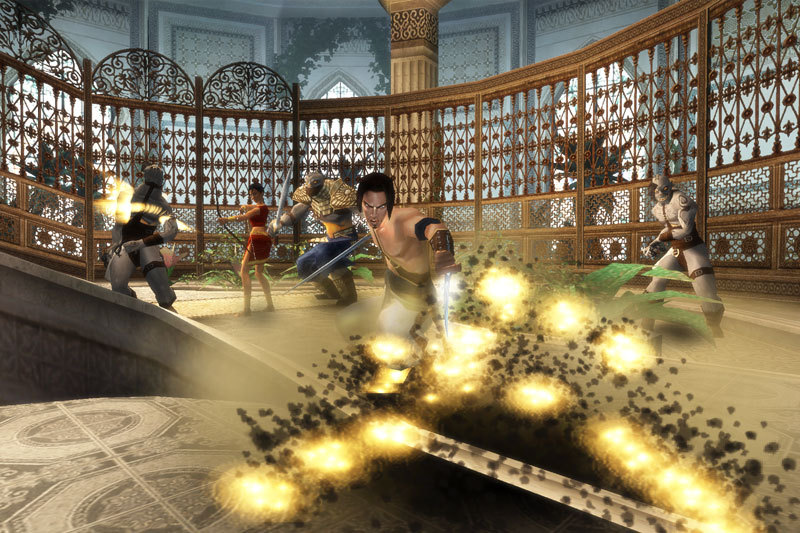
Sand comes from loose Sand Clouds and defeated Sand Creatures. The Prince can retrieve it with the Dagger; each retrieval fills a Sand Tank, and collecting eight clouds permanently adds another tank to the Dagger’s capacity. This makes a fight part of the resource loop rather than a detached arena encounter. Sword strikes stagger a sand creature, but a Dagger finish is needed to destroy it and recover its sand. Power Tanks gradually grow as enough sand is retrieved, enabling additional time powers. The distinction between damaging an enemy and finishing it therefore matters: leaving a weakened creature alive forfeits the refill, while spending powers freely can leave less time manipulation available for the next obstacle.
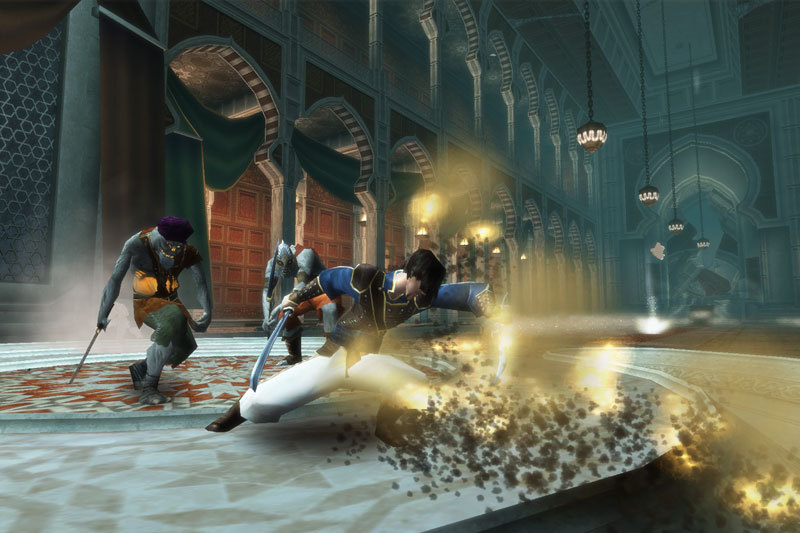
Combat keeps the Prince close to those resource decisions. He attacks with his sword and can vault over an opponent to strike from another angle; the Dagger serves as the finishing weapon that absorbs the sand inside creatures. Encounters use groups of Sand Creatures in palace rooms and along the route, where walls, ledges and nearby objects remain part of the fight. The Prince can interrupt or avoid danger with rewind, slow a threat, freeze a target or use Haste to create an opening, but each choice draws on the same sand economy that will matter after combat. He must balance immediate defense and damage against the sand needed for upcoming obstacles.
Health and progress use separate kinds of water and sand landmarks. Drinking from a pool, fountain or other water source restores lost health, while a Magic Fountain permanently lengthens the Prince’s life bar. Sand Vortices mark save opportunities and, on a first visit, show a brief vision of the route ahead before offering the save menu. These visions provide a glimpse of upcoming spaces without replacing the player’s work of interpreting the actual room. Collectible Sand Clouds restore the Dagger’s reserves and contribute toward its added capacity. Together, these stations give the player ways to restore health, preserve progress and replenish time powers, but each serves a different purpose.
Farah accompanies the Prince through parts of the palace and participates in the action with her bow. Their cooperation forms a practical part of survival: she can attack enemies from range, while the Prince handles close combat and the hazardous path through the architecture. The Prince must account for where she is when he moves, because the bow can strike him if he gets between Farah and her target. This keeps their positioning relevant during encounters rather than making her presence only a story detail. The pair also negotiate switches, gates and spaces that separate them, and the changing trust between them gives the contained palace journey its two central human perspectives.
Azad’s palace defense system combines movable objects, switches and water controls. A crate or statue can hold down a floor switch to keep a gate open, while wall-mounted switches and levers can open routes or extend structures such as drawbridges. In one flooded chamber, turning a crank drains water so the Prince can run along surfaces that were too wet to use before. These mechanisms make the room’s physical state part of its puzzle: the player must find a way to reach the control, then use the altered space to continue. The Sultan designed these defenses to repel an invading army; after the Sands transform the palace’s inhabitants, the Prince must operate them while moving through their traps.
- Developer
- Ubisoft Montreal
- Genre
- Action-adventure