
About Prince of Persia: The Forgotten Sands
Set between The Sands of Time and Warrior Within, the PC edition follows the Prince to his brother Malik’s kingdom as an invading army surrounds its palace. The Prince uses acrobatics, time reversal, and elemental powers to cross a besieged landscape and fight the sand creatures threatening the realm.
Prince of Persia: The Forgotten Sands is a separate adventure in the Sands of Time continuity, set between The Sands of Time and Warrior Within. After visiting the kingdom ruled by his brother Malik, the Prince finds its palace under siege by an invading army. Malik turns to an ancient power of sand in an attempt to defend the realm, and the resulting crisis leaves the brothers facing an army of animated creatures. The Prince’s route through the conflict is a linear action-adventure across palace spaces and the surrounding landscape, with the narrative following his effort to stop the threat and understand the consequences of using that power. The Windows PC release is the principal 2010 game, while the similarly titled Wii, DS, and PSP releases have separate stories and gameplay.
The Prince’s basic movement draws on the series’ acrobatic platforming: he runs along walls, leaps between ledges, climbs pillars, swings from poles, and navigates traps laid through large palace environments. Rooms are arranged as obstacle sequences, and the player reads the architecture for handholds, safe landing points, and the next reachable surface. Hanging hazards such as axes can cut across a jump, so a successful route depends on timing as well as identifying where to move. Levers, switches, and environmental mechanisms add small spatial puzzles to the traversal. The campaign teaches visual cues through repeated structures, then combines those cues into longer passages where several movement actions must be linked together. Rather than roaming an open map, the player advances through a designed route whose rooms use the Prince’s growing abilities to change how a familiar obstacle can be crossed.
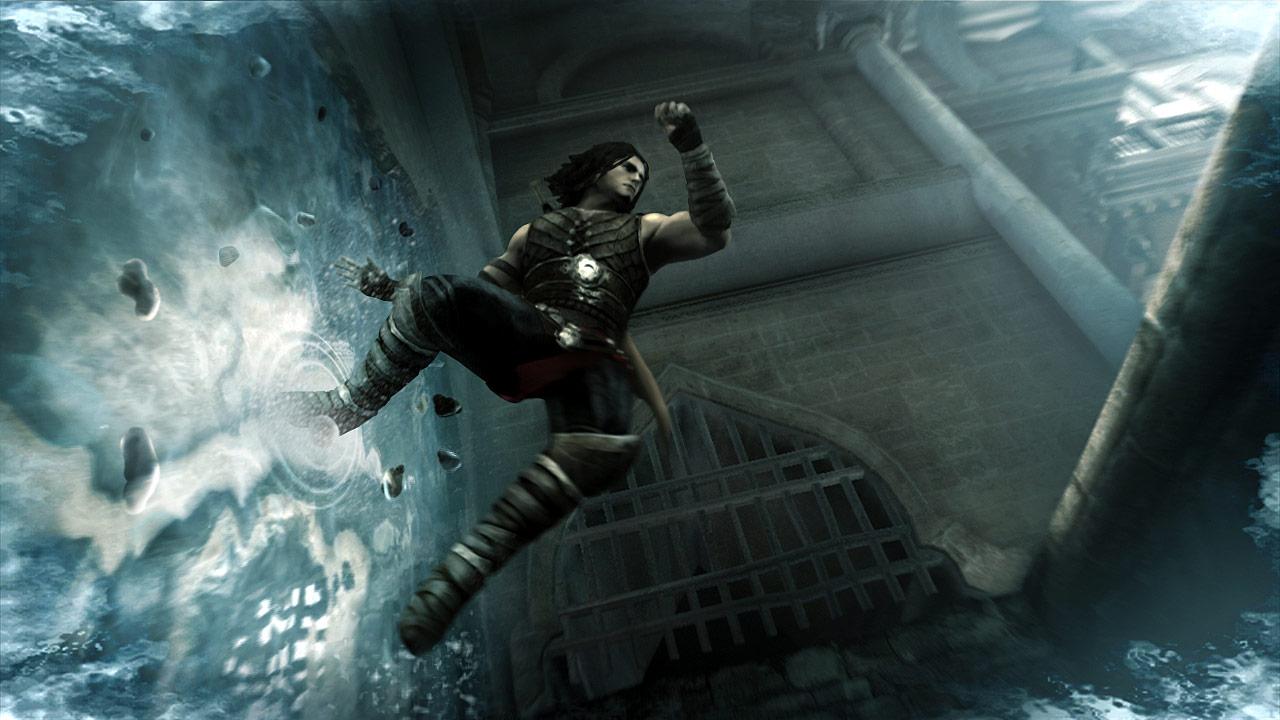
Water is the defining traversal system in the PC version. The Prince can temporarily freeze flowing water, turning a stream or fountain into a solid bar, column, or surface that supports a climb or swing. This makes water part of the level geometry rather than scenery: spouts can serve as handholds, and a flowing curtain can block a passage until the Prince uses his power to move through it. Water can also be used offensively in combat. The power has a limited duration, which makes the player choose when to hold a flow in place and when to let it run again. The levels build around these changes in the environment, adding water features to familiar wall runs, pole swings, and leaps so the Prince's route depends on combining acrobatics with the temporary surfaces created by his ability.
Time manipulation supplies a second way to recover from danger. The Prince can rewind a recent action after a missed jump or mistimed move, allowing a fall to be corrected before it becomes a full restart. Holding the water-freeze control drains an energy bar, and releasing it lets that bar refill; freezing a stream therefore has a limited window and requires the player to manage time between uses. Hidden collectibles provide experience that can be spent to upgrade powers. Combat spells and Rewind consume blue orbs, making a reversal compete with offensive abilities for that resource. If the Prince falls after the orbs are exhausted, play resumes from the last checkpoint. Together, these systems give the player separate decisions about a temporary environmental power, a limited combat resource, and whether a recent mistake is worth reversing. They support traversal and combat without requiring the player to abandon the campaign's directed route.
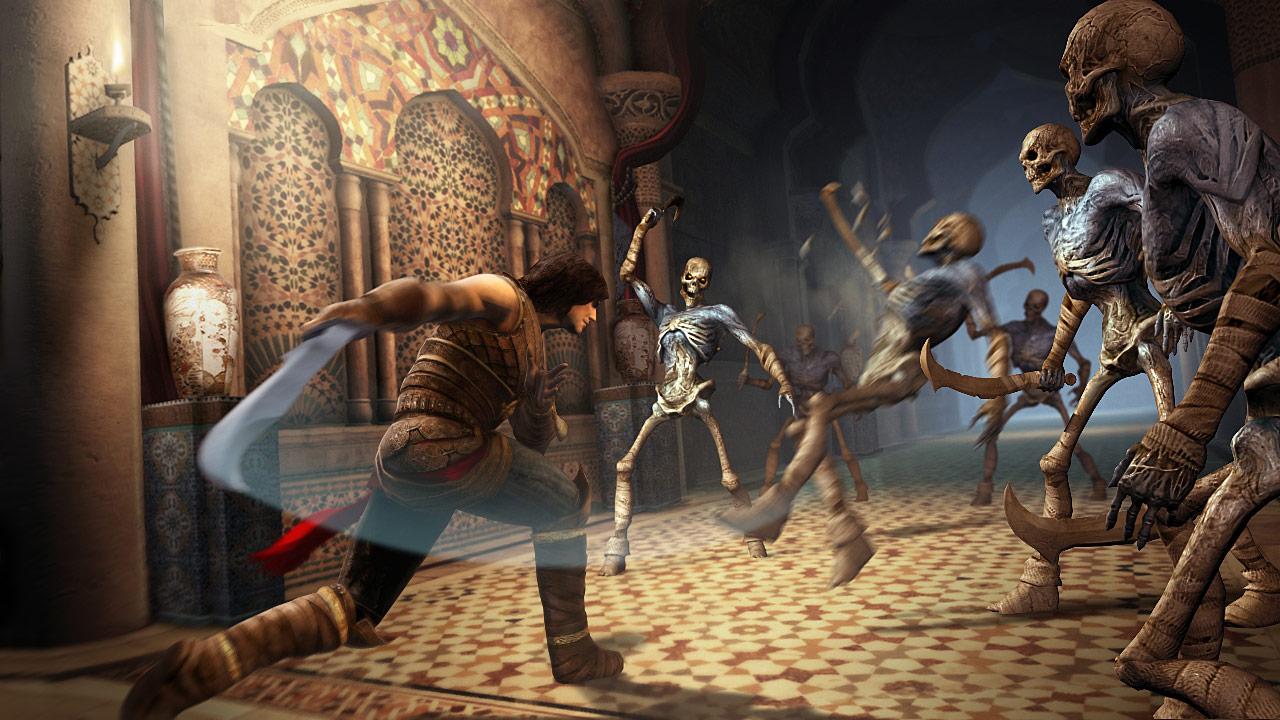
Combat shifts the focus from isolated duels to groups of sand creatures. The Prince attacks with his sword while moving among enemies, and elemental powers expand the available responses. The campaign’s skill tree lets the player unlock combat abilities; one defensive example is Stone Armor, which briefly protects the Prince from damage. Powers can be selected for use during fights, adding a resource and timing decision to the basic attack sequence. Battles may place many enemies in the arena at once, so movement through the group matters alongside attacking. The contrast between traversal and combat is deliberate in the room structure: after a climb or trap sequence, an arena can ask the player to keep moving while managing several opponents, then resume the platforming route once the fight is over. The sand army is the primary threat, while Malik’s decision to unleash it gives the conflict its personal connection to the royal family.
The Sand Army includes enemies that reward different responses. Wraiths carry swords and are the weakest opponents, while specters wear heavier armour, take several hits, and move slowly enough for the Prince to dodge their attacks. Ghouls carry shields and light armour; a direct attack meets their guard, but a kick moves the shield and opens a chance to strike. Summoners continually call wraiths and other minions, so leaving one active adds more attackers to the room. A head-on approach lets them use magic to push the Prince back and drain his health. The Prince can roll or jump to get clear when surrounded, and a jump or kick can knock an opponent down for a follow-up stab to the chest. The enemy mix turns each group fight into a question of which threat to interrupt and when to create an opening.
- Developer
- Ubisoft Montreal
- Genre
- Action-adventure