
About Primordia
In a world inherited by machines, Horatio Nullbuilt and his sarcastic droid Crispin leave their broken-down ship after a marauding robot steals its power core. Their search leads from the wasteland to Metropol, where recovering the energy source opens questions about the vanished humans and Horatio’s own past.
Long after human civilization has vanished, machines inhabit its rusted remains. Horatio Nullbuilt, a solitary robot, lives in the shell of a wrecked ship far out in the wasteland with Crispin, a small mag-lev droid whose dry jokes cut against Horatio’s guarded manner. Their home, the Unniic, is also a project: Horatio studies the Book of Man, tends its machinery and tries to preserve a private life in a landscape of wreckage. That routine breaks when Scraper, a marauding robot, steals the ship’s power core. Without it, the Unniic cannot remain a safe refuge. Horatio and Crispin leave to recover the core, carrying the basic needs of survival into a journey that gradually exposes a much older story. Their route leads toward Metropol, once a great city and now a glittering centre among the remains of the old world. The question of what happened to humanity hangs over the journey, but the immediate problem is practical: find the thief, find enough power and keep the ship running.
The wasteland is not an empty backdrop. Half-buried spacecraft, broken machinery and abandoned human structures suggest lives and technologies that the robots can only interpret from fragments. The game’s world is populated by machines with distinct names and purposes, rather than by surviving human communities. Horatio’s Book of Man gives him one inherited account of the species that came before, while the landscape offers physical traces that may support or unsettle such beliefs. The player encounters the past through objects, dialogue and places, not through a narrator explaining a complete history. This makes the contrast between human remains and present-day machine culture part of the investigation. Horatio’s own reluctance to face his origins gives that broader question a personal edge, though the story holds back the answers until the journey has established its setting and companions. The title’s post-human premise therefore shapes what counts as evidence: scraps, inscriptions, stories and the machines who preserve them. Because the original species is absent, its civilization is not presented as a complete museum of intact human life. It survives in fragments among the ruins, leaving the player to consider the difference between inherited belief and physical evidence.
Primordia uses a point-and-click structure. The player moves Horatio between locations, examines hotspots, speaks with characters and collects objects that can be used on devices or combined in the inventory. A datapad records discoveries and lore, while a map links visited environments and supports travel between them. These tools keep the focus on noticing what a place contains and connecting a clue to a practical obstacle. Early on, the stolen core turns the Unniic itself into a repair problem: pieces of salvage from the desert can be tested against the ship’s machinery until it can function again. The same logic continues as Horatio reaches places built from unfamiliar technologies. Access codes, mechanical repairs and information gathered from characters can open routes or clarify what a machine is designed to do. The game emphasizes investigation and logical thinking, with optional puzzles offering extra knowledge about the setting. Its progress comes from making the world’s technology legible, one object and one conversation at a time.
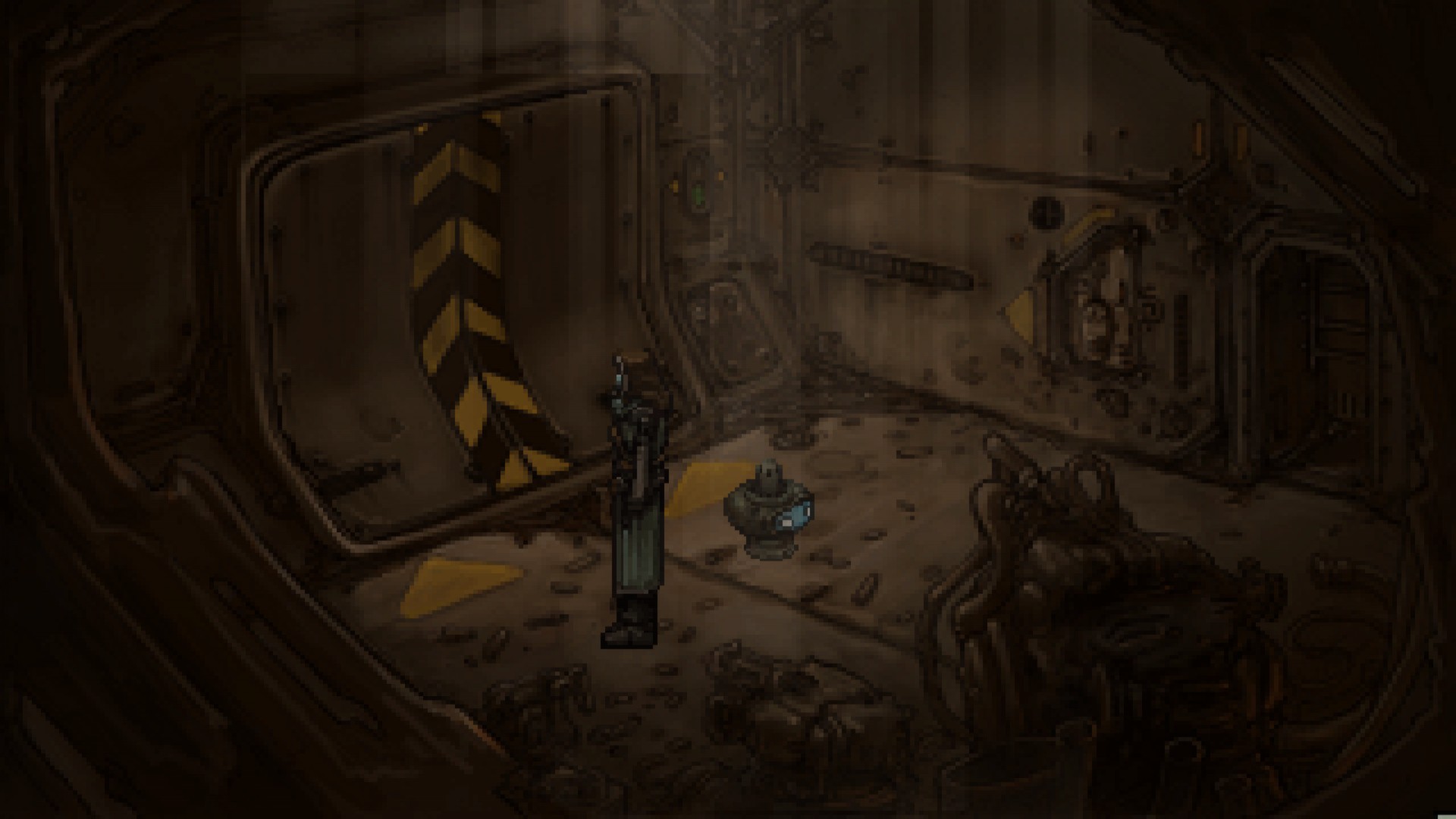
Crispin is more than a commentator following Horatio around. The companion has a complementary skill set and can be brought into interactions as a useful tool, letting the player test whether his abilities apply to a machine or other obstacle. He can also supply hints, although dialogue between the pair is just as central to their role as a puzzle aid. Horatio is restrained and serious; Crispin’s sarcasm gives their exchanges a second rhythm, and the contrast makes their shared history apparent without long explanations. Robots bear a fabrinymic, a builder-name that identifies the robot who made them. That convention gives the player a way to compare generations and think about the choices builders make when creating machines. Horatio designed Crispin to offset his own weaknesses, so their comic bickering also connects to the game’s wider question of how one machine shapes another. Character relationships and puzzle utility reinforce each other instead of occupying separate tracks.
Metropol changes the scale of the journey. The city is a striking destination in a landscape otherwise defined by exposed wreckage, and its inhabitants have their own customs, ambitions and understandings of the missing humans. Reaching it does not simply end the search for the power core; the encounter draws Horatio into the city’s competing concerns and makes his own history harder to ignore. Conversations give the player fragments of civic life and the machines’ beliefs, while the city’s spaces provide new mechanisms to inspect and new routes to open. The design still asks for observation and reasoning rather than fast movement: identify a useful object, learn how a device works, and apply clues in context. The backdrop of human ruins also changes meaning as Horatio meets robots who interpret those relics differently. What begins as a repair mission grows into an inquiry into machine identity, memory and the stories that emerge when the original humans are absent.
The puzzles are grounded in the physical world of the game. Many ask Horatio to repair or assemble mechanical devices, and an engine-rewiring challenge turns a traditional logic problem into plausible machinery. Other tasks involve locating information, interpreting codes or using the datapad to follow clues into new areas. The player can also pursue optional puzzles that deepen knowledge of the setting, so exploration has a layer beyond the main route. These interactions make Horatio’s inclination toward tinkering part of the control scheme: the player inspects the environment, forms a theory about a device and tests the right combination of parts or information. Some obstacles are conversational, with robot characters providing both narrative context and practical leads. The game does not treat its technology as abstract decoration; panels, engines and salvage are things to reason about, while the Book of Man and datapad put the history carried by machines alongside the mechanisms they build. Horatio can inspect points of interest for short descriptions, while the cursor helps mark interactive objects. Those small feedback loops matter in a world where many clues are components, labels or records rather than obvious quest markers.
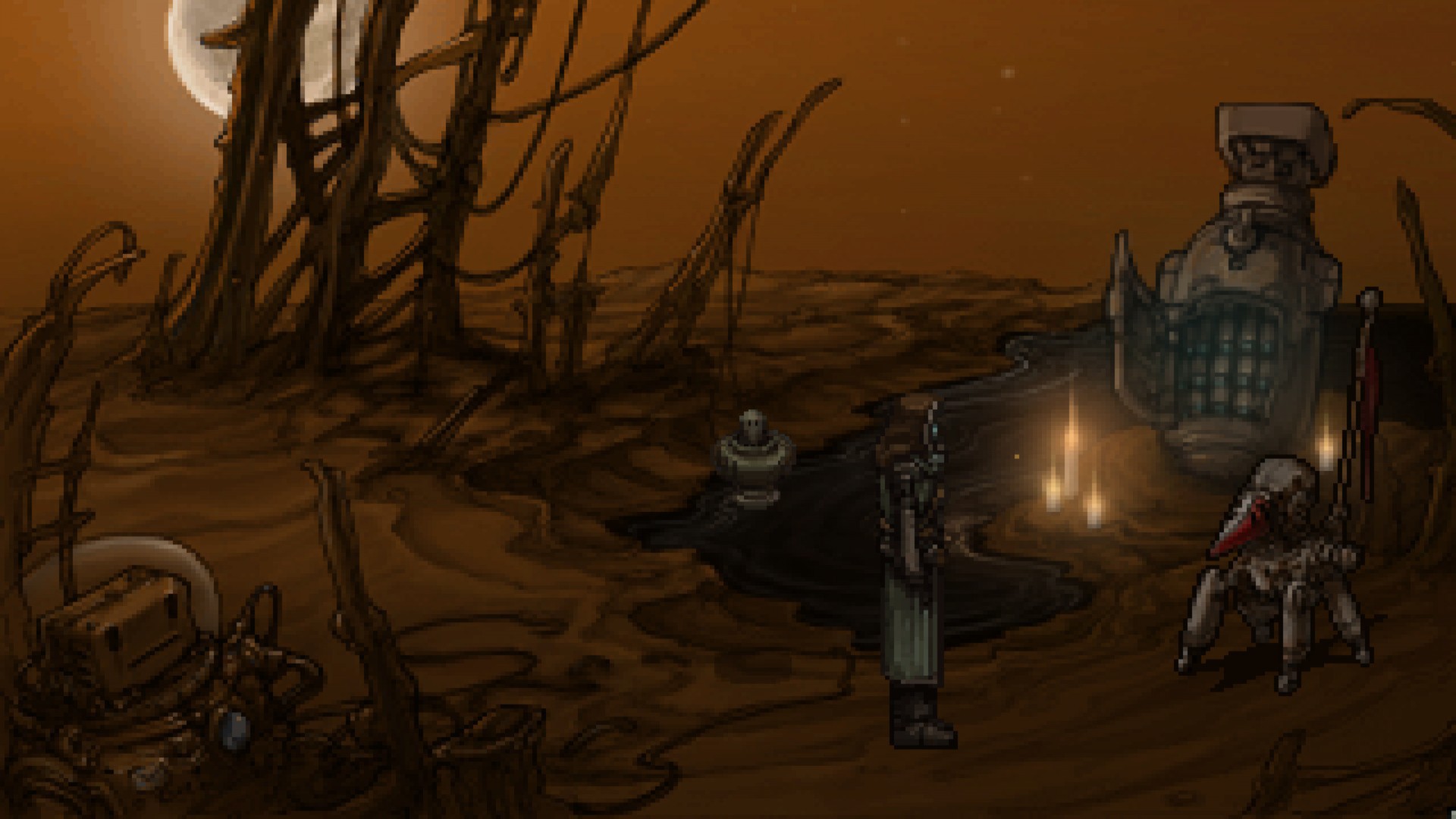
The presentation uses pixel art to give the derelict world a defined visual language, with hand-drawn rooms, distinctive robot designs and painted cutscenes. The game has more than fifty hand-drawn rooms, and its Steam edition is a single-player adventure with full English audio and subtitles in several languages. Horatio’s voice is performed by Logan Cunningham, while Crispin’s personality gives conversations a lighter counterpoint to the bleak setting. Sound also distinguishes the Unniic from the surrounding wastes: its music is more melodic because the ship represents Horatio’s comfortable home, and an antique phonograph plays an original song made for the game’s world. Wormwood Studios developed the game and Wadjet Eye Games published it; Steam lists Windows, macOS and Linux requirements. Across the adventure, the player moves from maintaining a home to navigating Metropol and weighing evidence about human history, with objects, dialogue and atmosphere carrying that change. The shift in music is also tied to the ship’s condition: when its generator temporarily works, the safer interior can sound more comforting, and the melody returns in altered forms elsewhere. The game’s changing soundscape gives a recurring theme to Horatio’s attachment to home.
- Developer
- Wormwood Studios
- Genre
- Point-and-click adventure