
About Portal
Set inside the Aperture Science Enrichment Center, Portal follows Chell as she is directed through tests by the facility’s sentient computer, GLaDOS. The first-person puzzle campaign centres on the Handheld Portal Device: two linked openings let Chell and portable objects cross otherwise separated parts of each chamber.
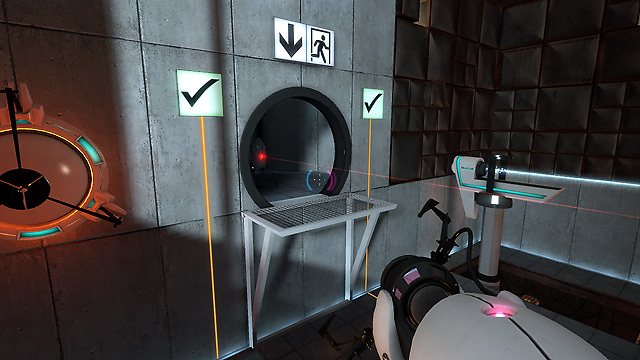
Chell wakes in a relaxation vault inside the Aperture Science Computer-Aided Enrichment Center, a laboratory built around controlled testing. GLaDOS, the facility’s sentient computer, speaks through the chambers as Chell is directed from one test to the next. The rooms are bright, sparse and carefully framed: glass observation windows expose other spaces, while doors, lifts and marked surfaces make each chamber’s practical goal visible. The arrangement suggests a managed experiment, but the automated voice is an active presence rather than a neutral announcer. GLaDOS offers instructions, evaluates results and adds personal remarks that complicate the promise that the tests are safe. Outside the test rooms, glimpses of maintenance corridors and neglected equipment give the facility a second, less polished character. The story is delivered through movement, architecture and dialogue, letting the environment and GLaDOS supply most of the context.
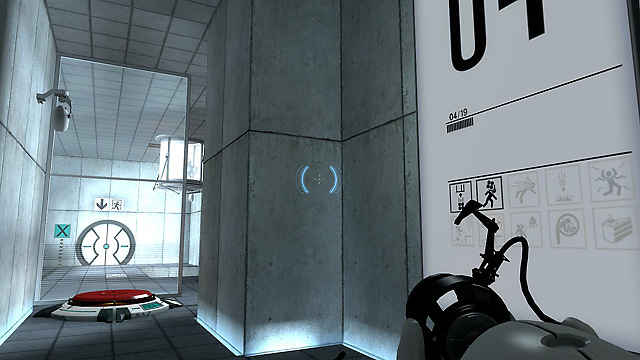
The Aperture Science Handheld Portal Device turns suitable flat surfaces into two connected doorways, one blue and one orange. Firing a new portal replaces the portal of the same colour, so solving a chamber means choosing both where to enter and where to emerge. Walking through one opening brings Chell out of its partner. This makes a distant platform reachable when a direct route is blocked, but it also lets the player carry objects across otherwise disconnected rooms. Portal placement is restricted to marked, compatible surfaces; the reticle signals where a portal can be placed, making surface and sightline part of the puzzle. A portal is therefore both a doorway and a movable piece of spatial infrastructure: changing one endpoint can alter access to a ledge, a button, an energy-ball path or a safe landing area.
Chambers add physical objects and hazards that interact with this paired-space rule. Weighted Storage Cubes can hold down large floor buttons, serve as steps to reach a ledge, shield against an energy ball or knock over a sentry turret. A button may open a door only while its weight is applied, connecting object placement to the route that follows. Ball Launchers send bright energy projectiles along fixed paths; a Ball Catcher receives one to activate a lift or door, so portals can redirect the projectile around barriers. The ball is dangerous to touch, and a cube can block or deflect it. Turrets track Chell and fire when they see her, but their limited footing and line of sight make them vulnerable to a portal exit behind them, a cube dropped from above or a redirected projectile. These elements are reusable rules, not separate minigames: each chamber combines them in a new arrangement.
Movement is another part of the puzzle language. Because a portal pair preserves momentum while redirecting the direction of travel, falling into a floor portal can send Chell out of a wall or ceiling portal at speed. A short drop can become a launch across a gap if the exit is placed correctly; a low portal can redirect a fall into upward motion toward a distant platform. The player must read height, distance, portal orientation and the landing surface together. This becomes especially useful where ordinary walking cannot bridge a gap or where a cube cannot be carried directly to its destination. Some rooms mix this movement with moving platforms, timed shutters or energy-ball routes, requiring the player to prepare a path and then use it while the mechanism is active. The same basic portal device supports careful repositioning and high-speed flinging, so understanding the room’s geometry matters as much as spotting its objects.
The test sequence gradually changes what the player must infer. Early rooms establish portal placement and the relationship between two openings; later ones layer in buttons, cubes, turrets, energy-ball launchers and longer momentum transfers. Each new arrangement asks for a plan about cause and effect: which surface can hold an opening, what must remain pressed, where a moving hazard will travel, and which route remains available after a portal is replaced. The Companion Cube gives one chamber a distinctive object, but its function follows the same rules as a regular Weighted Storage Cube; its heart markings and GLaDOS’s commentary add narrative meaning to a familiar tool. Emancipation Grids also constrain solutions by disintegrating carried objects and clearing portals when Chell passes through. Such boundaries prevent a simple carry-through answer and encourage the player to reconsider the route on the other side.
Portal’s campaign eventually moves beyond the orderly test-room pattern and into service spaces that reveal the machinery supporting the Enrichment Center. The shift changes the immediate task from satisfying a chamber’s stated objective to navigating a space that was not arranged as a formal test, while the Portal Device remains the central means of crossing gaps and reaching distant surfaces. GLaDOS continues to shape the experience through her voice, and the contrast between her controlled instructions and the facility’s less controlled spaces carries the narrative without frequent exposition. After the campaign, the game offers Advanced Chambers—modified versions of Chambers 13 through 18—and Challenge maps that revisit those chambers under limits for portal use, steps or completion time. These modes turn the same compact set of surfaces, objects and hazards into a more constrained exercise, asking the player to refine solutions already learned rather than introducing a separate campaign system.
- Developer
- Valve
- Genre
- First-person puzzle