
About Portal 2
Portal 2 is a first-person puzzle adventure set inside Aperture Science, where Chell uses a portal device to navigate testing chambers and abandoned parts of the research complex. Its single-player campaign pairs environmental puzzles with GLaDOS, Wheatley and other characters, while a separate two-player co-op campaign follows Atlas and P-body through purpose-built tests.
Portal 2 returns to Aperture Science, the enormous research facility introduced in the first game, and places the player back in the role of Chell. The single-player campaign moves between the familiar clean test chambers and older, disused sections of the complex, giving the facility a history that is visible in its changing architecture. The story is delivered through the people and systems encountered along the way: GLaDOS remains the testing facility’s controlling computer, while Wheatley and other voices complicate Chell’s passage through it. The focus stays on discovery and puzzle solving, with the larger mysteries of Aperture unfolding around the challenges rather than through a separate combat system.
The central tool is the Aperture Science Handheld Portal Device. It creates linked openings on suitable surfaces, letting Chell connect separated parts of a room and use the resulting path to move objects or herself. A chamber usually presents an exit that cannot be reached directly, then supplies a mixture of surfaces, buttons, doors, cubes and hazards that can be combined to open a route. The puzzles depend on reading space: players look for portalable panels, trace where a beam or moving surface leads, and work out how a change in one part of the room affects another. A route that appears blocked may become usable if a portal is placed at the other end of a beam or a cube is carried through to a pressure switch. The device remains the consistent foundation as new elements alter the rules around it.
Portal 2 adds several tools that turn a chamber into a small physics problem. Thermal Discouragement Beams must be routed toward receivers, often by redirecting them with a cube. Excursion Funnels carry the player or objects along a defined path and can be sent through portals to change their direction. Hard Light Bridges form traversable surfaces that can be redirected to span gaps or block a line of fire, while Aerial Faith Plates launch the player or objects across a room. These devices make spatial relationships more complex: a portal can carry a beam or bridge into a new orientation, and a funnel can transport something to a position that would otherwise be inaccessible.
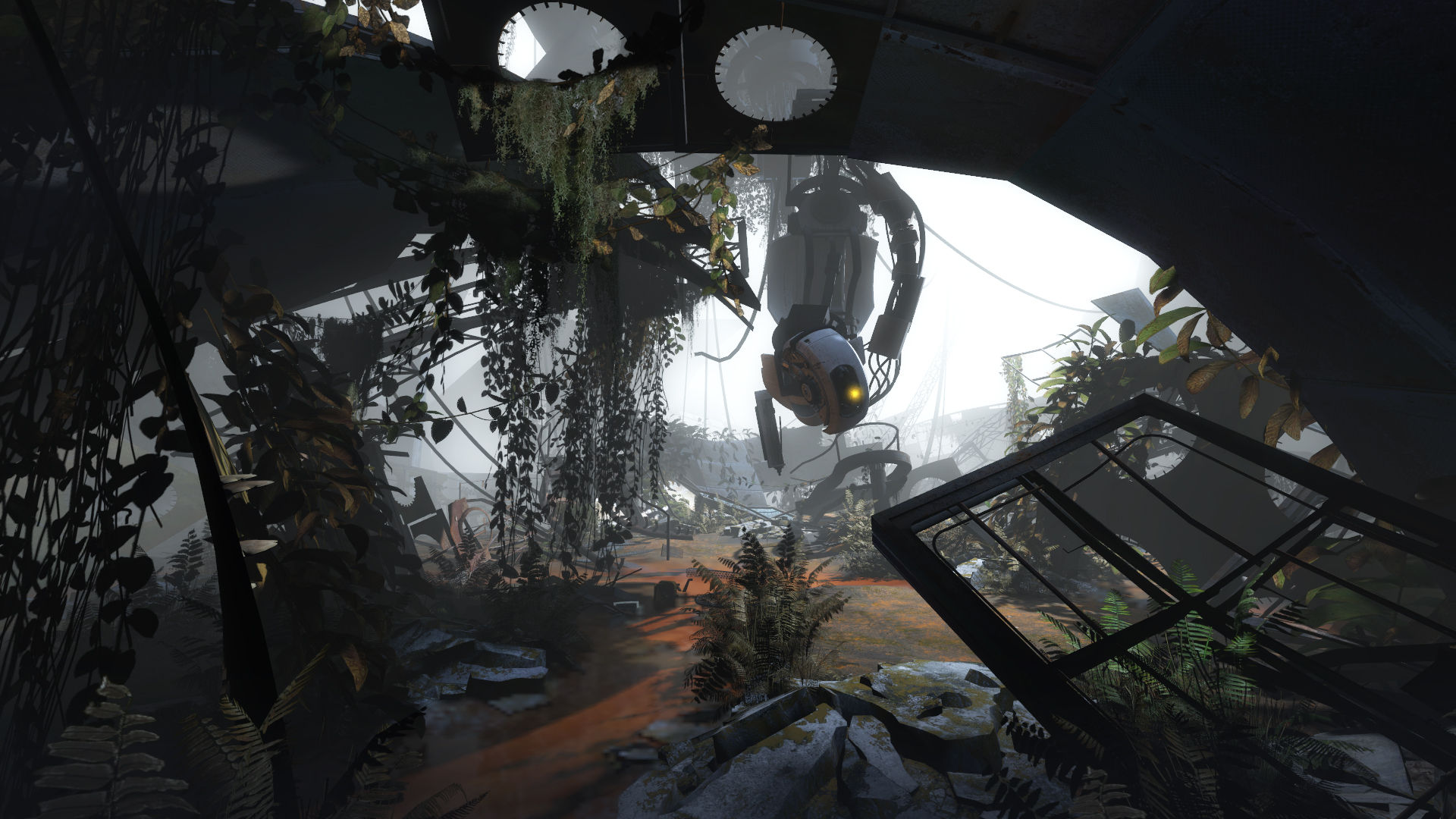
Paint-like gels provide another layer by changing the properties of surfaces. Propulsion Gel makes a coated surface increase running speed, Repulsion Gel makes it bounce the player or objects, and Conversion Gel makes otherwise unsuitable surfaces accept portals. The puzzle is often about getting the right substance to the right place, not simply applying it where it is first found; portals can redirect falling gel, and a funnel may carry it across a chamber. Combining these effects with the portal device creates routes for momentum, bouncing and access. The game introduces these systems in controlled tests, then asks players to recognize how they interact when a room contains several at once.
Between chambers, the single-player campaign broadens the sense of place. Chell passes through maintenance spaces, observation areas and remnants of earlier Aperture projects, with environmental details suggesting how the facility was built and used. The narrative shifts as characters take control of the testing process, changing the spaces and instructions presented to the player. Dialogue provides comic commentary and story context, but the immediate task remains tactile: inspect the room, test an idea, reposition portals, and use the result to reach the exit. The campaign’s character scenes are woven into this cycle rather than replacing it with extended action sequences or branching dialogue choices.
Portal 2 also contains a separate cooperative campaign for two players. One player controls Atlas and the other P-body, two robots designed for the Cooperative Testing Initiative; each has a portal device, so the pair can create four portals in a chamber. The co-op tests have their own story, characters and progression, and are designed around coordination rather than simply duplicating Chell’s solo puzzles. Partners may need to hold a route open while the other moves through it, pass an object between positions, or set up portals so both players can act in sequence. Because each robot controls its own pair of portals, one player can prepare the entry point while the other places the exit needed to continue the joint route.
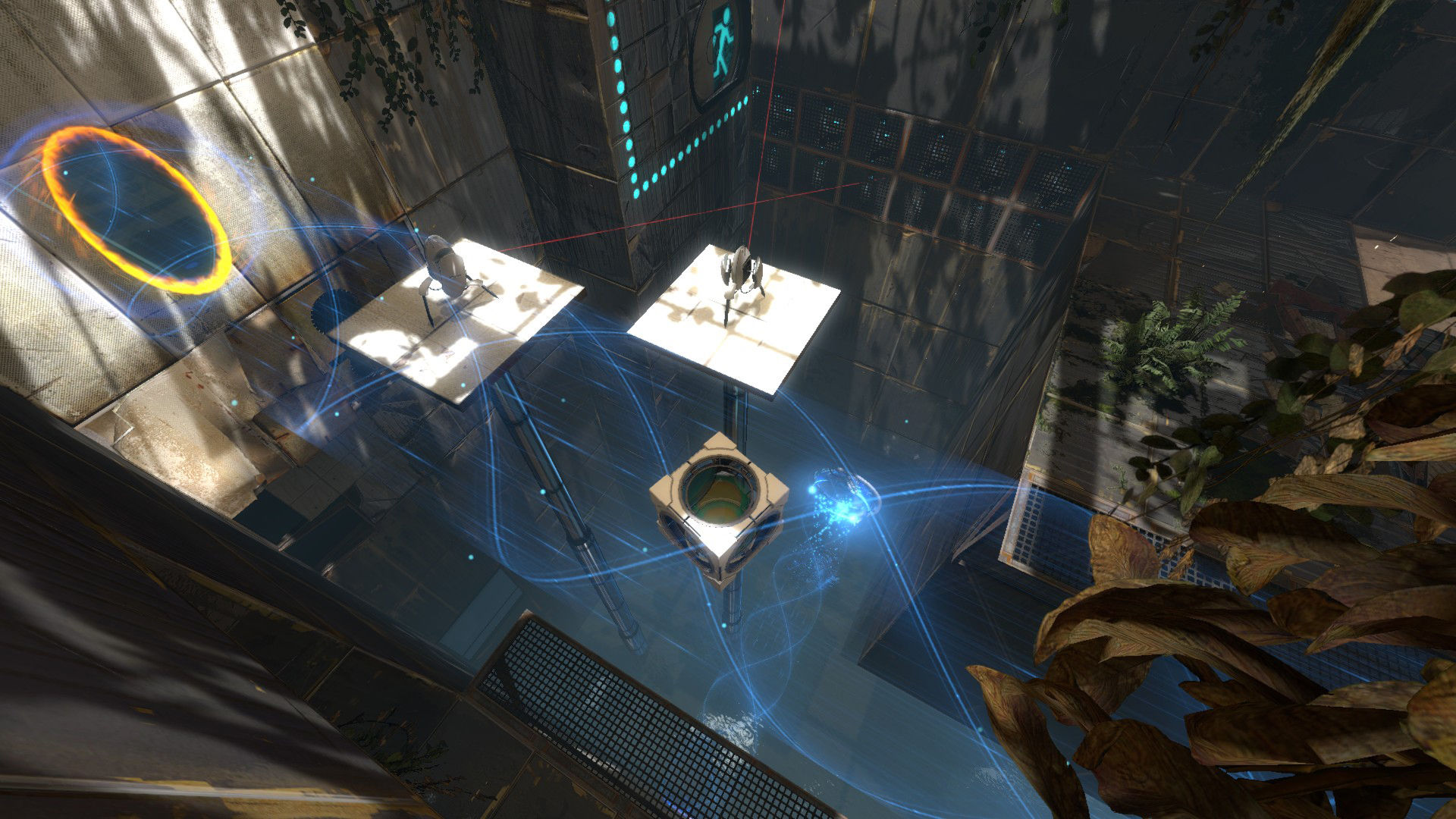
Co-op also has communication tools shaped around the problems of sharing a three-dimensional test chamber. A ping can direct a partner’s attention to a location or show where to place a portal, while a countdown helps synchronize actions such as pressing a switch or entering portals together. Both players see the signal, and the timer is synchronized even when they are playing on separate systems. The robots can also hand cubes to each other, making object transfer a direct part of solving a test. Those small interactions support the campaign’s central demand: coordinate what each player can see and do, then combine four portals into a shared solution.
- Developer
- Valve
- Genre
- First-person puzzle adventure