
About Planescape: Torment: Enhanced Edition
Awaken as the scarred, amnesiac Nameless One in Sigil, a city threaded with portals to the Dungeons & Dragons multiverse. Rebuild your identity through dialogue, exploration and tactical combat, recruit unusual companions, and discover how memories, beliefs and choices shape a journey across the planes.
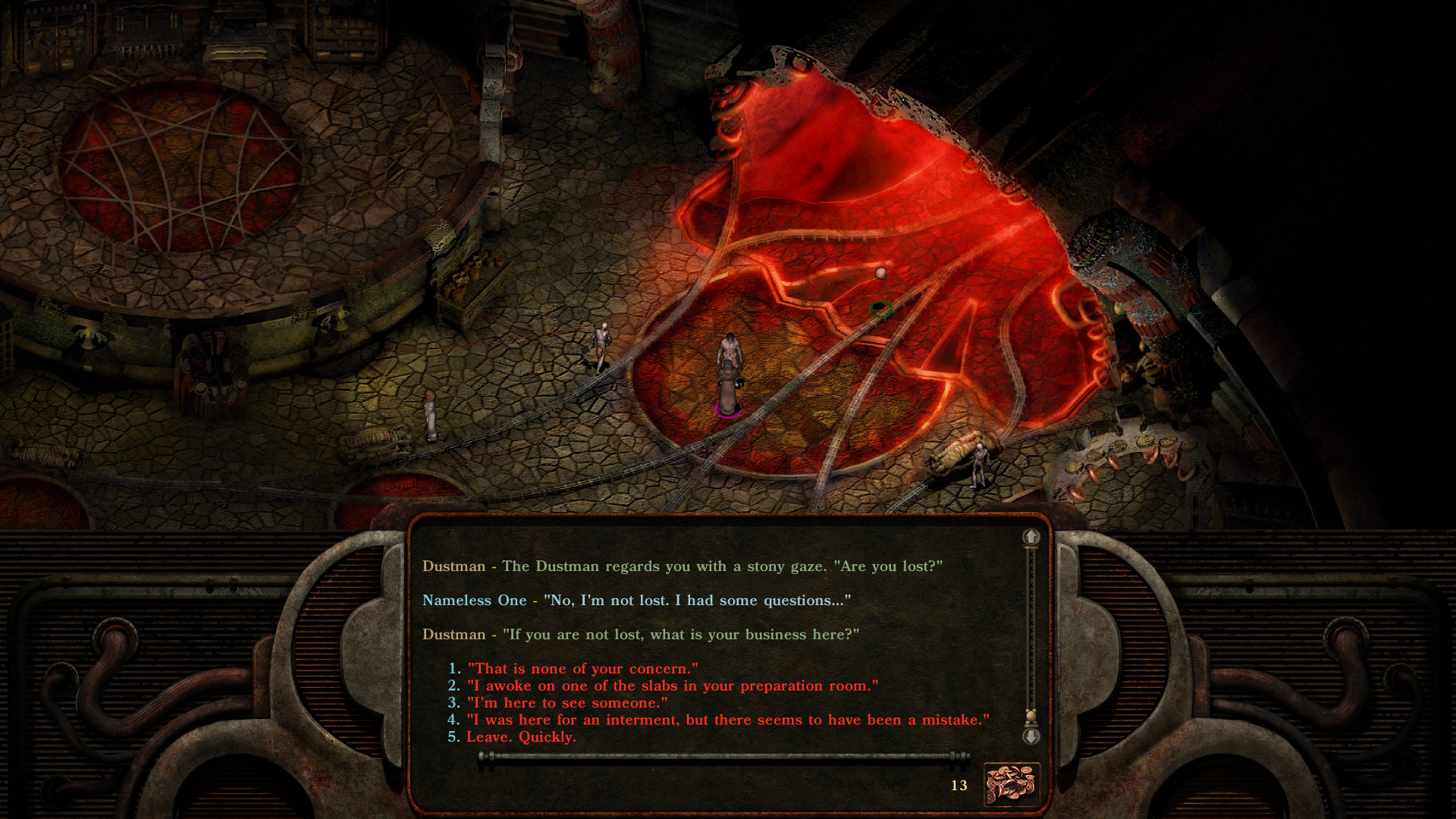
Planescape: Torment begins in Sigil’s Mortuary, where the Nameless One wakes on a slab with no memory of the lives behind his scars and tattoos. A talking skull called Morte helps him leave the building and begin asking how he came to be there and why he cannot stay dead. Those questions guide the journey, but conversations and discoveries often become as important as combat. The setting is the Planescape multiverse, where belief can shape reality and communities argue over what existence means. Sigil is the City of Doors: portals connect its streets to other planes, but finding a portal is not enough, since each requires the right key. The opening mystery therefore leads through a city of competing philosophies and strange inhabitants, then outward into places whose rules and dangers reflect the wider Dungeons & Dragons cosmology.
Sigil itself acts as a hub for people and ideas arriving from across the planes. The city is curved around the inside of a ring, its wards divided among places such as the crowded Hive and the Mortuary district, where the Dustmen tend the dead. The Lady of Pain rules Sigil and controls its portals; factions, meanwhile, organize people around beliefs about life, death, order and reality. These affiliations influence how residents regard the party and give philosophical disputes practical consequences in dialogue and travel. Beyond Sigil, portals lead toward the Outlands and Outer Planes, and the manual describes locations shaped by planar conflicts and unusual creatures. Returning to the city after an excursion means bringing back new information and questions, so the main activity repeatedly alternates between speaking with its residents, investigating a lead and testing what the party has learned elsewhere.
Conversation is a primary way to make progress. The Nameless One can question people about his past, ask for information, negotiate for services or attempt to resolve situations without fighting. The game’s dialogue choices draw on character attributes and what the player has learned; the manual highlights Strength for physical force and Intelligence or Charisma for talking through problems. Some exchanges also involve copper coins for a service or item, while the journal records information gathered during travel. Death is part of the character’s premise rather than an ordinary reload condition: when the Nameless One dies, he can return, and the shock may restore a memory or grant a skill or ability. That unusual rule makes death narratively meaningful, though immortality is not invulnerability; the manual warns that certain dangers can end the adventure permanently. The search for memory thus intersects with both conversation and the risks taken to pursue it.
The Nameless One’s development is tied to experience, attributes and the choices made along the way. At the start, the player distributes points among Strength, Dexterity, Constitution, Intelligence, Wisdom and Charisma. The manual describes these statistics as defining different strengths: a forceful fighter can emphasize physical attributes, while a character built around speech and reasoning can invest in Intelligence or Charisma. The Enhanced Edition’s store description also notes that the Nameless One can change class and alignment and gain abilities based on choices. Mages learn spells from scrolls or other identified magical items, copy them into a spellbook and memorize a limited selection by resting; priests receive their spells differently. These rules make preparation matter: a spell used in one encounter may need to be memorized again after rest, and the player balances available spell slots against what lies ahead.
Travel and combat are managed with a controllable party in an isometric world. The player selects the Nameless One or a companion, clicks a destination to move, and directs characters to interact with people, containers and enemies. Companions can be selected individually and arranged in a marching order; party behavior can be left on automatic or managed manually. Morte is the first guide, while the broader cast includes strange allies drawn from across the planes. In a fight, the player can position the group, choose targets and use attacks, abilities or prepared spells; experience grants combat proficiency points, but a trainer must teach the relevant improvement before those points can be spent. The game therefore links party composition and training to exploration: a new ally brings another perspective and role, while a trainer or service may provide a route to improving the skills needed for later encounters.
The Enhanced Edition retains the original role-playing adventure while adding interface and convenience options. Beamdog’s official store listing describes gameplay updates and bug fixes, a remastered soundtrack and a high-definition interface, alongside features such as tab highlighting, area zoom, a combat log and quickloot. Players can toggle the enhanced features to keep or disable them. The combat log records recent actions, while quickloot displays items in nearby ground piles; these additions make busy scenes easier to read and manage without changing the central premise of searching for the Nameless One’s identity. The journal, automap and inventory remain important tools: the player can review information, mark places on the map, inspect objects and coordinate spell access. These interface systems support a story where returning to old clues, companions and conversations can be as productive as pressing onward into another plane.
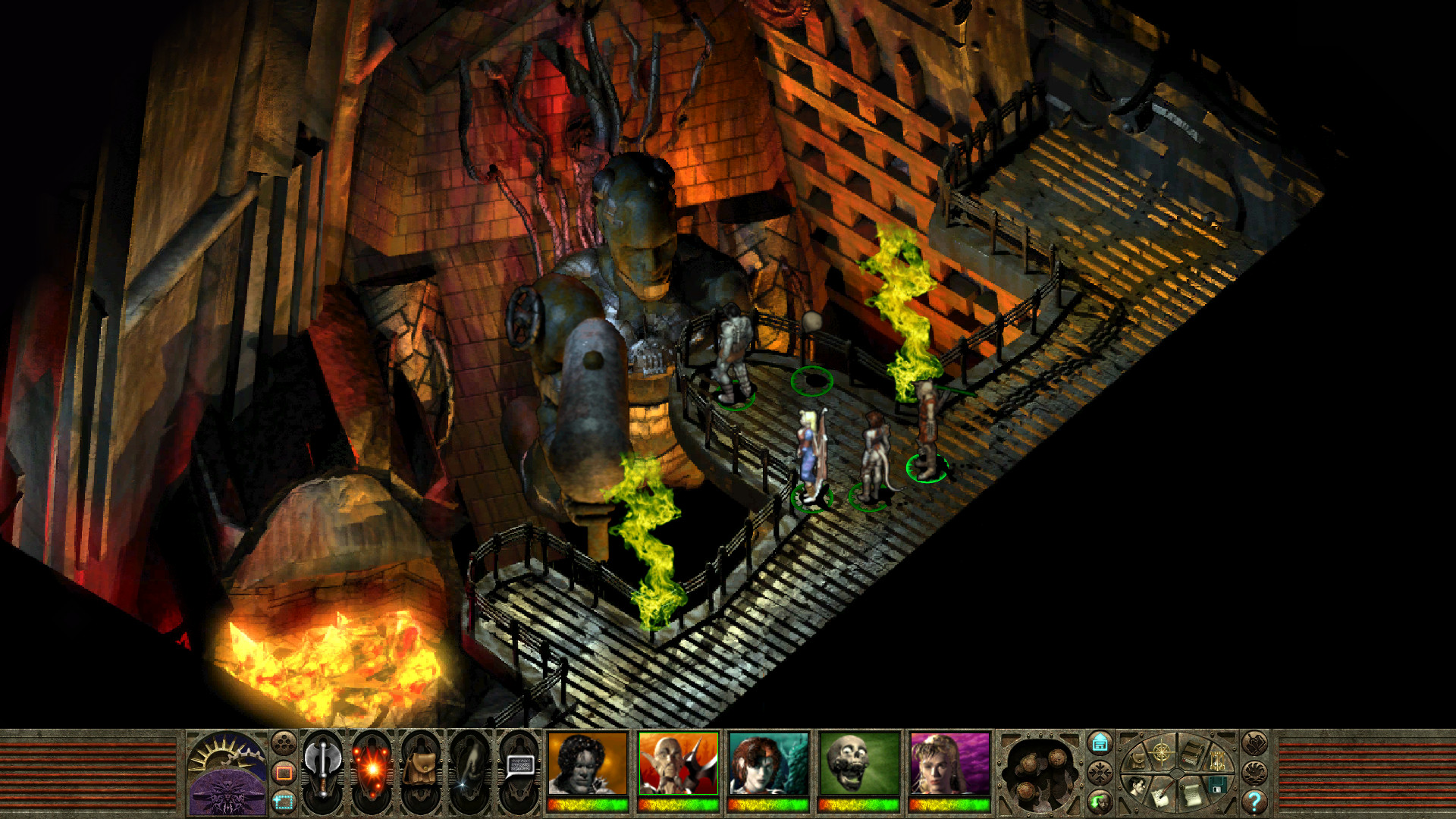
The party’s routes through Sigil also connect personal stories to the city’s larger disputes. Factions are political affiliations grounded in competing beliefs, and both alignment and faction ties can influence how creatures respond to the group. Some residents may offer goods, information or services; others can become hostile if a conversation or action crosses a boundary. Shops can restock, and dialogue may require payment, creating modest economic choices as the party gathers supplies and pursues leads. Thief abilities cover pickpocketing, opening locks, finding and disarming nearby traps, and moving unseen; their effectiveness improves with experience and Dexterity. Spellcasters prepare a different kind of toolkit, while fighters rely on weapon proficiencies learned from trainers. This gives the journey several interacting layers—social standing, party roles, learned abilities and planar routes—without reducing its central question to a single combat objective.
- Developer
- Beamdog
- Genre
- Adventure, role-playing game