
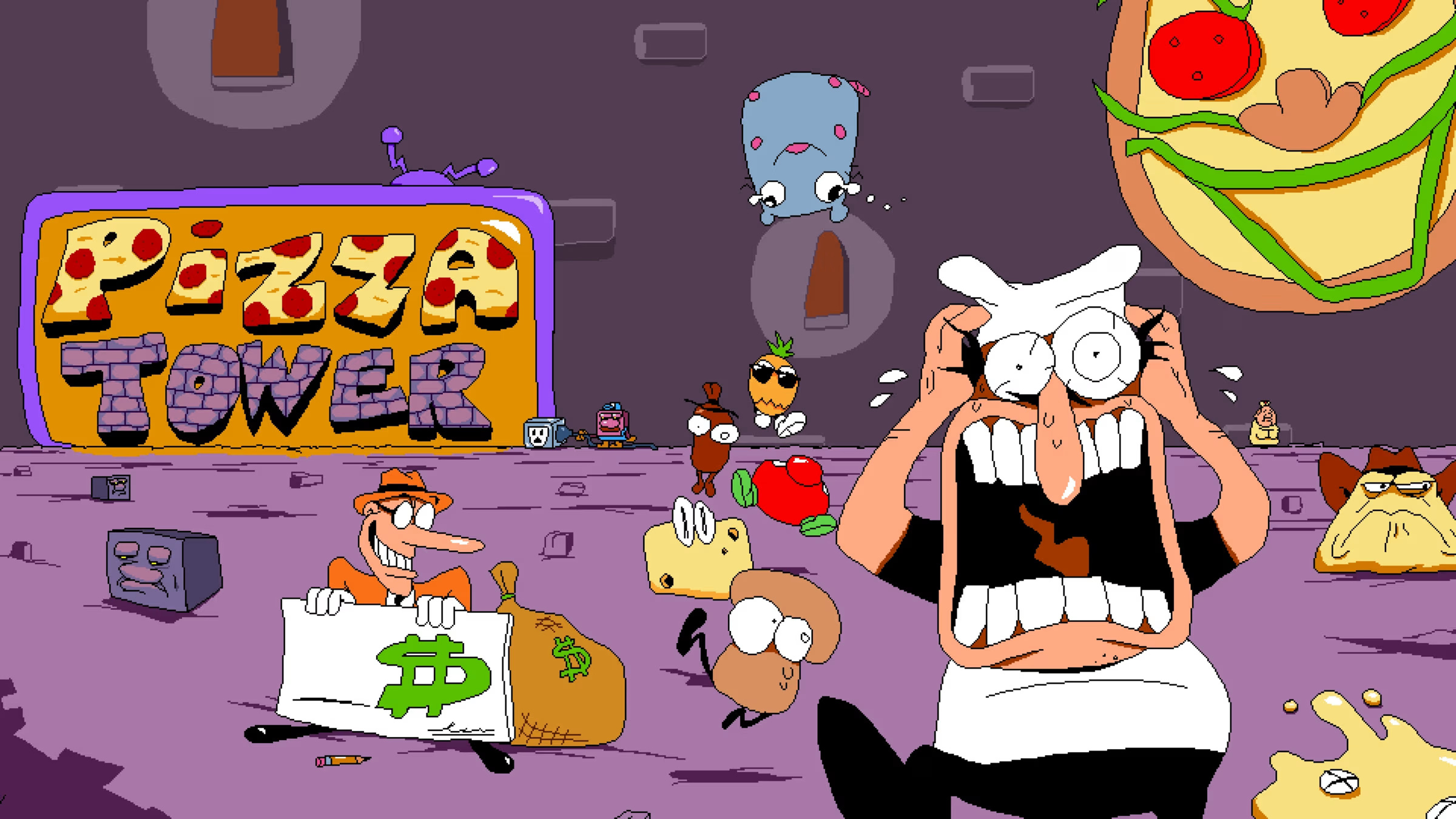
About Pizza Tower
Pizza Tower follows Peppino Spaghetti, a frantic pizza chef who climbs the strange tower threatening his restaurant. Across themed stages, he builds speed through linked moves, fights and stuns creatures, gathers ingredients and secrets, then races back to each exit when Pizza Time begins. Scores and uninterrupted combos support repeat runs for higher ranks.
Peppino Spaghetti is an anxious, middle-aged pizza chef whose restaurant faces destruction from the tower that gives the game its name. He responds by charging inside and pushing upward through its many floors, where each door leads to a distinct stage. The premise stays direct: break through the tower, gather toppings, overcome its monsters and reach the threat at its summit. Peppino’s nervous expressions and sudden bursts of anger make him an active part of the comedy rather than a silent platforming avatar. Gustavo is also playable in selected sections; he appears with Brick, his rat companion, in sections that shift the movement and combat rhythm away from Peppino’s solo run.
The tower organizes a collection of self-contained levels beneath a floor-by-floor hub. Its rooms and doors act as a staging area between challenges, while the stages themselves move through sharply differentiated settings: medieval scenery, ruins, deserts, city streets, factories, sewers, space and other food-themed distortions. These themes are not just backdrops. Individual stages introduce hazards, enemies and temporary abilities that alter how a route is crossed, then ask the player to carry familiar movement into a new arrangement. The layout supports both a forward push toward the exit and exploration for hidden rooms, collectible toppings and the stage’s secret treasure. Moving through the tower therefore alternates between choosing a door in the hub and learning a compact, mechanically distinct space. The tower has up to five floors, each leading to multiple levels, so the hub gives the ascent a readable structure without making every stage feel like another corridor in one continuous climb. The changing themes give designers room to combine familiar controls with new terrain and enemy patterns; the player keeps the same basic goal of crossing the stage, but the safest line and the best line for score can differ. This is why exploration is built into the action rather than separated into a map screen: a side passage, destructible obstacle or unusual route can change both what Peppino finds and how much momentum he carries into the next room.
Peppino’s movement is built around momentum and chaining states. A run can build into the Mach Dash, whose increasing speed lets him smash through obstacles and carry momentum across open ground. The grab dash gives him a forward attack that can catch enemies or objects; a ground pound can turn a descent down a slope into a new dash, and wall climbing can continue a high-speed run vertically before returning him to the dash state. A super jump converts a sufficiently fast run into a powerful upward launch. These actions connect rather than sit as isolated moves: slopes, walls, grabs and jumps can feed one another, so level geometry becomes part of the route. The grab and dash provide a straightforward path through a level, while chained actions let experienced players keep speed through more complicated routes. The same input can serve different purposes depending on where Peppino begins it. A dash along a flat floor gathers speed, a climb carries that speed up a wall, and a super jump can bypass a high barrier. Learning how to enter each room with momentum changes the route as much as learning the room itself.
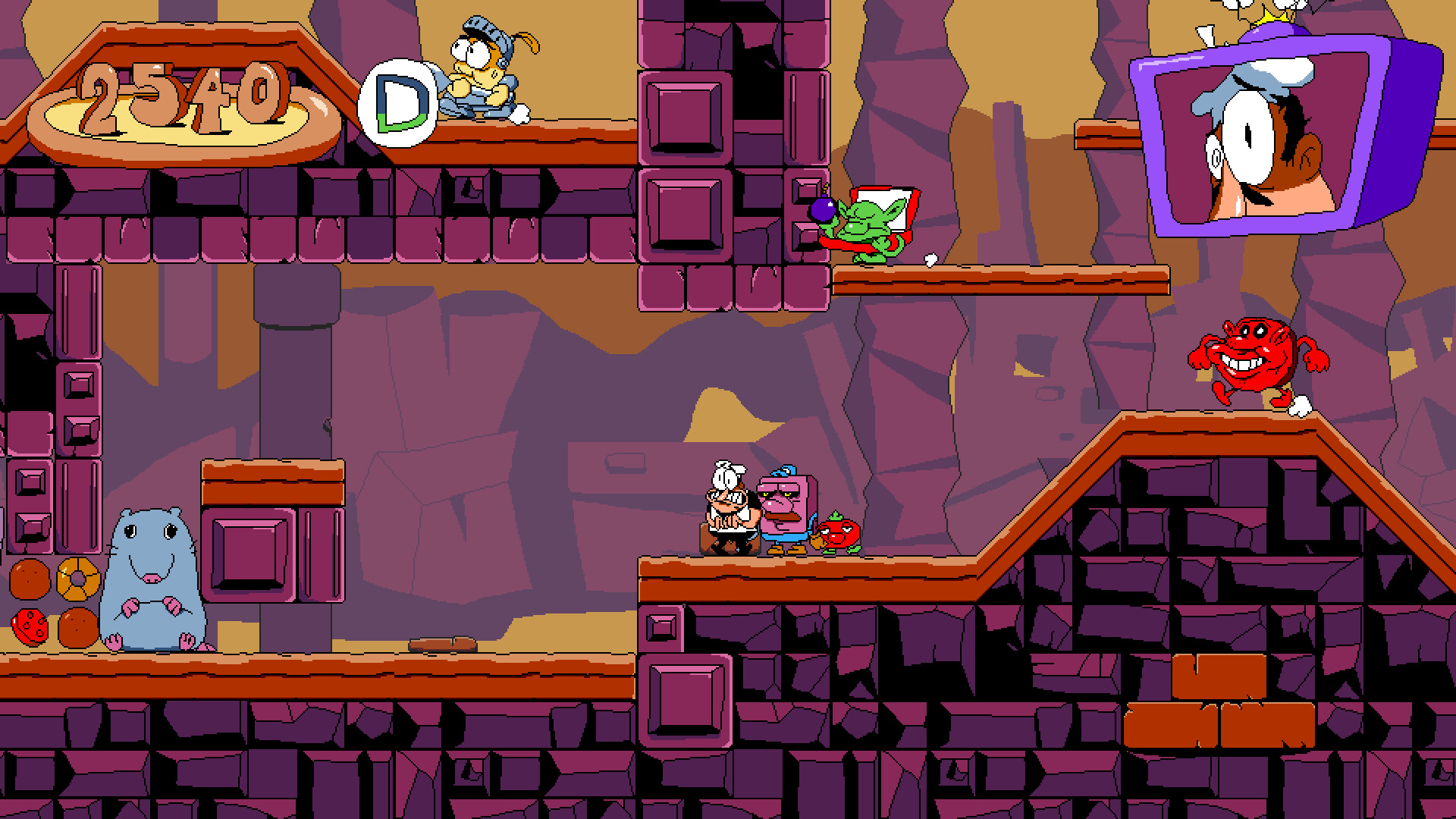
Combat uses that same forward motion. Peppino can grab, throw, shoulder through or otherwise strike enemies, and his speed changes how some encounters behave: a fast approach may send foes flying or let him pass through a crowded section while maintaining the run. Enemies also become points in a route, since defeating them contributes to the combo and score. The game’s ordinary platforming stages do not frame every mistake as a life-threatening fight; ordinary stages do not use a conventional health bar. Boss encounters provide a different structure, with an arena, recognizable attacks and a sequence of hits needed to finish the opponent. Their combat breaks up the long stages and gives tower progression a set of distinct confrontations.
The stage’s hidden content and score system give exploration a concrete purpose. Toppins are ingredient collectibles placed along the route, while concealed secret rooms take the player away from the obvious line through a level. Gerome, the janitor, opens a separate treasure room when found and brought to its door. Those discoveries add score and feed completion, but they also demand detours that must be reconciled with the stage’s movement flow. Enemy defeats, collectibles and combo chains raise the run’s score; the end-of-level judgement converts performance into a rank, with S marking a high-scoring run. The harder P rank demands a sustained combo and a more complete route through secrets, treasure and a second lap. Toppins contribute score, but the run is judged on more than gathering ingredients. A combo is not simply a count that grows when enemies fall: it is a chain that must be kept alive while the player moves through the level. Score items and major discoveries can restore its timer, while taking a hit reduces the remaining window and makes the route more fragile. This links the systems together: optional-looking pickups can provide breathing room, and an enemy encounter can serve as a bridge between scattered collectibles. For a normal completion, players can prioritize reaching the exit; for a higher rank, they balance points, discoveries and movement so that the chain continues into Lap 2 and through the return to the door.
Every standard stage has a return journey called Pizza Time. Reaching the exit switch starts a countdown and turns the route back toward the entrance into an escape sequence. The player retraces the level at speed, opens the way through the stage and aims for the exit before the pursuer catches up. This reverses the first traversal: rooms already crossed become a course to remember, and detours taken for secrets or treasure now have to fit into a fast exit line. The countdown and pursuing threat give the familiar rooms a new urgency, even though an expired timer does not automatically end most levels. The second lap, used for P rank attempts, asks players to repeat the escape path as part of the same score-focused run.
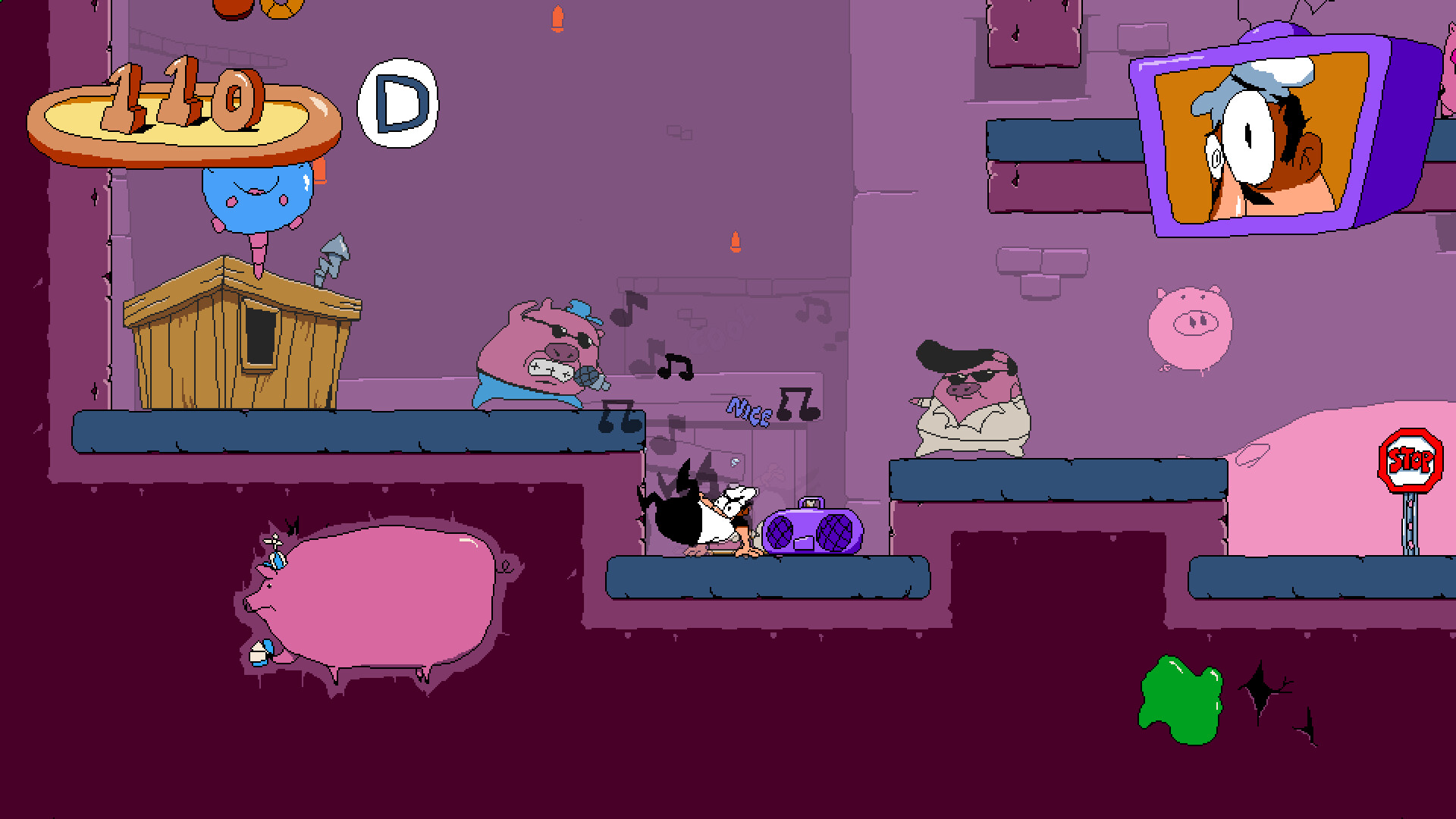
Temporary transformations and alternate characters create stage-specific changes to the movement vocabulary. Some forms briefly change what a route allows: the Firemouth form gained a high jump and an air dash, while the Ghost form became directional flight that could break blocks at different speeds. The stages use such abilities for short changes in traversal, then return Peppino to his core run-and-attack kit. Gustavo and Brick offer another variation in selected sections, with Gustavo’s movement and Brick’s attacks supporting their paired sequences. Across these changes, the cartoon presentation remains tightly connected to action: Peppino’s exaggerated poses communicate acceleration, surprise and impact, and the hand-drawn pixel animation shifts rapidly as moves connect. The soundtrack supplies a lively musical pulse through exploration, fights and escape.
Tour De Pizza released the game on PC for PC, then added The Noise as a playable character in a later update. A Nintendo Switch edition followed after that. The different releases share the central tower premise, although their individual control options and update histories need not match. The central loop remains the ascent through themed stages, where movement, discovery, fighting and a timed return route combine into both a clear forward objective and a score challenge for repeat runs.
- Developer
- Tour De Pizza
- Genre
- 2D momentum platformer with exploration and score attack