
About Pillars of Eternity
A supernatural storm awakens the player as a Watcher, able to perceive souls and memories, just as the Dyrwood faces the Hollowborn crisis: children are being born without souls. This is a party role-playing adventure through Eora, where quests, conversations, exploration and tactical battles uncover the roots of both mysteries.
Pillars of Eternity opens with a traveller arriving in the Dyrwood, a frontier nation in the world of Eora. A violent supernatural storm, called a biawac, changes the traveller’s life: the protagonist becomes a Watcher, someone able to perceive souls and witness memories from past lives. The awakening is not a gift that can simply be ignored. Its effects demand investigation, while the region is already unsettled by Waidwen’s Legacy, a crisis in which children are born without souls and are known as Hollowborn. The game lets the player shape the Watcher’s identity before this journey begins, choosing ancestry, culture, background and class. Those choices affect abilities and can influence how people respond in dialogue, giving the protagonist a particular place in Eora without fixing a single personality or moral path.
The Hollowborn crisis is both a personal mystery and a public dispute. Animancy, the study and manipulation of souls, divides communities: some believe its practitioners might understand or address the crisis, while others see the work as dangerous or sacrilegious. The Watcher’s unusual perception makes souls part of the investigation, but conversations and quests also reveal how beliefs, local reputations and political interests shape people’s reactions. The story moves through settlements, wilderness, ruins and the major city of Defiance Bay, where factions compete for influence and the consequences of earlier choices can be felt. The game keeps its central questions in view without reducing every problem to combat; dialogue may offer ways to gather information, settle disagreements or decide which groups deserve support.
The Watcher does not have to travel alone. The party can include up to six characters, combining story companions with custom adventurers recruited at inns. Edér, Aloth and Pallegina are among the named companions encountered in the first game; other companions bring their own histories, goals and abilities. Party composition matters in conversation, exploration and combat, so the player balances frontline fighters, ranged damage, support and magical skills. Character creation offers eleven classes, from familiar fighters, wizards, priests and rogues to Eora-specific options such as ciphers and chanters. Ciphers draw power from souls through weapon attacks, while chanters build magical effects from spoken phrases. Levels add class abilities and talents, and equipment, attributes and skills let the group develop along different roles.
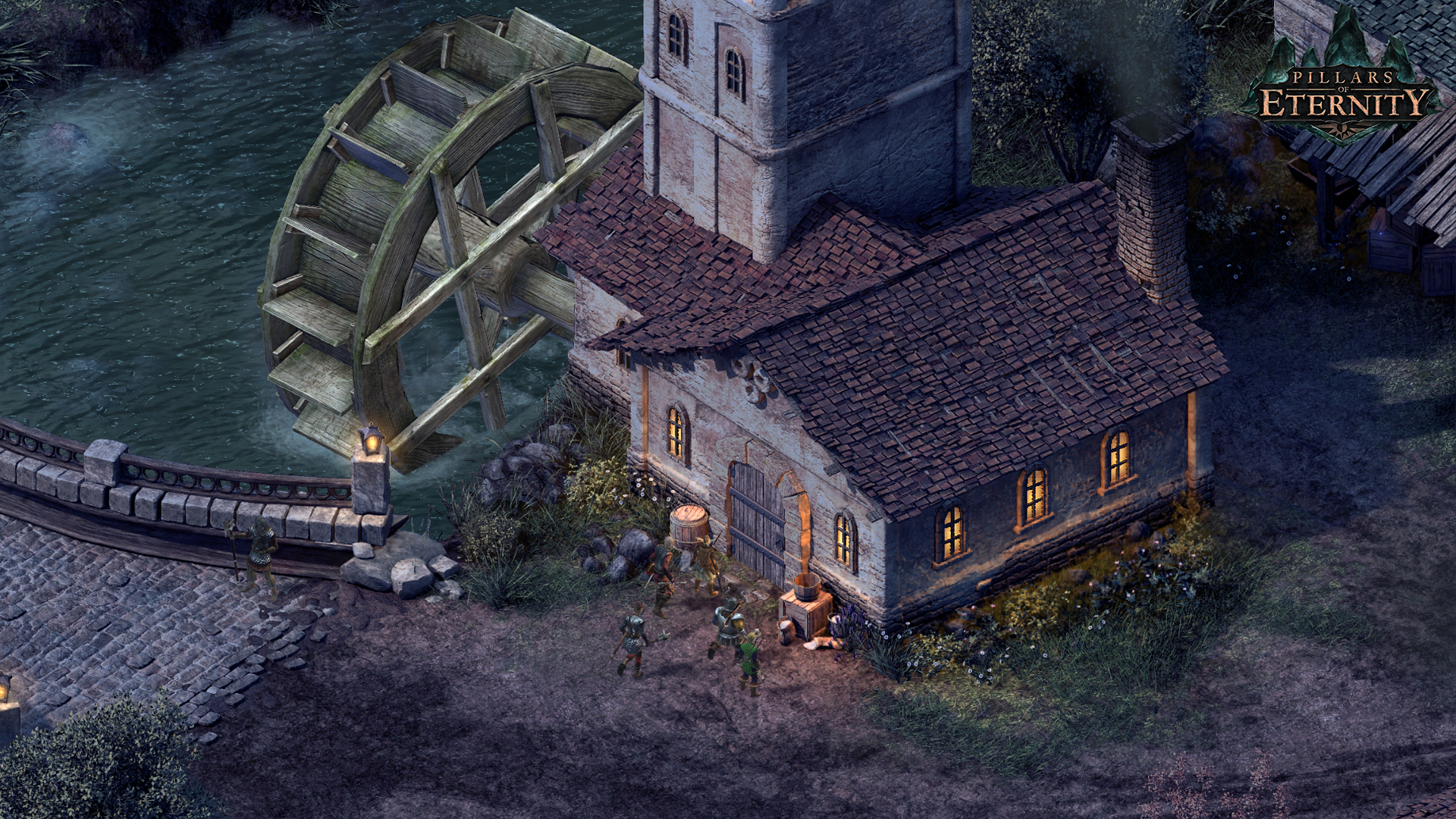
Combat unfolds on a battlefield where the player can pause to issue orders, inspect threats and coordinate the party. The original real-time-with-pause mode lets attacks and abilities resolve continuously after orders are given; the current game also offers a turn-based mode, and allows players to switch modes during a playthrough. Positioning helps protect vulnerable spellcasters and archers: melee characters can engage nearby enemies, while abilities interrupt, disable or damage groups. Attacks test Accuracy against one of several defenses, and the result can be a miss, graze, hit or critical hit. Damage types and armour thresholds change how effective an attack is, so a weapon or spell that works well against one opponent may perform poorly against another. Abilities may refresh each encounter or require resting, making resource use part of the tactical rhythm.
Damage management continues after a battle. Characters have Endurance, which represents their immediate combat capacity and recovers between encounters, and Health, which is a longer-term pool that accumulates losses until the party rests. When Endurance reaches zero, a character falls unconscious for the fight; serious Health loss can leave them maimed or dead, depending on difficulty and circumstances. Resting restores Health and many conditions, but field rests use Camping Supplies, which are limited by difficulty. Inns and the player’s stronghold provide other places to recover. Between fights, the group explores from an isometric view, searches for hidden objects in Scouting mode, disarms traps, opens locks, collects ingredients and follows leads in the journal. Stealth, Athletics, Lore, Mechanics and Survival can matter in encounters and exploration, encouraging a party with complementary skills.
As the Watcher’s investigation grows, the party earns access to Caed Nua, a neglected stronghold that can be repaired and upgraded over time. It becomes a base for resting, storage, hirelings and management tasks; improvements affect its security and prestige, and idle companions can be sent on missions for rewards. Beneath the keep lies the Endless Paths of Od Nua, a large dungeon that provides a separate descent through enemies, treasure and deeper history. The stronghold gives the player a longer-term project alongside the main quest, while side quests and companion stories reveal more of the Dyrwood’s people and conflicts. Choices can change reputations and relationships with factions, and character attributes or background can unlock different dialogue options. The journal tracks the main quest, side objectives, bestiary entries and discoveries, giving the player a record of leads as the map expands. With progression spread across levels, gear, abilities, party skills and the keep, the campaign asks the player to decide which investigations to pursue and when the group is prepared to push farther. Progress therefore comes through investigation, party development, alliances and exploration as well as victories in battle.
- Developer
- Obsidian Entertainment
- Genre
- Party-based role-playing game