

About Pikuniku
Pikuniku is a puzzle-platform adventure about Piku, a curious red creature who wakes in a cave and becomes involved in a village’s struggle against the smiling Sunshine Inc. Jump, roll, kick objects, help eccentric residents and use found hats and tools to open routes through a bright world. Local co-op offers separate challenges starring Niku.
Pikuniku begins with Piku waking in a cave, a small red, round-bodied creature whose legs are as expressive as they are useful. The cave opens onto a colorful side-on world that initially seems welcoming, but the villages beyond it are organized around Sunshine Inc., a company whose smiling public image conceals an exploitative arrangement. The company distributes money from the sky, and local people have been made dependent on its promises and rewards. Piku’s arrival disrupts this routine: residents first mistake the newcomer for a frightening beast, then enlist the creature to help with ordinary problems. These early encounters establish the game’s central rhythm. A request can begin as a comic misunderstanding, turn into a physical puzzle or platforming task, and reveal a small piece of how the community lives under Sunshine’s influence. The larger story grows out of those local relationships, following Piku as the residents’ troubles connect to the corporate conspiracy and a resistance movement. Its bright shapes and matter-of-fact dialogue keep the presentation playful while the situation beneath them becomes more pointed.
Movement is deliberately compact. Piku can walk, jump, pull its legs inward to roll, and kick objects or characters. The roll changes how quickly the creature travels across slopes and open ground, while jumping handles ledges and gaps; a kick can nudge an object into a switch, disturb a creature, or simply create a reaction. Those few actions give the environment a consistent physical grammar. Rather than introducing a large catalogue of verbs, the game asks what the existing moves can do in a new arrangement: an object may need to be shifted into reach, carried by a kick, or sent toward a mechanism, while the same terrain can become a route, barrier or improvised ramp. Villagers and other odd residents respond to these interventions, so exploring a room often means testing its objects as well as speaking to the person who lives there. The design makes ordinary movement part of the comedy, but it also gives puzzle solutions a clear basis: observe the space, identify what can move, and use Piku’s weight, legs and momentum to change it.
The adventure moves between compact routes, small hubs and distinct environments such as valleys, forests and mines. A place is not only scenery to cross; it is a network of characters, doors, platforms and obstacles that can be revisited when Piku acquires something useful. Requests from residents give exploration a social direction. A person may need help with a practical task, a creative block or a problem caused by the corporate order, and completing it can lead to a new item or a fresh path through the surrounding area. That structure lets side errands feed into the main journey without turning the world into a checklist. Backtracking has a purpose when a newly acquired hat or object changes what Piku can do with an earlier feature. The player is encouraged to remember a plant, doorway or suspiciously arranged object and test it again later. Optional paths, hidden spaces and small activities reward that attention, while the main route continues to connect the villagers’ needs with the widening conflict around Sunshine Inc.

Hats and found objects extend the original moveset through context-sensitive interactions. A hat can change what Piku does when approaching a particular feature: the watering hat, for example, lets Piku act as a mobile sprinkler, causing a plant to bloom into a temporary platform. This turns an environmental detail into a small traversal puzzle. First the player notices a plant that cannot be climbed in its current state; then a later tool makes it respond; finally the new growth opens a higher ledge or another section of the room. Other hats and objects provide similarly specific ways to interact, including drawing or triggering an unusual response from a character or obstacle. The game signals some intended uses with visual cues, while other solutions depend on experimentation. These tools do not replace jumping, rolling and kicking; they give those actions new contexts and make revisiting older spaces worthwhile. Finding an item can therefore change the route through a level, reveal a secret area, or resolve a resident’s request, linking collection to both exploration and the story’s episodic tasks.
Piku’s progress is expressed through access and discovery rather than a large combat build or numerical character-stat system. As the journey continues, new hats and objects expand the set of environmental interactions, while helping residents opens further routes and optional challenges. Coins gathered along the way can be spent on accessories, and secret areas contain additional discoveries for players who probe the edges of a path or revisit a room with a new tool. Small self-contained diversions change the pace: a task can become a dance challenge, a sports-style contest, a chase or a short encounter built around a particular obstacle. These sequences use the same playful physical language as the platforming instead of establishing a separate combat progression loop. The game does include confrontational set pieces, but its emphasis remains on solving situations and advancing through the world rather than repeatedly defeating enemies for experience or equipment. That distinction shapes how rewards work: items mainly create new interactions, cosmetics add character detail, and completed favors make the next part of the community’s story available.
The tone depends on the contrast between a simple, high-contrast visual world and the systems that quietly govern it. Rounded characters, broad blocks of color and minimal facial features make Piku and the villagers readable in motion, while the shifting poses and kicks supply much of their physical humor. The landscape is presented as a sequence of hand-shaped 2D spaces, from the opening cave to homes, natural routes and industrial or corporate locations. Short dialogue exchanges often move from plain requests to an unexpected character response, and the writing uses those moments to make the residents feel idiosyncratic rather than interchangeable quest markers. Sound and music support the same light, unusual register; the world can look like a children’s story while its characters discuss dependency, work and control in direct terms. This presentation lets the political premise remain legible without changing the game into a lecture. It also makes small changes in a familiar space noticeable: a newly flowering plant, an open route or a resident who has become more independent carries visual and narrative meaning at once.
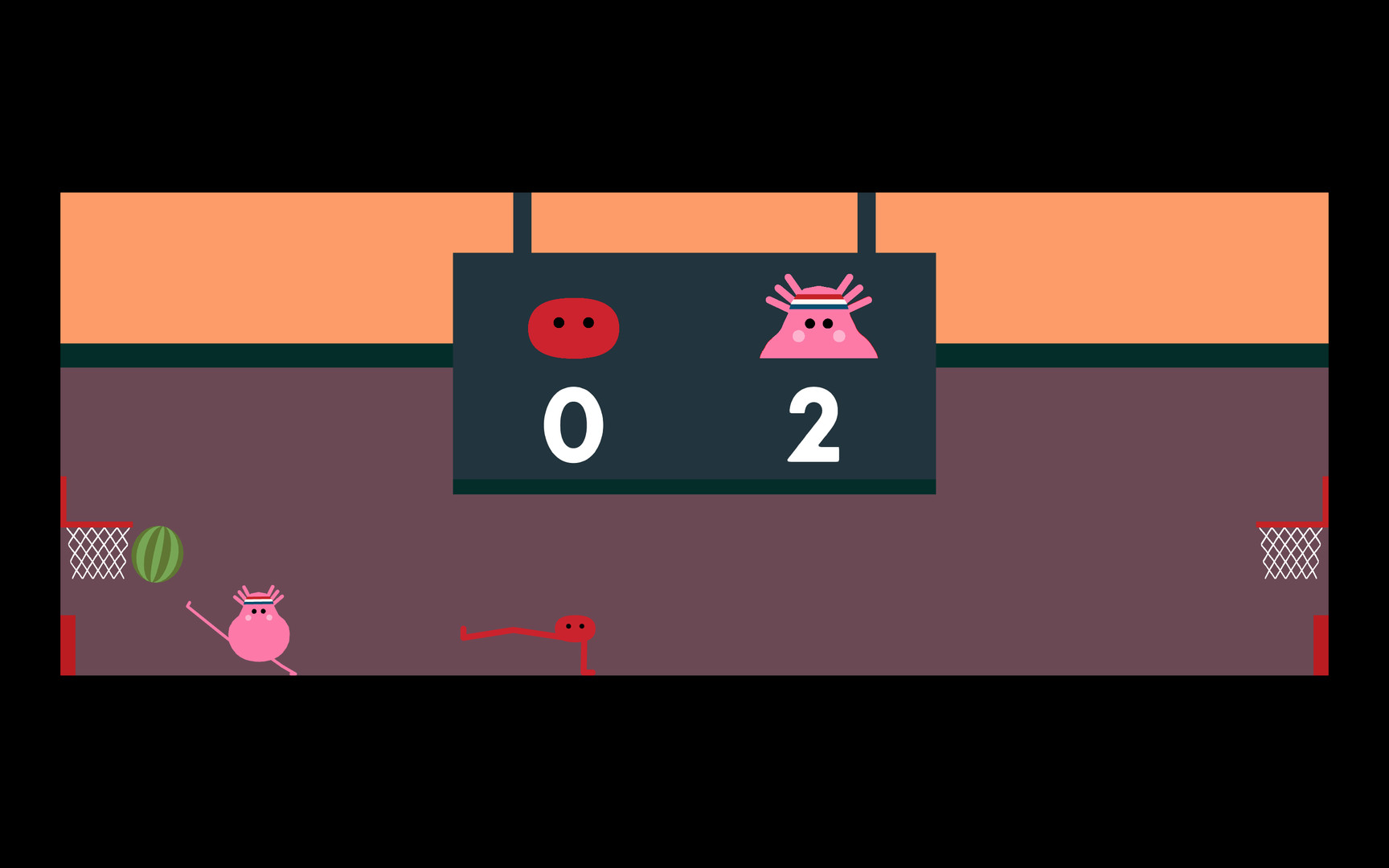
Alongside the single-player adventure, Pikuniku includes a separate local cooperative mode built around custom puzzle-platforming levels and challenges. A second player controls Niku, a color-swapped counterpart to Piku, and the pair must coordinate the same basic movement and kicking actions to cross spaces designed for two people. The mode is distinct from the main campaign rather than a second character joining Piku’s story; its puzzles focus on timing, positioning and using one another’s movement to reach the next safe point. The contrast is useful to the game’s overall design: the campaign turns simple actions into a sequence of world and story interactions, while co-op isolates those actions and asks two players to combine them. The Steam release identifies single-player and shared-screen co-op features, while Nintendo’s Switch listing describes local multiplayer and custom cooperative levels. The original adventure keeps Piku’s village-centered journey separate from these two-player challenges. Playing together shifts attention from the company and its residents to the small spaces where two elastic bodies can move and help one another.
- Developer
- Sectordub (Steam also credits Arnaud De Bock, Rémi Forcadell, Alan Zucconi and Calum Bowen)
- Genre
- Puzzle-platform adventure / puzzle-exploration