
About Pathfinder: Kingmaker - Enhanced Plus Edition
Pathfinder: Kingmaker is a single-player isometric role-playing game set in the Stolen Lands of Paizo’s Pathfinder fantasy world. Lead a customizable adventuring party through wilderness, ruins and political disputes, then establish a kingdom whose territories, towns and court develop alongside the main story.
The Stolen Lands are a contested frontier where earlier rulers have risen and disappeared, leaving wilderness, old ruins and competing claims behind them. Pathfinder: Kingmaker begins with an expedition into this region and builds its central story around the task of bringing territory under a new rule. The danger is not limited to creatures encountered on the road: neighboring powers, rival groups and tensions inside the court can all affect the project of establishing a stable realm. The campaign moves between travel and exploration, conversations that reveal local interests, and expeditions into places that hold the region’s history. As the party gains ground, the protagonist’s role changes from adventurer to ruler, linking events in the field with decisions made at the capital. The game is an original single-player computer role-playing campaign in Paizo’s Pathfinder setting, rather than an online service or a recreation of the tabletop adventure’s exact play sequence.
The party is built around a custom protagonist and companions with distinct classes, loyalties and personal aims. Linzi, a bard, records the journey and frames its events as a chronicle; Amiri brings the perspective and fighting style of a barbarian from the Realm of the Mammoth Lords. Tristian is a cleric whose arrival is connected to the curses troubling the Stolen Lands, while Valerie is a fighter who has left behind her former connection to Shelyn’s paladins. Their skills help cover different needs in and out of combat, but their beliefs and histories also shape conversations and companion storylines. The player chooses who travels in the active group, equips them, and develops each character as levels are gained. Party composition therefore affects both tactical options and which companion perspectives are present when the group encounters a person, dilemma or threat.
Character development adapts Pathfinder rules into a computer role-playing system with classes, archetypes, abilities, skills, feats and spells. Level-ups ask the player to make choices about a character’s role: a fighter can specialize through combat feats, a wizard selects spells, and a cleric may combine support magic with a chosen fighting style. The game’s wide selection permits focused or mixed builds, and companions can be developed manually or along suggested paths. Encounters use real-time-with-pause combat, so the party acts continuously while the player can pause to issue orders, select targets and use abilities; an option can pause after real-time turns. Positioning, area spells, defensive abilities and the timing of limited-use resources matter when several opponents engage at once. Difficulty settings and individual combat options let players change how closely some rules follow tabletop Pathfinder and how much party control they want to manage.
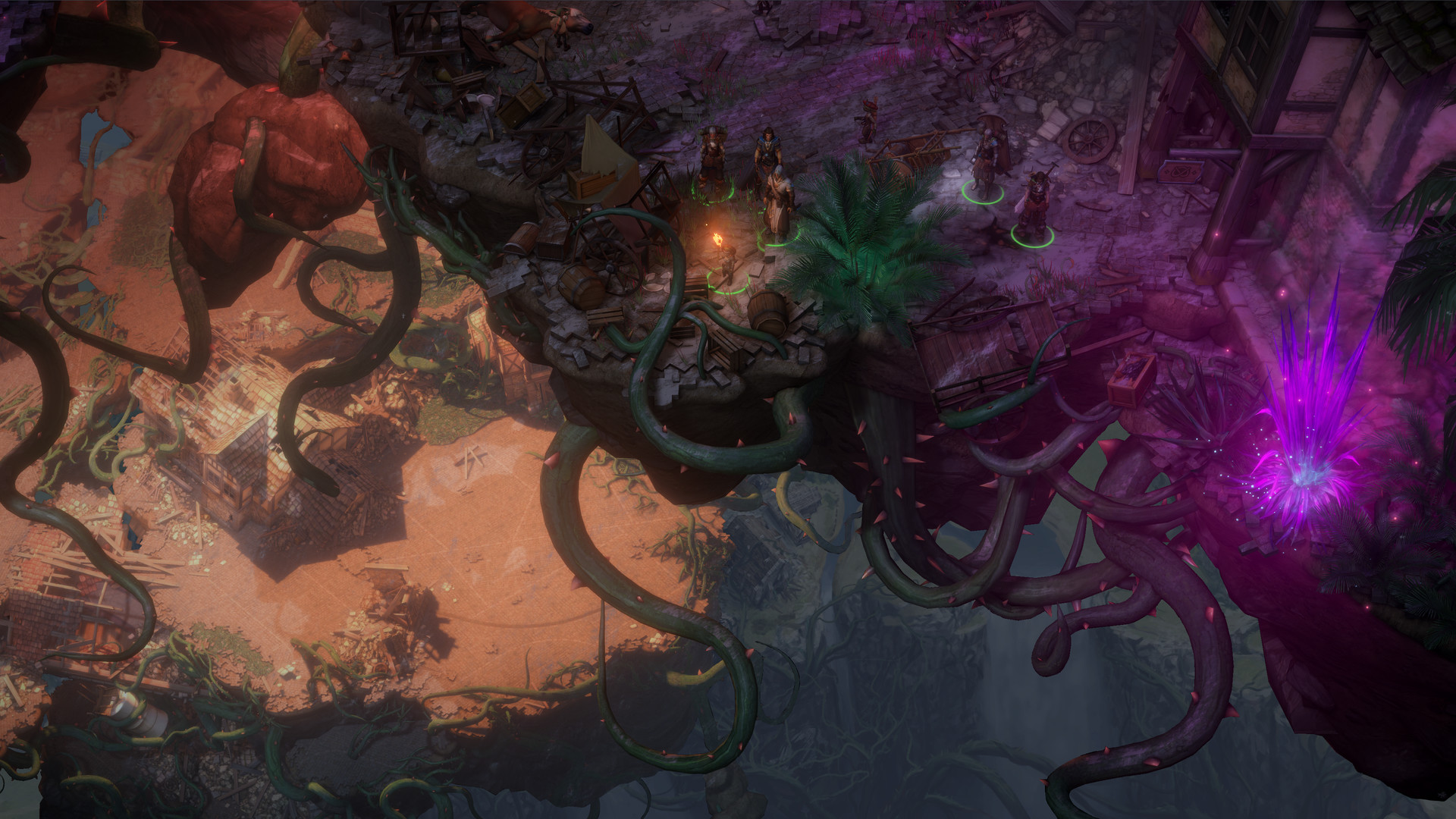
Exploration takes the group through the Stolen Lands’ outdoor regions, settlements, caves and constructed dungeons. The world map is a planning layer for travelling between discovered locations, while local areas present characters to talk with, objects to investigate and encounters that can interrupt a journey. Resting is another party-management decision rather than a simple reset: the camp screen lets companions take roles such as hunter, cook, camouflage specialist or guard. Their skills affect the results of those duties, and overburdening someone with multiple assignments can leave that companion tired. Hunting can reduce the need to consume purchased rations, while camouflage can help keep the camp less exposed. Companions may also talk around the fire, placing character interaction within the ordinary rhythm of preparing for the next stretch of travel.
Founding the realm adds a strategic layer to the adventuring campaign. The ruler claims regions, authorizes settlements and develops towns, while companions and other characters can take positions as court advisers. Kingdom matters arrive as timed problems or opportunities that require an adviser and a response; handling them competes with time spent travelling, exploring and pursuing the main campaign. Decisions can express different approaches to authority and affect the realm’s alignment, people and surroundings. Expansion also changes the capital and creates new communities, so kingdom growth is visible in the places under the protagonist’s control. This management loop is tied to the story’s political pressures: the ruler must respond to events beyond the party’s immediate reach while still assembling a group to address dangers directly in the field.
The Enhanced Plus Edition is the base game edition identified by the Steam listing. Its listed updates include additional abilities and character-building options, new items, balance changes, an improved kingdom-management interface and more varied random encounters. The page lists expansions such as Varnhold’s Lot and Beneath the Stolen Lands as separate downloadable content, so the edition name alone does not mean every expansion is included. A distinctive thread running through the main campaign is the spread of curses in this frontier. Tristian’s investigation connects that phenomenon to the region’s wider mysteries, and curse-related events provide another way the surrounding land intrudes on the ruler’s work. The party’s route through ruins and wilderness therefore unfolds within a landscape whose dangers include both immediate hostile encounters and longer-running magical trouble.
- Developer
- Owlcat Games
- Genre
- Single-player isometric party-based computer role-playing game