
About Papers, Please
After Arstotzka and Kolechia end a six-year war, a labor lottery assigns you to inspect travelers crossing into Grestin. Check passports and changing permits against Ministry rules, decide who may enter, and balance each day’s work against the needs of your family in this document-focused story of border control.
Papers, Please begins in 1982, after the fictional communist state of Arstotzka ends a six-year war with neighboring Kolechia and takes control of its half of the divided city of Grestin. A labor lottery selects the player character for a job at the Ministry of Admission’s border checkpoint, with a small East Grestin apartment promised for the inspector’s family. The booth becomes the viewpoint for the story: travelers queue on the other side of the window, while daily bulletins announce political developments and new instructions. The player is an ordinary state employee, responsible for deciding who may cross into Arstotzka as the border reopens and official policy changes.
Each shift starts with a Ministry bulletin and an updated rule book. The player calls each traveler forward, requests the papers required that day, and moves documents around the desk to inspect them. Early checks can focus on passports, but the rule set grows to include entry permits, identity cards, work permits and other credentials for particular applicants. Names, photographs, birth details, issuing places, expiration dates, seals and stated travel purposes must agree with one another and with the rules. The rule book lists valid requirements and can be consulted during a shift; memorizing its changing details makes processing faster, while overlooking one can turn a routine case into an error.
When something does not match, the inspection tool lets the player compare two pieces of evidence, such as a passport against a permit, a document against the rule book, or a traveler’s appearance against their photograph. A confirmed discrepancy can be raised with the entrant, whose answer may resolve the problem or reveal another inconsistency. As new procedures arrive, the booth gains tools such as fingerprint checks and a body scanner, allowing suspicious identities or concealed contraband to be examined. A traveler with valid papers may be admitted; someone who fails a requirement can be denied; and a supported case against a suspected criminal can allow detention. These are distinct decisions, each tied to evidence and to the instructions currently in force.
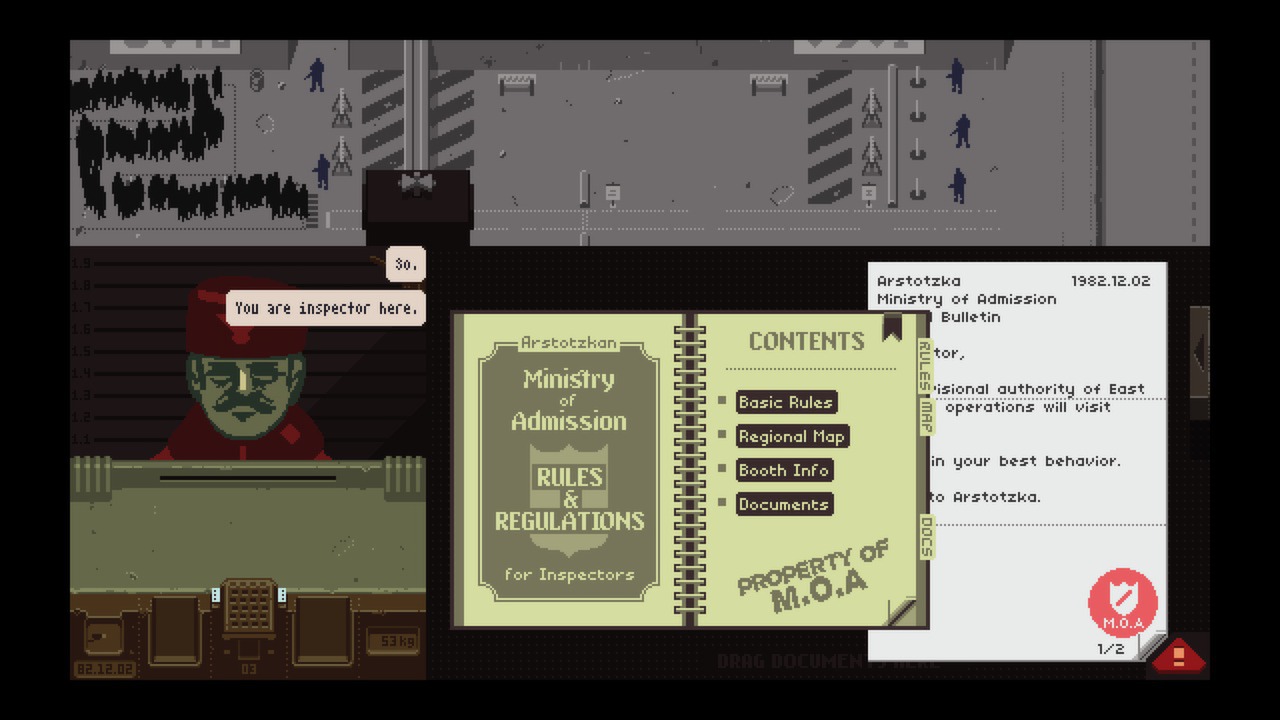
The inspection desk is also a timed workplace. Travelers processed during the shift contribute to the inspector’s earnings, while mistakes bring Ministry citations that reduce the final pay. A clock limits each workday, and applicants continue to arrive as the queue advances, so taking longer to verify every detail competes with the need to complete enough cases. Rules can grow more demanding at the same time that the paperwork gets heavier. The daily summary turns those small choices into a household budget: pay is counted, penalties are applied and expenses must be selected. The game connects the speed and accuracy of a seemingly repetitive office task to what the family can afford at home.
At day’s end, the player chooses whether to pay for essentials such as food and heat, and can respond to family members’ health needs, including medicine when someone becomes ill. Rent and other costs narrow the money left over, so an extra citation or a slow shift can matter beyond its immediate inconvenience. The family appears in status summaries rather than as characters the inspector can visit or speak with; their condition is communicated through the budget and household indicators. Keeping them supplied may mean passing up optional spending, while a shortfall can leave someone without care. This recurring calculation gives the border decisions a personal stake without removing the pressure to follow the Ministry’s rules.
The story develops through a mix of ordinary applicants and scripted encounters that connect the day-to-day work with Arstotzka’s wider political tensions. Some people arrive seeking employment or family reunification; others bring concerns that place a human request against a regulation. The Ministry’s changing orders, newspaper reports and the actions of groups such as the secretive EZIC organization add competing demands to the inspector’s routine. The player may follow official instructions, make exceptions, or cooperate with people working against the state, and those decisions affect which events follow. Story mode has multiple possible conclusions, shaped by choices and by the inspector’s ability to keep working, but the central task remains deciding each case at the window.
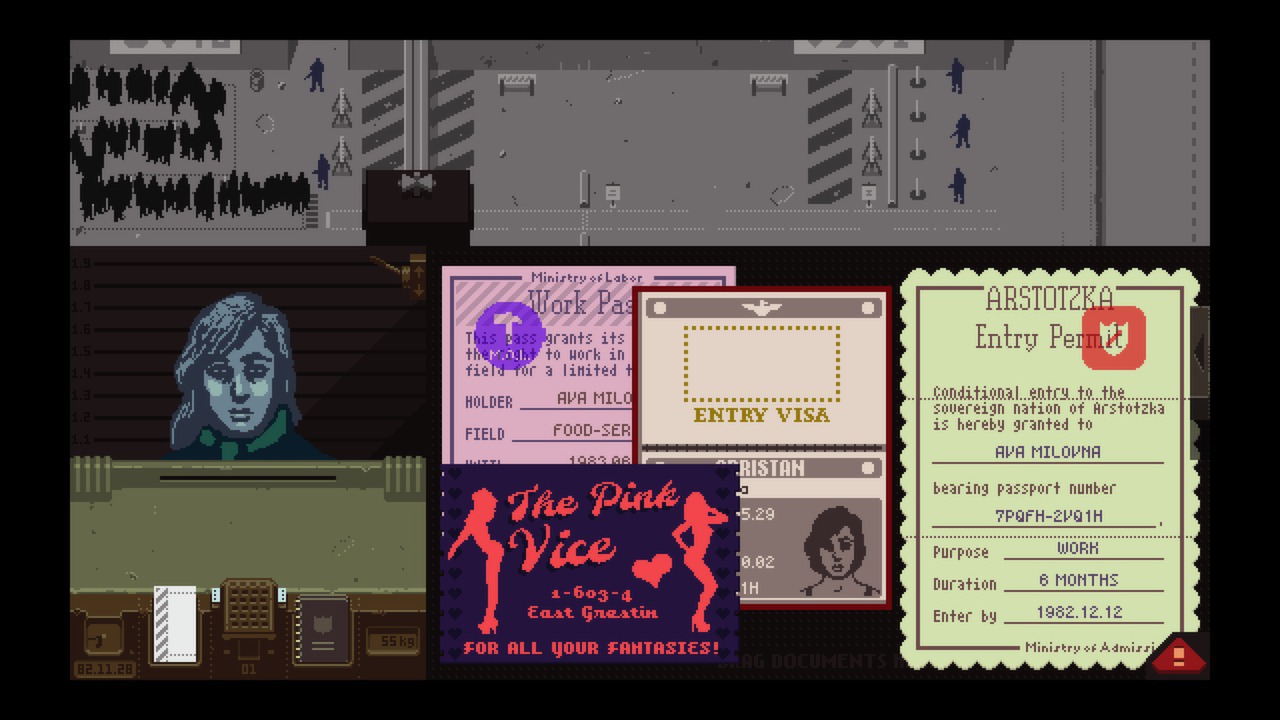
The compact pixel-art presentation keeps attention on the booth, its paperwork and the line beyond the glass. A low-resolution screen is divided into the checkpoint, inspector’s booth and crowded desk; passports and permits can be opened, compared and rearranged, so document handling is physical mouse work rather than a menu list. Muted colors and restrained detail give the workplace an institutional look, while the limited space lets papers accumulate as the shift continues. Sound makes small actions legible: stamps land with a firm finality, keys and desk objects ping, and ambient booth sounds carry much of the atmosphere between musical cues. The interface makes routine clerical gestures the main way the player acts in the world.
Alongside the story, an Endless mode offers a separate test of document-processing skill without the plot progression. It sets the player to handle incoming applicants and focuses on maintaining a clean record while working efficiently, turning the rule-checking loop into a score-oriented challenge. The format keeps the same basic rhythm of reviewing papers and making decisions but removes the story’s day-by-day political developments and personal requests. In the main story, by contrast, procedural competence is only one part of progress: new regulations, characters and competing obligations gradually change what a day at the checkpoint asks of the inspector.
- Developer
- Lucas Pope
- Genre
- Adventure; indie; document-inspection simulation elements