
About Paper Trail
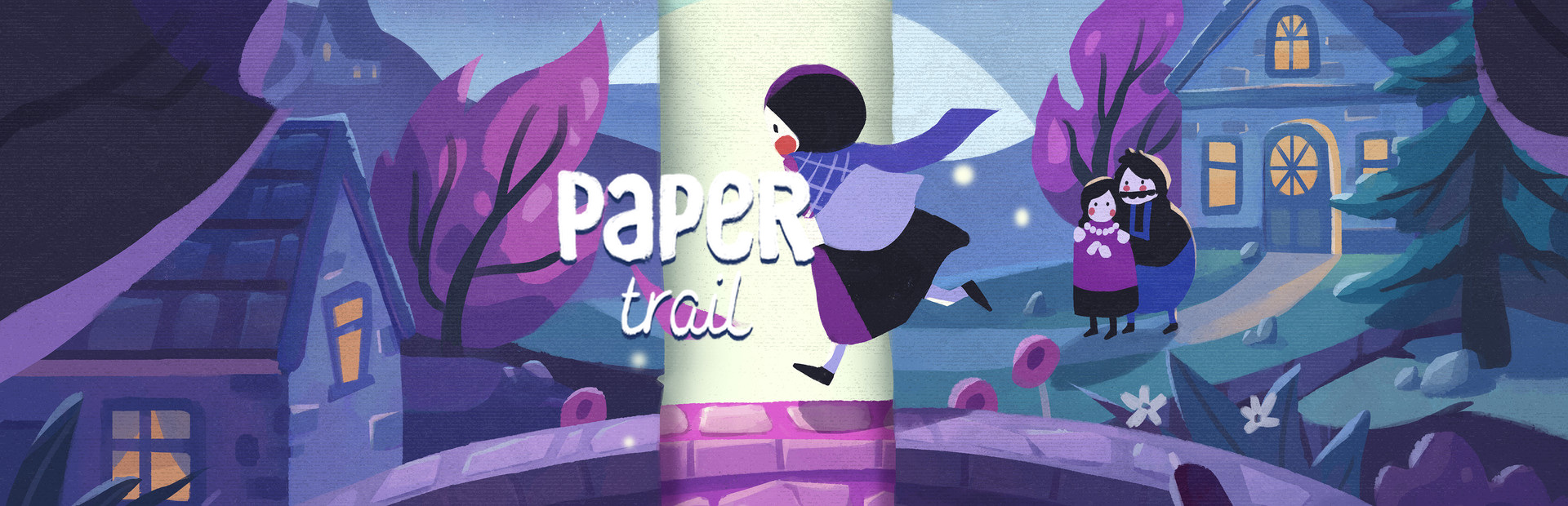
Paper Trail follows Paige as she leaves her village for university, carrying family worries into a world made from foldable sheets. Bend a page to connect paths on its front and back, then use that route to cross caves, swamps and other illustrated places. Its puzzles and encounters turn leaving home into a journey you can physically reshape.
Paige has done well at school and wants to study at university. That would make her the first person from her village to take that path, a prospect that excites her while drawing a mixed response from her family. Paper Trail places that departure in a world made of sheets that can be folded, so moving away from home is also an exercise in finding a way through. Paige cannot simply walk to the next destination along a fixed road. She has to bring distant edges together, expose the other side of a sheet and make new passages across a landscape that previously seemed divided. The premise gives the folding mechanic more meaning than a clever visual trick. Paige is trying to reach a future beyond what she knows, but the journey requires her to reconsider the shape of the ground beneath her feet. Creative director Henry Hoffman has linked Southfold, Paige's home town, to memories of wanting to leave a small town and go to university. The story therefore has a concrete emotional starting point even though its world is fantastical. Paige meets other people outside her village, hears their stories and finds that their needs can affect the route ahead. The game does not abandon her original purpose; it lets the distance between wanting to leave and actually arriving at a new life become the space in which its puzzles and encounters happen.
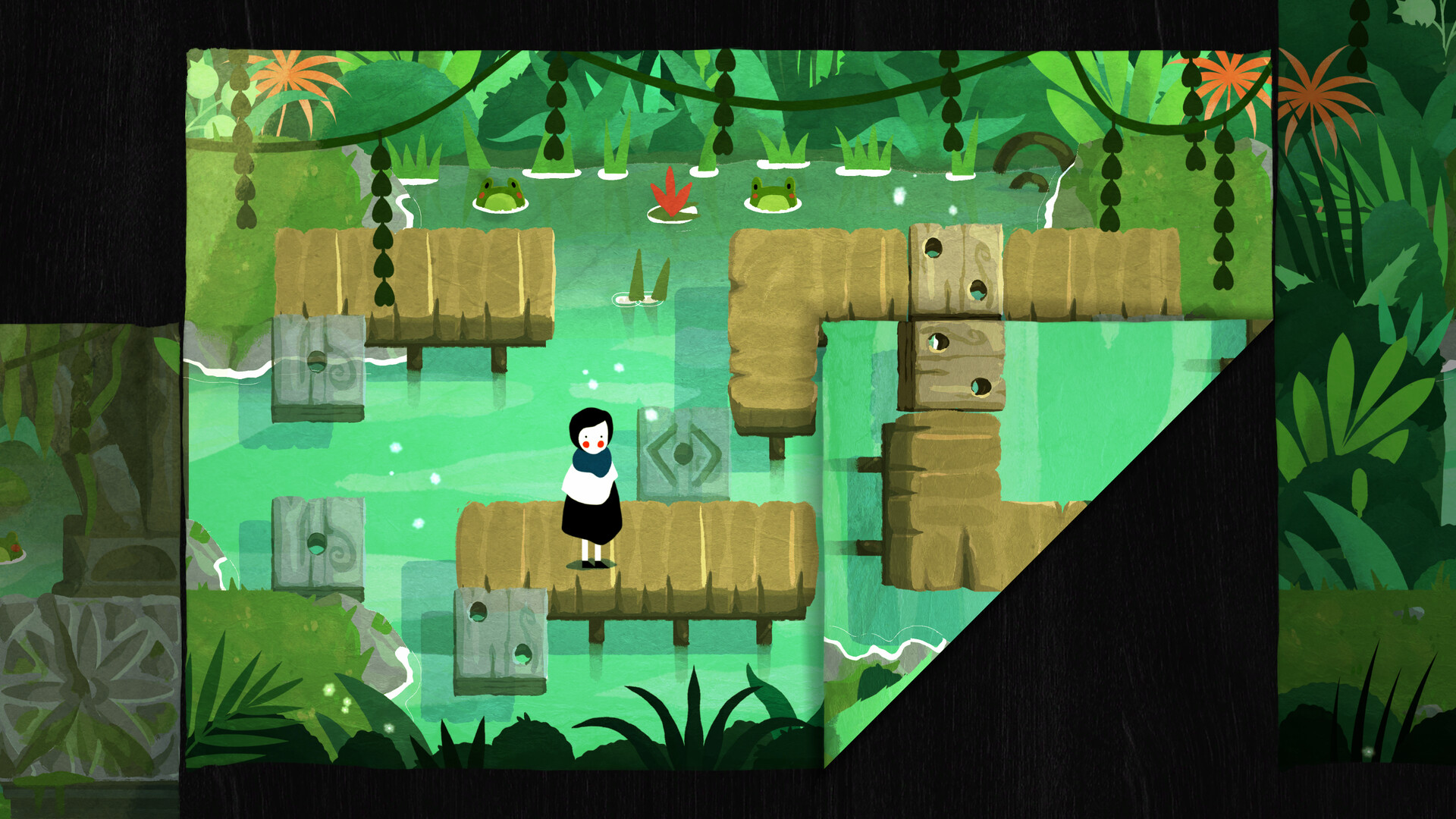
Each area is a piece of paper with a front and a back. A route drawn on one surface can meet another when an edge is folded over, allowing Paige to cross where there was no connection. This is the central act of play: look at where she stands, imagine what lies on the reverse, then bend the world until two traversable areas align. A simple fold might make a bridge from one side of a gap to the other. Later, the same principle can ask the player to reposition an object, make several temporary connections and think about what must happen before a fold is undone. The designer's account of the mechanic began with physical sketches. Ideas drawn on both sides of a sheet accidentally overlapped when the page was folded, suggesting that one level could reveal another. Paper Trail turns that discovery into a complete spatial language. The player is rarely manipulating an abstract diagram separate from the place Paige occupies. A crease changes the actual room, path or clearing she must move through. Seeing a familiar edge become a doorway is the game's recurring revelation, and the more elaborate puzzles ask how many such relationships can be made from a single sheet.
Different environments give that language different problems to solve. In caves, solid rock and empty space make walkable ground easy to distinguish, while boulders can become objects to position across new routes. A swamp uses grass and wooden jetties against water, with rafts that can be dragged into play. Treetops introduce doors that transport Paige, and later ruins change the shape of the paper itself instead of always providing neat rectangles. These details matter because folding alone does not automatically solve a room. The player needs to know what can be walked on, which object can be moved and where a temporary route will place it. A path that gets Paige to one side might leave a boulder on the wrong surface or fail to give her a way back. Hoffman has explained that clear distinctions between walkable and unwalkable space shaped the artwork for every environment. The designs are therefore practical as well as decorative. Rock, water and rooftops carry different visual identities, yet each helps the player read the physical rules of a puzzle at a glance. As mechanics introduced in one place return in altered forms elsewhere, the challenge becomes recognising a familiar idea inside a new scene rather than learning an entirely unrelated rule at every turn.
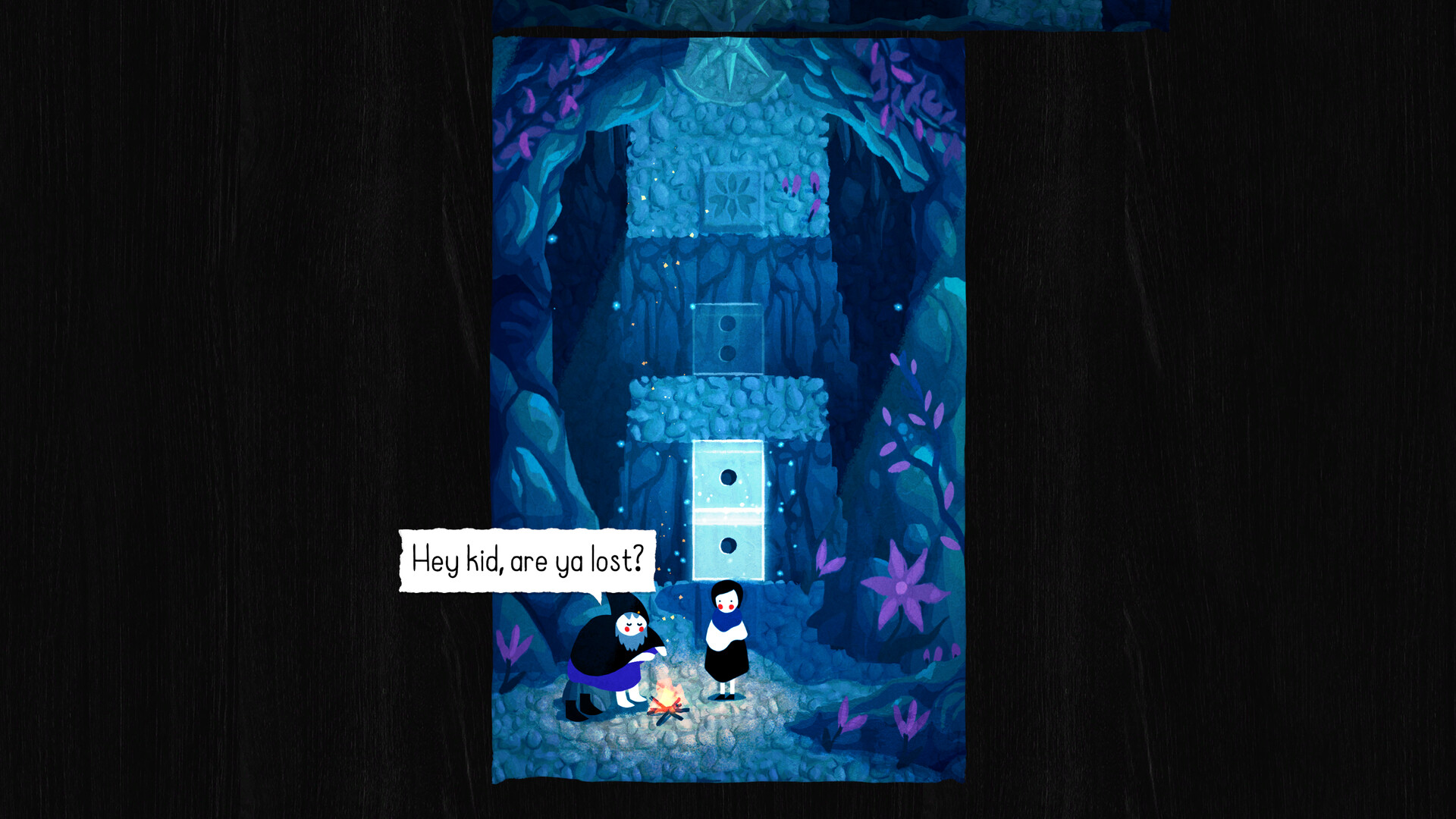
Paige travels through populated places, not empty sheets designed solely to test geometry. Eel fishermen, lighthouse keepers, children, bandits and other residents have their own short stories. Some offer hints or teach a mechanic; others are part of the journey's humour or ask for help opening a way forward. Foldable story scenes let the surrounding paper world participate in those encounters. The cast gives a reason to stop between puzzles and pay attention to what the next environment means to someone who lives there. Paige's own decision to leave home also becomes less isolated when she meets people whose priorities differ from hers. She has a destination, but the road between Southfold and university includes other lives and places worth understanding. The narrative does not need to turn every character into a long quest giver to make the world feel inhabited. A small interaction can establish a settlement's mood or reveal how the landscape is used by its residents. This distinguishes the adventure from a collection of folding exercises. The game is interested in what Paige sees when she finally goes beyond the place she knows, and its puzzle structure gives her many reasons to look closely.
The visual language reinforces the feeling of handling a handmade book. Flat printmaking and watercolour influences shape the scenery, while the characters have simple monochrome forms resembling cut-paper collage. Areas use bold colour schemes, and each page looks like a distinct illustration that can still become part of a larger route. The perspective is deliberately mixed. Ground surfaces are readable from above so folds create understandable paths, while characters and buildings face outward so the journey has expressive figures and recognisable architecture. Earlier development experimented with a side-on view, but Hoffman said the hybrid approach made the spatial puzzles and the visual story work together. Sound also serves the material idea: the developers paid attention to the response of crinkling paper as a fold moves, and the original music gives individual places a mood beyond their colour palette. The experience is meant to feel tactile even when played on a screen. Folding is an action with visible edges, a changing image and an audible texture. Those details make it easier to believe in Paige's strange power and to understand when two parts of the world have become one path.
Paper Trail is demanding in the way a good spatial puzzle can be, but it includes ways to inspect a problem without committing blindly to a guess. The reverse of a page can be viewed, reducing the need to memorise an unseen layout. An optional hint system can show a sequence of folds while leaving some placement decisions to the player. Hoffman has described extensive playtesting and revisions to the difficulty curve, including changes to whole worlds when early mechanics proved frustrating. The aim is a steady growth in what the player can do with a familiar action, not punishment for failing to picture a hidden surface. There is no combat campaign behind the folding; progress comes from observation, experimentation and making a route. Newfangled Games developed and published the original game in 2024. Its premise is easy to state, yet the act of joining two sides of a page creates a surprising number of practical and narrative possibilities. Paige moves outward toward university while the player repeatedly discovers that separation can be changed by looking from another angle. This overview leaves the exact routes and later story turns to the journey itself.
- Developer
- Newfangled Games
- Genre
- Top-down paper-folding puzzle adventure