
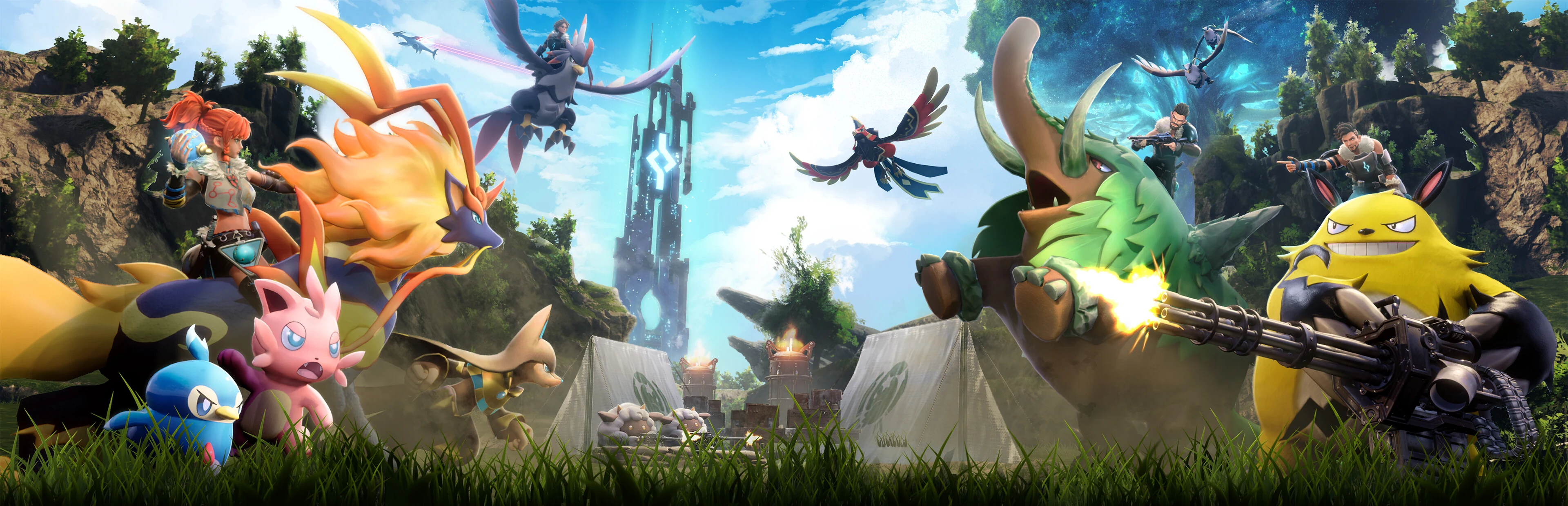
About Palworld
Pocketpair's creature-collector spent two and a half years in Early Access before it reached 1.0 in 2026. The catching is the hook, but the base you build around it is the part that keeps you up at night.
What you are actually playing
Palworld is an open-world survival and crafting game from Pocketpair, and its one big idea is that the creatures you fight are the ones you employ. You catch Pals, put them to work on farms and assembly lines, and keep the rest of the team for fighting, hauling, mining, generating power and carrying you around the map.
It left Early Access in 2026, roughly two and a half years after it first went on sale in early 2024. It is a paid game, and on Steam the only extra listed beside it is the soundtrack album; the updates since launch — the crossplay patch, the Terraria collaboration and 1.0 itself — arrived as free patches to the same app. You can play alone, in online co-op with up to four, or on a dedicated server that holds up to 32.
Catch first, put them to work
The loop starts with a thrown ball. You throw a Pal Sphere at a wild Pal and take your chances: the lower its health, the better the odds, and 1.0 adjusted the capture formula so Pals are easier to catch overall. Early on the routine is simple — find something small, soften it up, throw, and take the new teammate home.
What you do with that catch is the whole game. Most Pals carry a Partner Skill: some fight beside you, some sharpen your bow or your guns, and the riding Pals carry you over land, sea and sky, which turns the map into a route you choose. 1.0 also stopped some of them waiting on crafted gear, so a glider Pal or a follow-up attacker now works the moment you catch it.
The base is the game
Your base runs on a Palbox, and the Palbox is a workforce manager. Every Pal has work suitability — kindling, planting, watering, gathering, handiwork, transporting and more — and matching the Pal to the job is the difference between a camp that feeds itself and a yard full of Pals watching a queue they cannot finish.
When the match is right, the base keeps moving without you standing over it: furnaces, generators, farms and ore pits carry on while you are out exploring. It is also a household to look after. Workers eat from a feed box, sleep in beds, recover their sanity in hot springs, and drop out of the rotation when their sanity slides or the box runs empty.
1.0 doubled down on this side of the game. It added shoreline and sea construction, a spread of new building parts, and utility machines such as the Ancient Material Synthesizer; it also taught workers to sweep up dropped loot instead of leaving it on the floor.
A bigger Palpagos
Exploration is built for the kind of trip that finds something: watchtowers uncover the map and then become fast travel points, ancient ruins hide small rewards behind simple minigames, and the wildlife sanctuaries turn a rare catch into a stealth problem, with defence drones and searchlights guarding the Pals inside.
1.0 grew the map rather than reshuffling it. A set of floating islands called Sunreach now sits above Palpagos with its own Pals, tower bosses and special ores, and the World Tree finally became the heart of the story instead of a backdrop. Small islands, new settlements and a higher player level cap came with it, and the update added 72 Pals — 47 new creatures and 25 variant forms.
Weapons, Pals and the fights you pick
You are armed, not just supported. The weapon ladder runs from bows and spears to assault rifles and rocket launchers, and your party Pals fight their own battles alongside you; 1.0 added a command that points a Pal at a specific enemy. Pal combat got a long look too, with the active skills and the Partner Skills of more than 200 Pals rebalanced so the team you bring is a real decision.
The structured fights are the tower bosses and the arena, and 1.0 retuned both, tightening the time limits and giving wild Pals new attack habits. It is not a fighting game with a world bolted onto it, but combat is more than a delivery system for the catching.
Breeding, mutation and the long game
If you like optimisation, the breeding farm is where Palworld hides its depth. Two Pals produce an egg, and what it inherits is drawn from its parents rather than copied from either one whole: 1.0 changed breeding so inherited active skills come from the three slots each parent has equipped. Mutation is the long-shot bonus — a small chance of a stronger Pal with a passive skill of its own — and the right cakes push your odds at better stats, double eggs or a better shot at a mutation.
The far end of the game is Awakening: Radiant Gems found in the World Tree unlock a Pal's hidden power, and the same area hands out passive skills that are strong because they cost you something, trading defence for attack or draining hunger for speed. It is a long climb, and the point of it is a team that is yours rather than the one everybody else fields.
Playing together
Co-op is the same game with more hands. Four players share an online world, a dedicated server raises that to 32, and crossplay covers every platform the game runs on, so the system you own does not decide who you play with. Guilds gained roles and permissions to go with the shared base, which matters once two people are arguing about who left the furnaces unattended.
You can also trade Pals and fight other players, and the Global Palbox moves a Pal between worlds. The 1.0 update allows main-mission progress in PvP mode. Hosting is the part that is not uniform: dedicated servers and features such as Discord invites are scoped to particular builds, and the 1.0 in-game voice chat — which you switch on in a dedicated server's world settings — is not supported on the WinGDK version. Voice chat gives a group another way to coordinate its base work.
What it costs you
The first cost is upkeep. An automated base is a machine with needs: food in the box, beds and hot springs, and Pals who stop working when their sanity runs down. 1.0 turned base raids into waves as well, which makes where you put your workers and your defences a decision you keep having to make.
The second is scale. Palworld is a very large game now — a deep roster, several biomes and a technology ladder that wants a lot of materials. 1.0 softened the sharp edges by making Pals easier to catch and reworking the accessory and crafting systems, but it is still a long collection.
The third is what 1.0 did to a returning player's checklist. Main and sub-mission progress was reset for the new reward structure, defeated-bounty history was cleared, and random-spawn placement data from older versions is not carried forward. Your world and your Pals come with you; the list of things you had ticked off does not. Old mods are worth removing before you update, because Pocketpair's own advice is that switching them off is not enough.
One practical note: the store's own system requirements ask for an SSD and warn that performance will vary with the number of active Pals. A big base with a lot of workers is the load case, so it is worth planning your farm around your framerate.
Should you play it
Yes, if you want the collect-and-build loop with a workforce attached. Catching is quick, the base is the long game, and 1.0 is the fullest that side of Palworld has ever been.
Skip it if you want a tight, short survival game, or if managing a second set of needs behind your own sounds like homework. Palworld asks you to keep track of food, beds and morale as well as your own hunger bar, and the job is never quite finished.
Go deeper with V4mp
- Developer
- Pocketpair
- Genre
- Survival
Explore Palworld further
Explore the wiki for detailed reference pages on the game's world, systems, items and locations.