
About Oxygen Not Included
Oxygen Not Included is a colony simulation set inside a procedurally generated asteroid. A small crew of Duplicants must dig out living space, secure breathable air and food, and build systems for power, plumbing and temperature control. Every expansion consumes resources and changes the underground environment, linking daily survival to long-term engineering.
Oxygen Not Included places a small crew of colonists, called Duplicants, inside a subterranean asteroid where oxygen, warmth and food are limited conditions rather than background details. The player directs the group as it excavates rooms, constructs buildings and allocates materials across a growing base. The colony’s first spaces sit within a larger body of rock, so digging is both a way to obtain resources and a decision to expose new pockets of gases, liquids and heat. As the base spreads, the crew has to travel farther through the asteroid and support more activity with the same interconnected supply of air, food, water and energy. The setting is presented as a space-colony survival simulation, with strange lifeforms and technology discovered in the rock. Its central question is practical: how can a temporary shelter become a functioning habitat without exhausting the conditions that keep its inhabitants alive?
The Duplicants carry out jobs that turn plans into a working settlement. Excavation opens routes and creates room for construction; assigned tasks let the crew build, transport materials and operate the colony’s equipment. Each new room can make work easier or bring essential services closer, but it also adds demand to the settlement. The player therefore balances immediate requests with infrastructure that makes later tasks possible. A new passage can reach a resource or make a more useful layout, while the accompanying expansion means more space whose atmosphere and temperature must be managed. The colony is not a fixed base-building puzzle: its interior is continually altered by digging, building and the movement of gases and liquids. Duplicants have individual stress responses, and their morale depends on conditions such as food, accommodation and leisure. A base that sustains bodies still needs to be arranged as a livable workplace.
Air is one of the colony’s most visible systems. Duplicants need breathable oxygen, while carbon dioxide accumulates in the spaces they occupy, so the player must create oxygen and understand where gases are moving. The Oxygen Overlay makes the atmosphere visible across the base, showing how oxygen is distributed and where carbon dioxide is gathering. That view helps connect the layout of rooms to the behavior of the air inside them. Oxygen production is only part of the problem: a colony also needs power and materials to keep production running, and air must reach the places where the crew works and sleeps. The same underground space contains different gases, and the player can build systems that process unbreathable gas into usable air. With excavation, construction and an oxygen overlay working together, exploration becomes a way to redesign circulation and respond to changing conditions rather than simply clear the map.
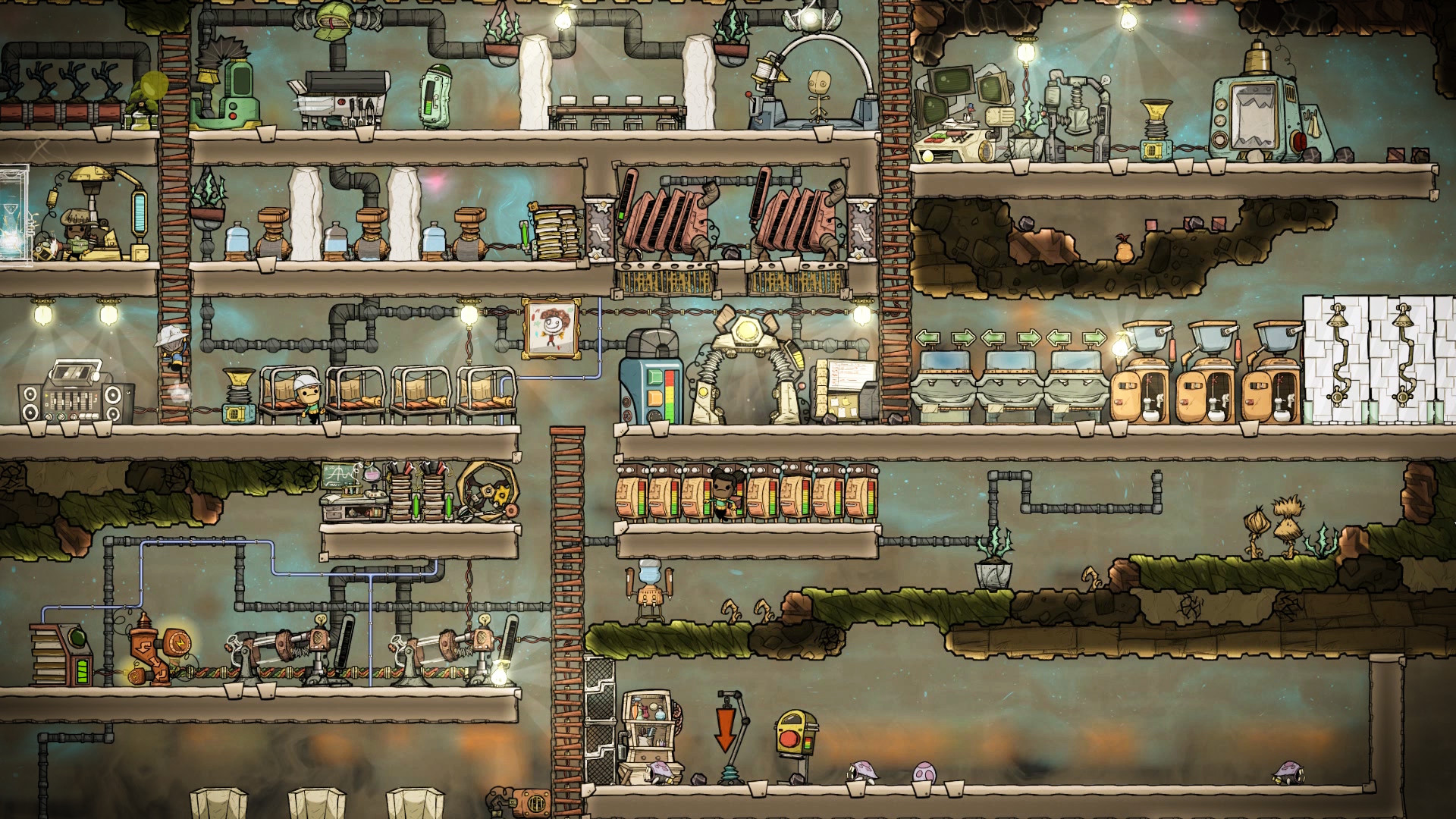
The base’s utilities are built as networks. Plumbing can move liquids and fuel through pipes to the places that need them, while gas and liquid simulation makes the route and contents of a network matter. Power comes from sources such as coal, hydrogen, natural gas or manual generators, and a power grid must carry that supply to machines. The colony’s power system also has limits: runoff, circuit overloads and meltdowns are problems the player must manage. Heat is another consequence of machinery and activity. Temperature can become too high or too low for comfortable living, so the player monitors ambient conditions as well as heat produced by the colony. These systems meet at the scale of a room: a pump needs power, a pipe needs a destination, and the surrounding environment can change as the machinery runs. Building a utility is therefore a question of both what it supplies and what its operation adds to the base.
Food and resource use turn survival into a production chain. The Duplicants need sustenance, while the colony must find and allocate materials for construction, power and life-support systems. Preparing food requires space, materials and equipment that also serve other purposes. The crew’s stress simulations connect those material decisions to their routines: better food, accommodations and leisure help keep stress at bay, and Duplicants may react to stress in destructive ways. Alongside food and oxygen, liquid networks supply critical areas of the base, and gases or waste can be processed instead of discarded. Steam’s description highlights extreme recycling, including converting waste into fuel and processing unbreathable gas. That emphasis changes how the player reads a problem: an unwanted output may become an input elsewhere, provided the base can support the steps needed to collect and transform it.
Research, discovery and environmental monitoring give the colony room to grow beyond its first survival loop. Science unlocks technology, while digging reveals new space, resources and unfamiliar lifeforms inside the asteroid. The player can call up different views of the simulation to inspect oxygen, temperature and power rather than relying only on the appearance of a room. New technology can improve how a base produces, moves or reuses resources, but each expansion also asks the player to maintain more systems. Procedurally generated worlds offer different arrangements of untamed space rocks, so the underground environment is not a single static floor plan. The game’s focus stays on turning those conditions into a durable colony: Duplicants work, consume resources and affect the same atmosphere and infrastructure that the player is trying to stabilize. A successful design must keep those relationships in view as it expands.
- Developer
- Klei Entertainment
- Genre
- Space-colony simulation