

About Overboard!
Aboard a 1935 ocean liner bound for New York, actor Veronica Villensey has eight hours before landfall to conceal her husband’s murder and direct suspicion elsewhere. This choice-driven narrative game turns conversation, movement around the ship and a ticking schedule into a replayable scheme shaped by what passengers witness and remember.
Overboard! begins after the crime that a conventional detective story might spend its length trying to solve. Veronica Villensey, a starlet travelling with her husband Malcolm aboard the SS Hook, has pushed him from the ship and must now make the death appear to be someone else’s doing. The year is 1935, and the liner is crossing the Atlantic toward New York. Its confined social world contains passengers and crew with relationships, routines and secrets of their own. Veronica’s problem is not simply to hide evidence: she has to work out what people know, control what they think they saw and create an account that can survive scrutiny when the ship reaches port. The setup casts the protagonist as the architect of a cover-up, leaving the player to decide whether she relies on charm, deception, coercion or more direct measures. Other people are active participants in this situation, not a row of witnesses waiting for questions. They move about, encounter events and form their own impressions, so the mystery is a social web that Veronica must navigate while the clock counts down.
The game presents its story as an interactive visual novel in which the player chooses Veronica’s dialogue and actions and decides where she goes. Rather than moving through a large landscape, she travels among locations aboard the ship and talks with the people present there. A conversation can be used to gather information, build trust, give an explanation or plant a misleading impression. The same person may be approached differently on another attempt, and what happens elsewhere can change the context of a later exchange. Other characters have their own movement and agendas; the developer describes them as remembering what they see and hear, including Veronica’s behavior. This means choices are judged against a shared timeline of events. A lie may be useful if it fits what a passenger already believes, but risky if somebody witnessed a contradiction. The ship’s constrained geography makes movement itself a decision: going to one room consumes time that could have been spent finding another character or checking an item. The interface centers on readable choices and location selection, letting attention focus on social timing and the changing state of the passengers rather than reflex-based navigation.
Each run takes place under an eight-hour narrative clock that advances as Veronica acts. The liner’s scheduled arrival gives the story a fixed deadline, and the clock makes even routine decisions part of the plan. Spending time on appearance, conversation or movement can mean missing a chance to meet someone elsewhere. Passengers also follow routines that shift their locations during the day, so a route that was available in one run may not play out in exactly the same way in another. The player is therefore balancing objectives against timing: investigate a potential witness, locate evidence, influence a passenger, or stay away from a scene that could expose the protagonist. The short span of a run supports the central premise instead of being a conventional chapter structure. It compresses the action into one urgent day and lets the player see how different priorities collide before the ship docks. A small decision can change who is available or what can be said later. The system encourages deliberate experimentation, while the clock prevents the player from exhaustively visiting every person and location in a single attempt.
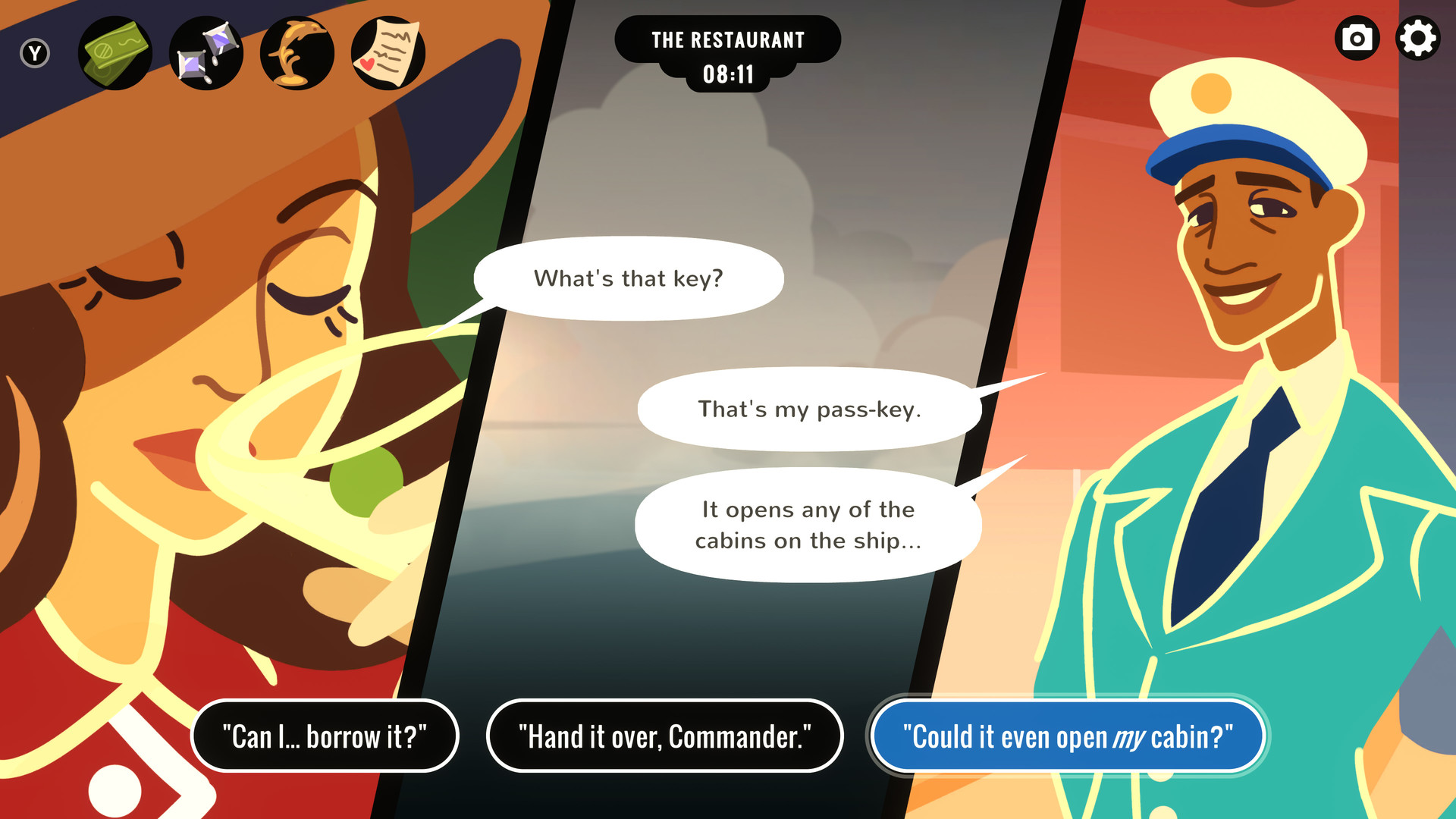
Conversation is both the main interface and the main instrument of the cover-up. Veronica may answer a question, evade it, make an accusation, pretend to be someone else, flirt, befriend, threaten or try to enlist another person in her plan. The choices are not presented as a simple dialogue tree in which every option merely reveals a different line of exposition; they can change what a character believes, how they respond later and whether they become a liability. Clues, evidence and secrets provide material to work with, while the passengers’ existing motives influence how they interpret what Veronica says. The player can try to redirect attention by framing somebody, exploiting another person’s hidden interests or making a competing story seem more plausible. Some actions can be criminal in their own right, extending the danger beyond the initial murder. This makes the tone a darkly comic inversion of the detective role: the player is managing suspicions rather than gathering evidence on behalf of justice. The experience depends on observing reactions and keeping track of what has already happened, since an apparently convincing line can become damaging if it conflicts with a witnessed event.
Progress is measured by the state of the investigation and the outcome of each run, not by character upgrades. Veronica can search for evidence, learn what different passengers know and use that information to steer an eventual accusation. At the end of a run, the ship’s passengers gather and discuss the disappearance; what they saw, heard or were told shapes the theories that emerge. The result can expose the cover-up, send suspicion toward another person or lead to a different resolution. The game’s branching structure is designed for replay: after one attempt, the player knows more about routines, relationships and possible methods, even though Veronica does not simply carry that knowledge as a character statistic into the next run. A fresh attempt lets the player test a different plan, make different choices and discover other sides of the shipboard story. Inkle describes the game as highly replayable, and its compact time window makes those alternate approaches practical to explore. The aim is not to complete a checklist of every line in one pass; each route is a partial view of a changing social situation, with consequences that become clearer when the player tries another strategy.
The ship functions as a small, readable stage for a cast of people moving through intersecting routines. Its rooms and public areas provide distinct places to encounter passengers, crew, objects and opportunities, while the Atlantic crossing keeps everyone inside the same bounded environment. The visual presentation is hand-drawn and text-led, with character portraits and dialogue carrying much of the dramatic detail. Rather than rely on cinematic action sequences, the game puts emphasis on written exchanges, decisions and the player’s mental model of the social scene. Its compact interface supports this focus: the player can choose actions and destinations without needing dexterity or real-time combat skill. The mood mixes a period crime story with black comedy, as polite social conventions and glamorous starlet identity coexist with evidence disposal and calculated manipulation. The vessel keeps the cast near enough for overheard conversations, missed meetings and contradictory stories to matter. This concentration gives small locations and routine encounters weight, because where Veronica is and who is nearby can affect which conversations or plans remain possible at that moment.
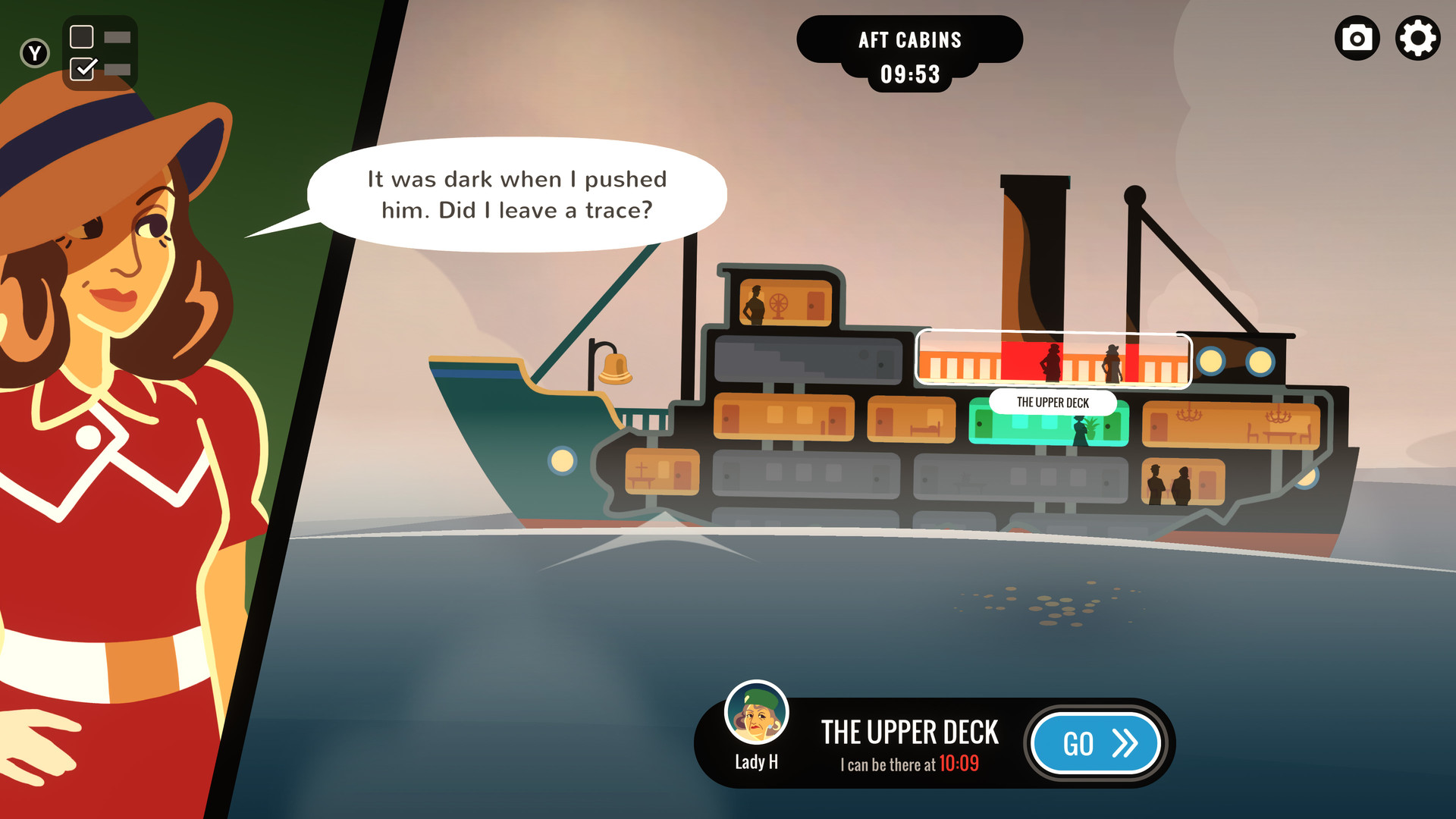
A successful plan cannot be reduced to one perfect line of dialogue. Veronica needs to know who is moving around the SS Hook, what each person has seen, which pieces of evidence remain and how much of the day is left before docking. A persuasive story told too late, or to someone who witnessed the wrong event, can unravel another part of the cover-up. Replaying the eight-hour scenario lets the player test a new route through that social web: meet a passenger earlier, hide a trace, exploit a secret or build suspicion around someone else. Each attempt reveals another part of the cast's routines and motives without making any single path the definitive version of Veronica's day. The ship's small scale makes these changes easy to notice, while the deadline prevents her from pursuing every opportunity at once. The result is a murder mystery played from the guilty side, where knowing the truth is only the beginning of the problem.
- Developer
- inkle Ltd
- Genre
- Choice-driven interactive narrative / visual novel