
About Outlast
Outlast is a first-person survival horror game in which investigative journalist Miles Upshur enters Mount Massive Asylum after receiving an anonymous tip. Inside, he searches the facility for evidence and a way out while avoiding its unpredictable inhabitants. Stealth, hiding, running and traversal carry him through the secretive institution.
Outlast follows Miles Upshur, an independent investigative journalist who receives an anonymous tip about Mount Massive Asylum. The remote Colorado institution has reopened under the research and charity branch of the Murkoff Corporation, and Miles enters to investigate what is happening there. Once inside, he encounters a facility far removed from an ordinary hospital: the story moves between questions of science, religion and forces that resist an easy explanation. Miles is not entering as a soldier or a combat specialist. His goal is to uncover the truth and survive long enough to escape, which makes every investigation a risk. The player experiences the asylum through his first-person perspective, following the evidence while responding to dangers that can appear unpredictably.
Mount Massive is the game’s central environment, a large institution that has become hostile and difficult to navigate. Its rooms, corridors and enclosed facilities create a route through spaces used for care and research, now marked by the crisis unfolding inside. The player explores these areas for a way onward and to understand what has happened, using the building’s doors and connections to orient Miles. The asylum supplies both the investigation’s evidence and its obstacles: the player must enter deeper into a secretive institution even as its inhabitants make movement dangerous. This gives the story a clear physical direction. Reaching another section can reveal more about the facility, but it also means crossing unfamiliar ground where there may be little warning of what is ahead.
Miles’s camcorder is his central tool. He can raise it to record his exploration and document particular scenes, which adds information about events at Mount Massive. Its night-vision mode also makes dark areas visible through the camera display, replacing a conventional flashlight as the way to inspect unlit spaces. Keeping the viewfinder active therefore has a cost: night vision drains the camera’s battery, and spare batteries found around the asylum restore its charge. The player has to choose when the extra visibility is worth spending power and when to navigate without it. In a dark room, switching night vision on can help reveal a route or threat; leaving it on throughout every passage risks exhausting a resource needed later. The camera links evidence gathering and navigation to one device.
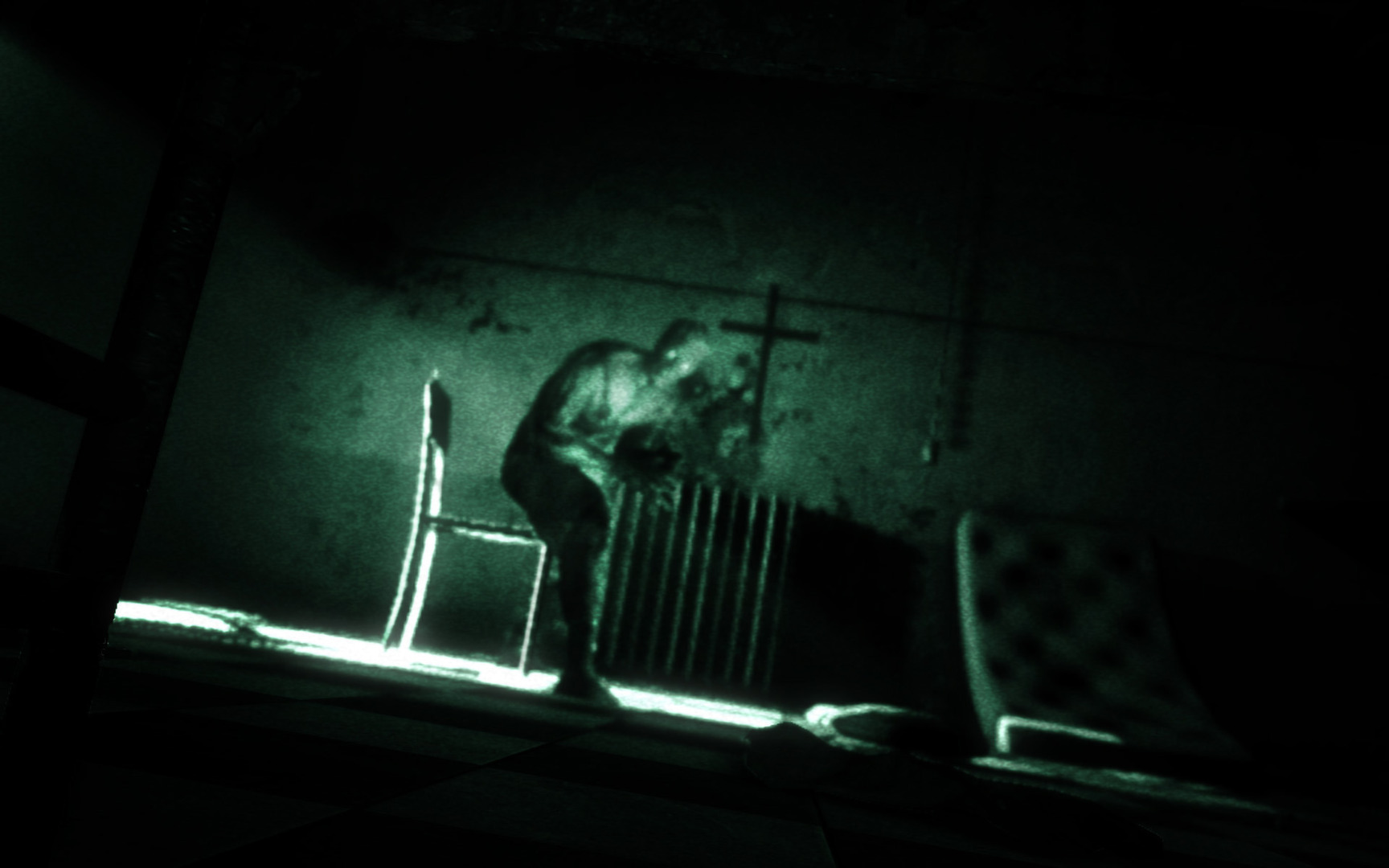
Recording is optional as an investigative habit, but it gives the camcorder a role beyond seeing in the dark. Miles can film selected events and details as he moves, and those recordings provide additional information about what is happening at the asylum. The player can keep the camera raised to document the journey or use it more selectively, deciding which moments deserve attention while watching for danger. This changes how a room is read: a place may contain a route forward, a threat to avoid and a detail worth recording at once. The story is not presented as a sequence of detached briefings; it emerges as Miles examines the institution and encounters its crisis. His journalistic purpose gives exploration a concrete motive even when the safest choice would be to leave a space quickly.
Outlast gives Miles no combat option. When an inhabitant threatens him, the player must avoid confrontation by hiding, staying out of sight or running away. Beds, lockers and other spaces can conceal him, while doorways and the layout of connected rooms offer opportunities to break contact. These actions are temporary solutions: a hiding place only helps while Miles remains undiscovered, and a sprint may lead into another exposed area. Enemies can catch up from uncertain directions, so the player has to read immediate surroundings rather than rely on a weapon or a fixed attack routine. The pressure comes from remaining vulnerable while trying to preserve a route through the building. Once danger passes, the player can return to investigation, but the possibility of pursuit remains part of each new space.
Movement through the asylum combines cautious exploration with bursts of physical escape. The game includes parkour-inspired traversal, so the player may need to vault or move quickly through the environment rather than simply retreat along the same corridor. Doors and room connections can separate Miles from a pursuer, lead toward another section or leave him exposed while he works out where to go. A route that is easy to follow when the halls are quiet becomes harder to judge during a chase. Keeping track of exits, cover and the next opening matters because running without a destination can leave Miles cornered. This traversal system supports the central investigative loop: move into a new area, search it for useful information, then adapt when the threat makes staying there unsafe.
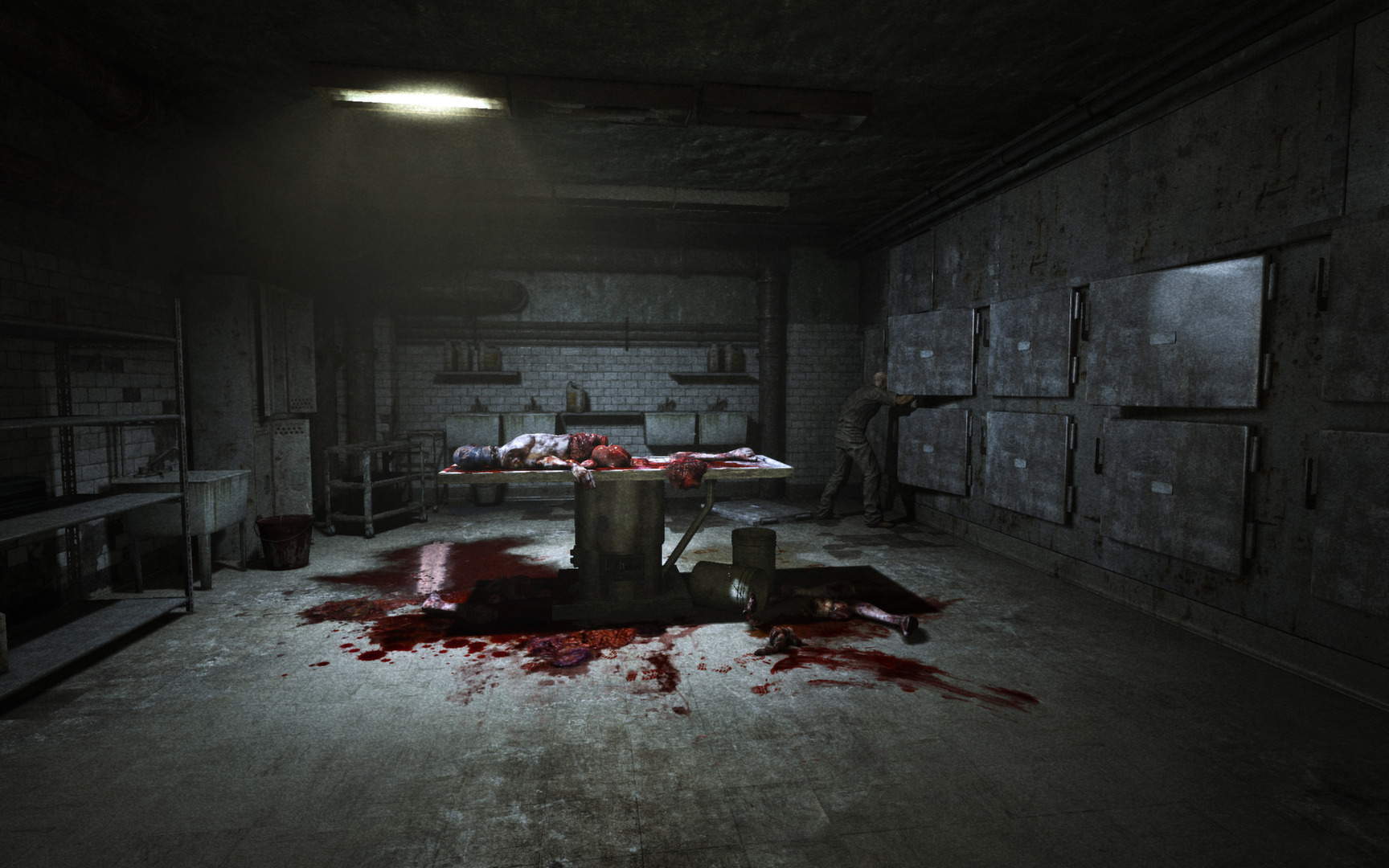
The base game’s focus stays with Miles and his investigation of Mount Massive. The separate expansion Outlast: Whistleblower follows software engineer Waylon Park and presents another perspective on events at the asylum; it is not part of Miles’s playable story here. In Outlast, the player follows the anonymous lead, explores the facility, records selected details and searches for a way out. The mystery concerns the institution and the activities hidden inside it, while progression depends on surviving each new stretch long enough to learn more. The camcorder reinforces that structure: its lens is useful for observation, night vision makes darkness navigable at a battery cost, and recording can capture additional context. Exploration and survival remain inseparable because the evidence is located inside the same dangerous place from which Miles is trying to escape.
- Developer
- Red Barrels
- Genre
- First-person survival horror