
About Ori and the Blind Forest: Definitive Edition
In Ori and the Blind Forest: Definitive Edition, guide the guardian spirit Ori through the fading forest of Nibel after a storm sets a crisis in motion. Explore interconnected 2D environments, gain movement abilities, fight hostile creatures, solve traversal puzzles and restore the forest while the expanded edition adds areas, skills and fast travel.
Ori and the Blind Forest: Definitive Edition follows Ori, a small guardian spirit separated from the Spirit Tree during a storm and raised by Naru in the forest of Nibel. When the forest begins to wither, Ori sets out with Sein, a light that guides the journey, to restore the forest’s balance. The story is told through animated scenes and through changes in the places Ori visits, while the player controls Ori across a connected two-dimensional world. Nibel is arranged as branching regions rather than a sequence of isolated stages: routes lead through groves, caves, water and dangerous terrain, with blocked passages that become reachable after Ori gains new abilities. The expanded edition adds two areas that develop Naru’s history, but its central journey remains the original game’s effort to revive Nibel.
Movement and platforming form the core of play. Ori can run, jump and cling to walls, then gains abilities such as Double Jump, Bash, Stomp, Glide, Wall Climb and Charge Jump as the journey progresses. These skills change how the same landscape can be crossed: Bash redirects Ori from enemy projectiles and environmental objects, while Stomp breaks certain floors and activates pegs. Glide extends a jump over spikes or gaps, and later movement skills open routes through cracked surfaces and vertical passages. Obstacles often combine timing, positioning and ability use rather than requiring a separate key for every door. The player studies the room, identifies a projectile, lantern, switch or breakable surface that can be used, then chains movement together to reach a safe platform or the next passage.
Progress depends on reaching Ancestral Trees and absorbing the abilities they preserve. A newly learned move can immediately change the next room, and it can also make earlier regions worth revisiting because some ledges, cells and side paths were inaccessible before. The world map records explored ground and gives a larger view of the branching route, while Spirit Gates use Keystones as local locks that the player must collect before passing through. Larger objectives involve opening paths into major areas and completing environmental sequences that affect the forest. These tasks make navigation itself part of progression: players often move through a region several times from different heights or directions, using newly acquired skills to connect previously separate platforms and uncover additional routes.
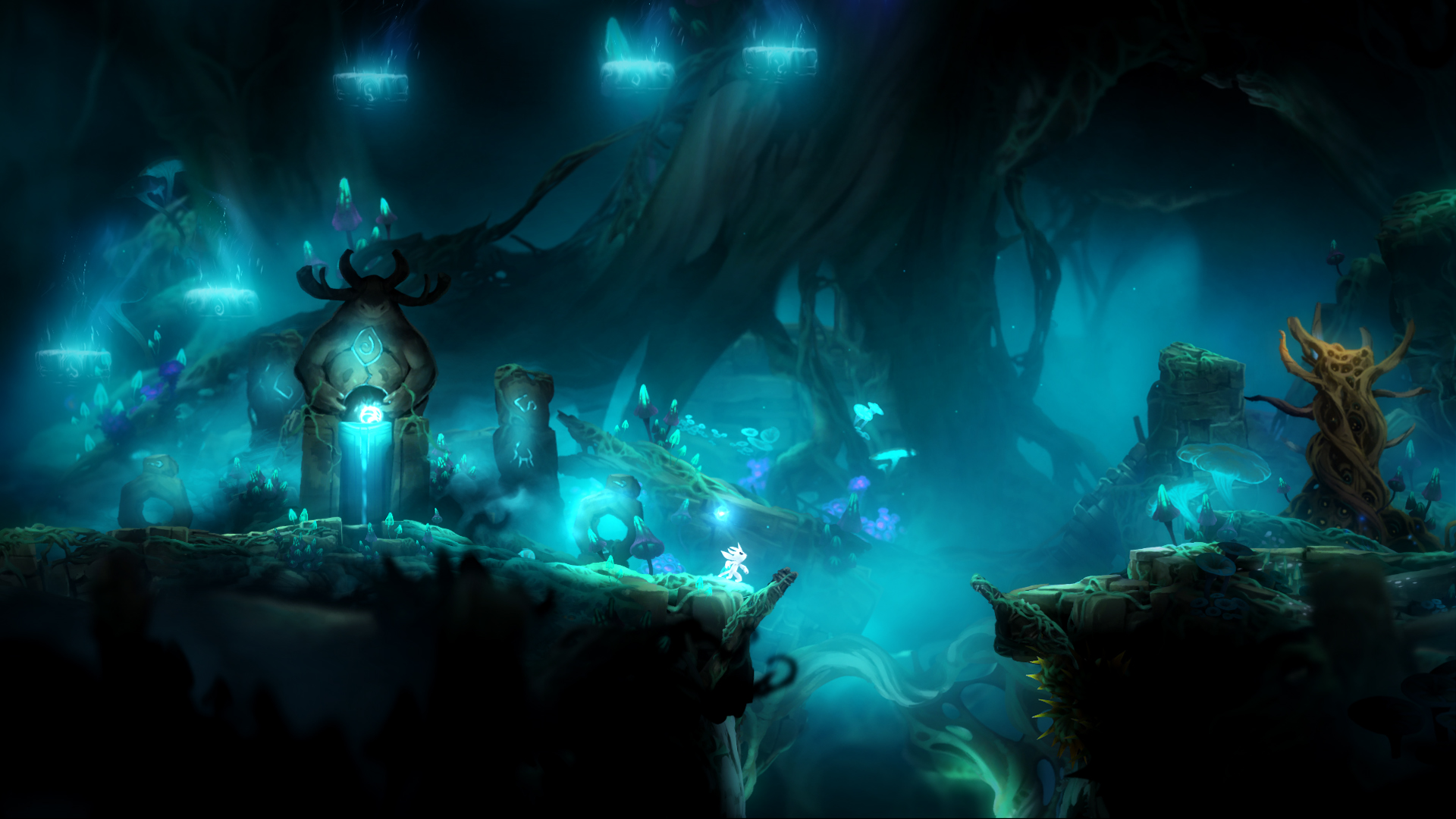
Ori’s survival is measured through Life and Energy cells. Life provides resilience against enemy attacks and environmental hazards; Energy powers special actions and the manually placed Soul Link checkpoint. Creating a Soul Link saves progress at a chosen safe location, so its cost creates a decision about how much energy to reserve for abilities or healing and when to secure a difficult section. Spirit Wells provide fixed places to save and restore resources. Ability Points earned through exploration and encounters can be invested in three branches that improve combat, efficiency or utility, including enhancements to attacks, pickups and Soul Links. Ability Cells grant a point directly, while Life and Energy Cells increase their respective capacities. The result is a progression loop built around exploration and survival, with optional detours strengthening Ori before the next demanding traversal sequence.
Combat is integrated into movement and environmental puzzles. Sein attacks nearby threats with Spirit Flame, and Ori can use Charge Flame to release a stronger burst when needed. Bash turns an enemy’s projectile into a launch point, letting the player redirect its path while sending Ori in another direction; this can clear enemies, cross hazards or reach high ground. Other encounters ask the player to avoid contact and keep moving through rooms with falling rocks, lasers, spikes or unstable platforms. The controls reward deliberate timing because one successful action can serve several purposes at once: evade danger, change direction, damage a foe and gain height. Energy management also shapes combat, since some attacks and defensive options draw from the same resource that supports Soul Links and other abilities.
The Definitive Edition expands this structure with Black Root Burrows and Lost Grove, new story sequences, difficulty choices, Dash and Light Burst, and fast travel between discovered Spirit Wells. Black Root Burrows uses darkness as a navigation condition: Ori carries a light orb whose illumination affects visibility and interactions with objects, so the player must make progress while judging the surrounding space. Dash gives Ori a short burst of forward movement, while Light Burst throws a projectile that can damage enemies and interact with the environment; upgrades can extend how these skills work. The edition also supports full backtracking and travel between found wells, making it easier to return to places where a newly acquired movement ability reveals a side route. Players can select Easy, Normal, Hard or One-Life settings, so the same platforming route can be approached with different stakes. The Theater also gathers cinematics alongside promotional and behind-the-scenes material, giving this edition an additional way to revisit its production and story presentation. Together, these routes and skills make familiar stretches of Nibel newly navigable while adding a distinct pocket of story around Naru.
- Developer
- Moon Studios
- Genre
- Action-adventure platformer