

About Old Man's Journey
An elderly traveller crosses a hand-drawn world, reshaping hills to create a route through each landscape. Brief visual memories reveal a life marked by loss, changed plans and hope. Old Man’s Journey is a quiet puzzle adventure that joins hill-shaped paths and route choices with a wordless story about finding a way home.
Old Man’s Journey follows an elderly traveller as he sets out from a quiet coastal town and crosses a series of sunlit landscapes. His journey leads toward home, within a wider story of life, loss, reconciliation and hope. Rather than explain the old man’s history through extended dialogue, the game reveals parts of it through brief visual memories along the route. The player’s immediate task is to help him keep moving: a hill or crossing blocks the way until the landscape has been reshaped into a traversable path. That practical goal gives the journey its forward direction, while each memory adds context to the person travelling. The game does not make the player choose responses or steer a party of characters. Its focus stays on this man, the terrain in front of him and the images that look back on his life. The story’s emotional shifts are carried by the order of places and vignettes, leaving the player to connect what a memory shows with the journey now underway. This arrangement makes travel and recollection parts of one structure: the old man moves forward through the world as the player gradually sees more of the life he has lived.
The route begins beside the sea and passes through distinct settings of rolling green hills, coastal settlements and sunlit shores. The landscapes are hand-drawn and designed as layered views, with slopes, paths and intersections visible together on screen. They resemble places to travel through, but they also function as spatial puzzles. The old man follows the contours of hills rather than walking freely across a flat ground plane, so the shape and position of each slope determine which directions are available. The fictional landscapes evoke Mediterranean coasts and northern regions, with landmarks and objects placed along the route to invite attention. In play, that means a scene can give the player both a traversal problem and a reason to look around it. A landmark helps establish where the path is leading; an intersection raises the question of which connected slope the old man should follow. The player explores by reading these composed spaces, noticing where routes meet and how terrain could be rearranged. The environments remain visually calm, yet their arrangement contains the concrete information needed to plan a way onward.
The defining mechanic is landscape shaping. The player alters the hills so the old man can walk along their silhouettes, joining his current position to the next reachable section. The image behaves like a set of overlapping layers: where paths meet, the player can switch between intersecting routes, changing which contour continues the journey. This makes a puzzle more than a matter of drawing one continuous line across the screen. The player must notice the existing shapes, identify the route the man can walk, and use an intersection or modified hill to connect the correct segments. A hill’s profile sets the path; its relation to nearby slopes determines whether the man can reach another area. The player shapes hills, walks the man along their silhouettes and switches routes at intersections. These actions are the game’s essential vocabulary, and individual landscapes recombine them into new path problems. The player does not solve them by collecting keys or attacking enemies. Instead, changing the world itself opens movement. The man’s walk then shows whether the chosen connection works, giving the player a readable link between a terrain adjustment and progress through the scene.

Each landscape asks the player to connect a starting point to a reachable destination using hills and intersections. The route is read as a sequence of segments: one slope may lead to a crossing, but the player must choose which intersecting contour continues the path. Changing a hill alters the available silhouette, while switching routes changes how the man proceeds through the layered scene. Because the landform is also the path, solving the puzzle means understanding both the terrain’s shape and its connection to neighboring slopes. Landmarks and objects give the composed landscape points of focus, but the traversal problem remains clear in the old man’s position and the visible contours around him. A successful arrangement lets him walk onward; the next scene presents a new combination of hills and crossings. This gives the level sequence variation without replacing the central rule with unrelated tasks. The player repeatedly studies the terrain, edits a path and sees the consequence through the traveller’s movement.
The visual memories provide the story’s second kind of progression. They show moments from the old man’s life in short vignettes and convey the themes of precious moments, broken dreams and changed plans through images. Instead of supplying a branching conversation system or a sequence of narrated explanations, the game asks the player to look at what is shown and relate it to the traveller’s present. The order of the memories matters because each one adds a part to the account as the journey continues. This approach allows a landscape puzzle and a memory to serve different but connected purposes: terrain determines where the old man can walk, while an image offers a glimpse of what the journey means to him. The game tells its visual narrative through imagery, with broad themes of life, loss, reconciliation and hope. The vignettes keep attention on a man travelling and reflecting on his past. The vignettes are brief, which keeps the adventure’s attention on the route while letting the images deepen the context of the journey.
The presentation combines hand-drawn landscapes, frame-by-frame animation and an original soundtrack by SCNTFC. The illustrations use bright, whimsical settings to make hills, pathways and intersections easy to read while giving each place its own character. The game’s side-on layered view supports both tasks: the player can see the old man’s silhouette against the terrain and compare the available contours before reshaping the landscape. Animated details within the world add movement to what would otherwise be a static puzzle board, while the memory vignettes use imagery to tell the parts of the story that are not spoken aloud. Music accompanies the changing emotional course of the trip. The visual style and music follow the story’s changing emotional course, keeping the presentation tied to the journey rather than separating it into unrelated cutaways. The result is a readable visual language in which a hill’s shape communicates the next problem, a landmark gives a landscape a point of focus and an animated memory can shift the meaning of the trip without interrupting it with exposition.
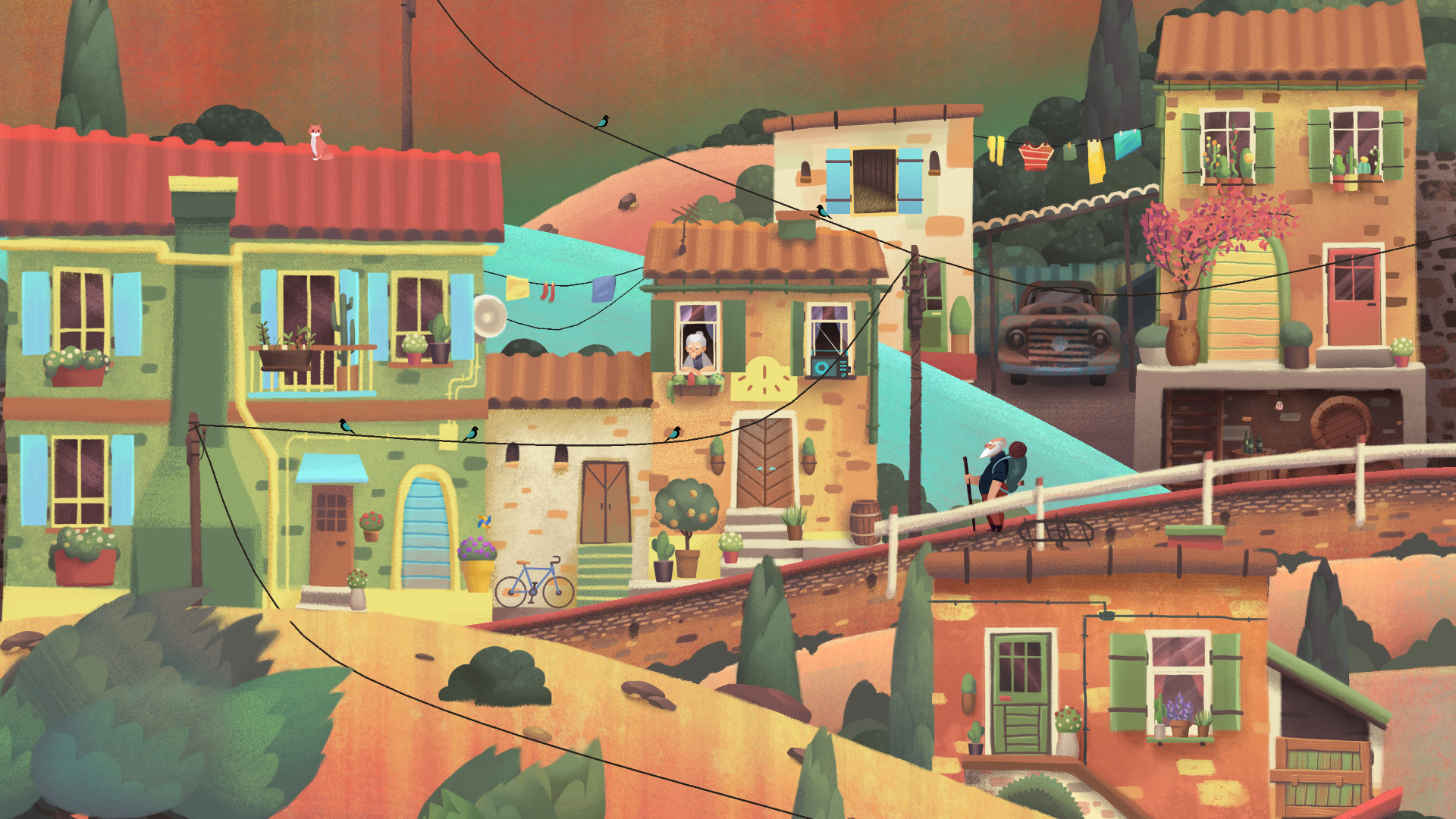
The journey’s sequence of settings links route puzzles to visual memories. The old man crosses a coastal town, rolling hills and other sunlit places; reshaping the terrain lets him continue, while brief images add context to the life behind the trip. Hills define walkable contours, intersections offer route choices, and landmarks give each view a distinct focus. Those elements keep the central task legible as the landscapes change. The memory vignettes provide the story’s progression without interrupting the journey with dialogue choices or a separate narrative system. Hand-drawn scenery, animation and music carry the shift from one place and recollection to the next. The player’s work remains spatial and concrete: make a connected route and let the traveller move through it. As the images accumulate, the forward path and the old man’s reflections form a single account of finding a way home.
- Developer
- Broken Rules
- Genre
- Landscape-shaping puzzle adventure