
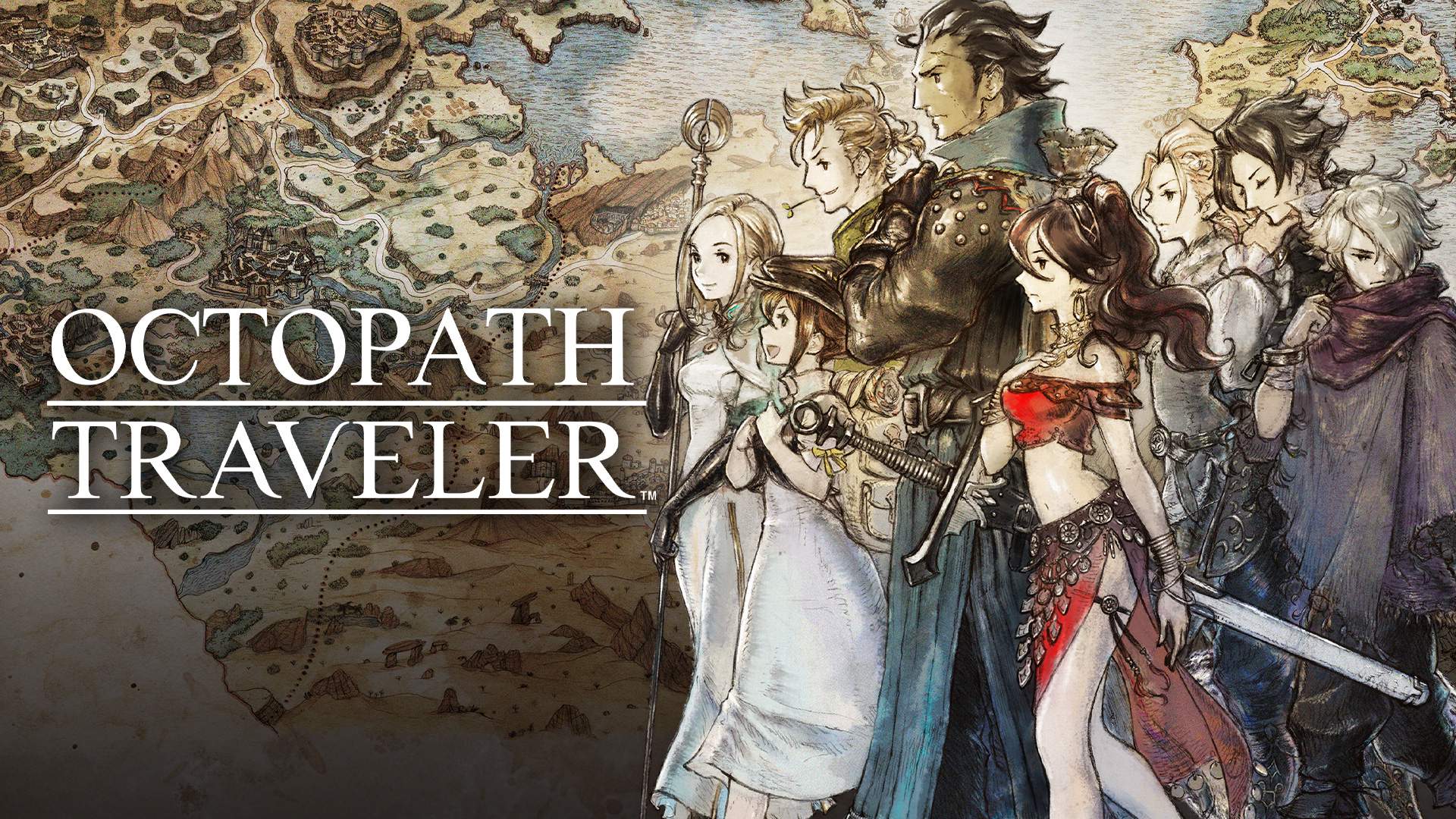
About Octopath Traveler
Eight travelers set out across Orsterra for reasons that rarely resemble one another. Octopath Traveler lets you choose a starting protagonist, recruit the others and follow their individual stories while shaping a four-person party. Town interactions depend on each traveler’s Path Action; turn-based fights revolve around exposing weaknesses, breaking enemy shields and deciding when to spend Boost Points.
An adventure in Orsterra can begin with a church pilgrimage, a stolen book, an old diary or a hunt for a missing teacher. Octopath Traveler places eight protagonists in different regions of one continent and asks you to choose whose journey starts first. Ophilia takes her adoptive sister's place on a sacred pilgrimage after Archbishop Josef falls ill. Cyrus leaves his scholarly post to trace a vanished ancient tome. Tressa follows the words of an anonymous traveler rather than remaining in her family's shop, while Olberic, a knight without his former kingdom, takes up his sword when a boy is abducted from the village he protects. Their starting problems are specific and personal. Choosing one does not erase the others: you can find and recruit the seven remaining travelers as the route opens, then follow their separate chapters. The game therefore has a different shape from a quest that simply adds companions to one hero's fixed mission. Its title refers to the eight possible starting paths, and the person you choose first determines where on the map your account of Orsterra begins.
The other four beginnings make the range clearer. Primrose waits in Sunshade's pleasure district for a chance to pursue the people responsible for her father's death. Alfyn leaves home to heal people beyond his own community. Therion, caught after a failed theft, must retrieve three Dragonstones to win back his freedom. H'aanit departs her forest home to search for the master who left on a dangerous hunt a year earlier. Revenge, medicine, obligation and curiosity coexist on the same continent without becoming interchangeable motives. Forests, desert outposts and snow-covered religious sites mark different parts of Orsterra, and each traveler begins in a different land. You can cross those regions to gather a party, pursue another character's next chapter or take on side stories along the way. The available fighting group holds four travelers at once, even if more have joined the broader journey. That distinction gives travel a practical consequence: the companions whose stories you have discovered also become a set of skills from which you must assemble the active group for the next fight.
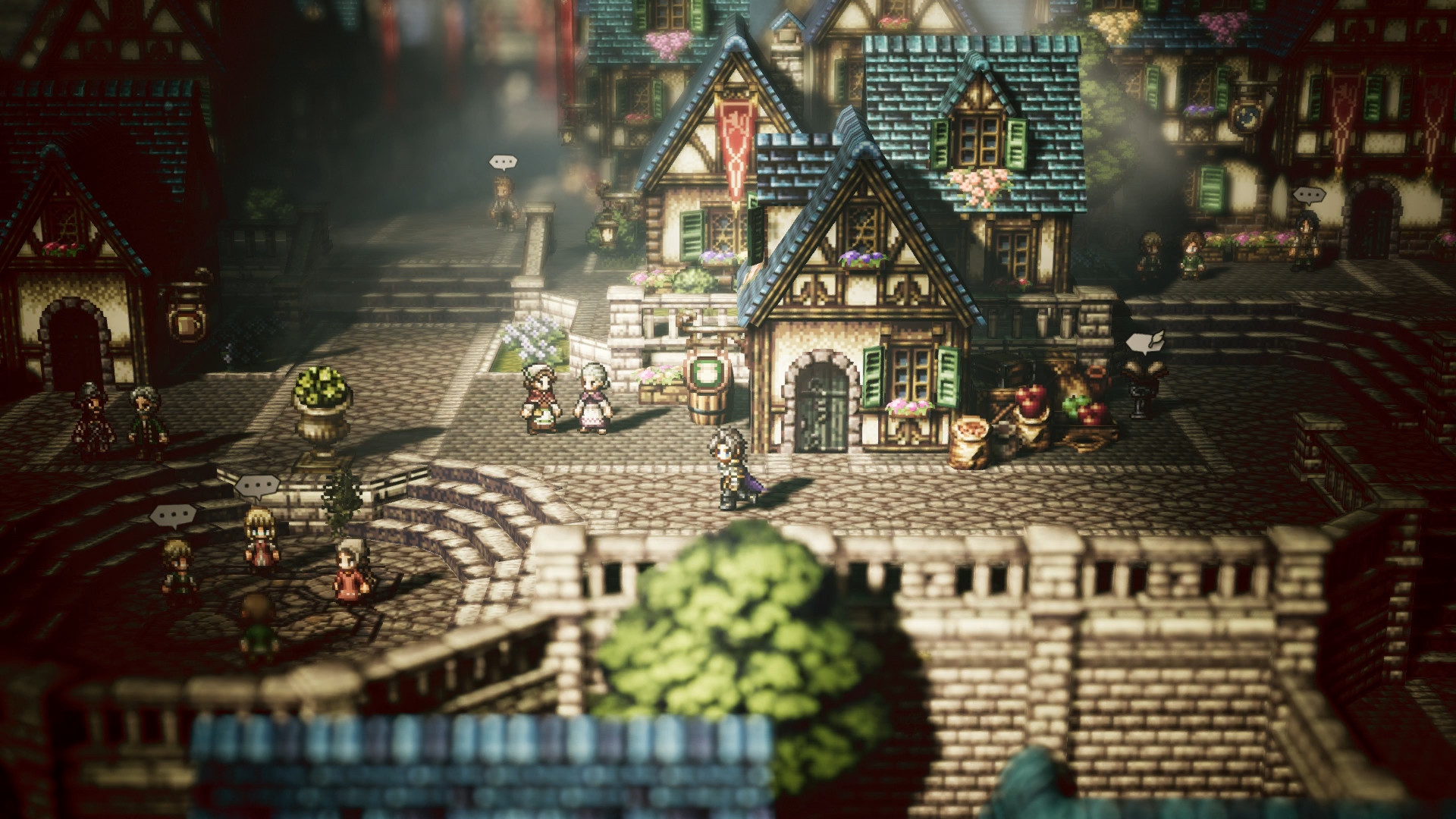
A town is more than a pause between battles because every traveler has a Path Action that changes how they deal with its residents. Olberic can Challenge a villager to a fight; H'aanit can Provoke one. Tressa can Purchase an item from someone, whereas Therion can try to Steal it. Other actions let the party draw out information or bring an inhabitant along. These are not merely different labels for an identical interaction. The game groups actions into noble and rogue forms: a noble action such as Purchase cannot fail, while a rogue attempt may fail and repeated failures can harm the party's reputation in that town. A barkeep can restore that standing for a fee. This makes a shopkeeper, guard or passer-by a possible source of an item, information, help or resistance depending on who approaches them. It also makes party composition meaningful outside combat. A traveler selected for a useful spell may offer a very different way into a local side story than the companion whose action can negotiate with its people. The choice of approach changes the cost and risk of getting what you need, without requiring every town to be a separate self-contained puzzle.
The turn-based battles turn on information and timing. Enemies have vulnerabilities to particular weapon types or magic, initially hidden until an ability reveals one or the relevant attack lands. Striking a weakness removes Shield Points. Bring those points to zero and the enemy enters Break: its current and next turns are cancelled, and attacks against it become critical hits while it is exposed. That sequence is more involved than selecting the strongest attack every round. A party needs ways to test or reveal vulnerabilities, enough coverage to strike them, and enough attacks at the right moment to finish breaking a shield. An early hit that reveals a weakness can change the rest of the encounter. A character who seems less forceful in isolation may be the one whose weapon or spell creates the opening for everyone else. Because only four travelers fight at once, assembling a balanced group involves thinking about their different jobs and attack types before the enemy's particular weakness is known.
Boost Points add a second clock to that shield game. Travelers accumulate points during battle and can spend them to strengthen an action. Boosting a normal attack can produce more strikes, which may strip several Shield Points in one turn; using the points on a spell, heal or support ability can amplify a different kind of response. The tension is whether to spend immediately to bring on a Break or hold points for a stronger action after the enemy becomes vulnerable. Both choices depend on the rest of the party's turn order and available attacks. A wounded group might use its stored power to recover rather than convert an opening into damage. The system gives the active four an interlocking purpose: one member exposes or reaches a vulnerability, another depletes the remaining shields, and a third is ready to act when the enemy loses its turn. The game awards money, experience and Job Points after battle, so combat also feeds the longer work of developing the group rather than resetting to the same available moves every time.
Each protagonist begins with a primary job, from warrior and scholar to hunter and apothecary, and that job supplies a recognizable set of battle and support skills. Special shrines around Orsterra allow a traveler to take a secondary job while retaining the first. A hunter paired with warrior skills can push further toward offense; a cleric with apothecary abilities can cover different kinds of support. These are examples of what the system permits, rather than a compulsory build order. Job Points unlock further skills, so growth involves both the people you have recruited and the roles you let them learn. There is a useful relationship between the narrative and mechanical halves: Therion's history gives him a reason to seek the Dragonstones, but as a thief he also offers a particular town interaction and battle toolkit. The same is true of Tressa as merchant and Alfyn as healer. Their identities are not left behind when a story scene ends. They shape what the party can obtain, how it can navigate a town and what options appear in a difficult encounter.
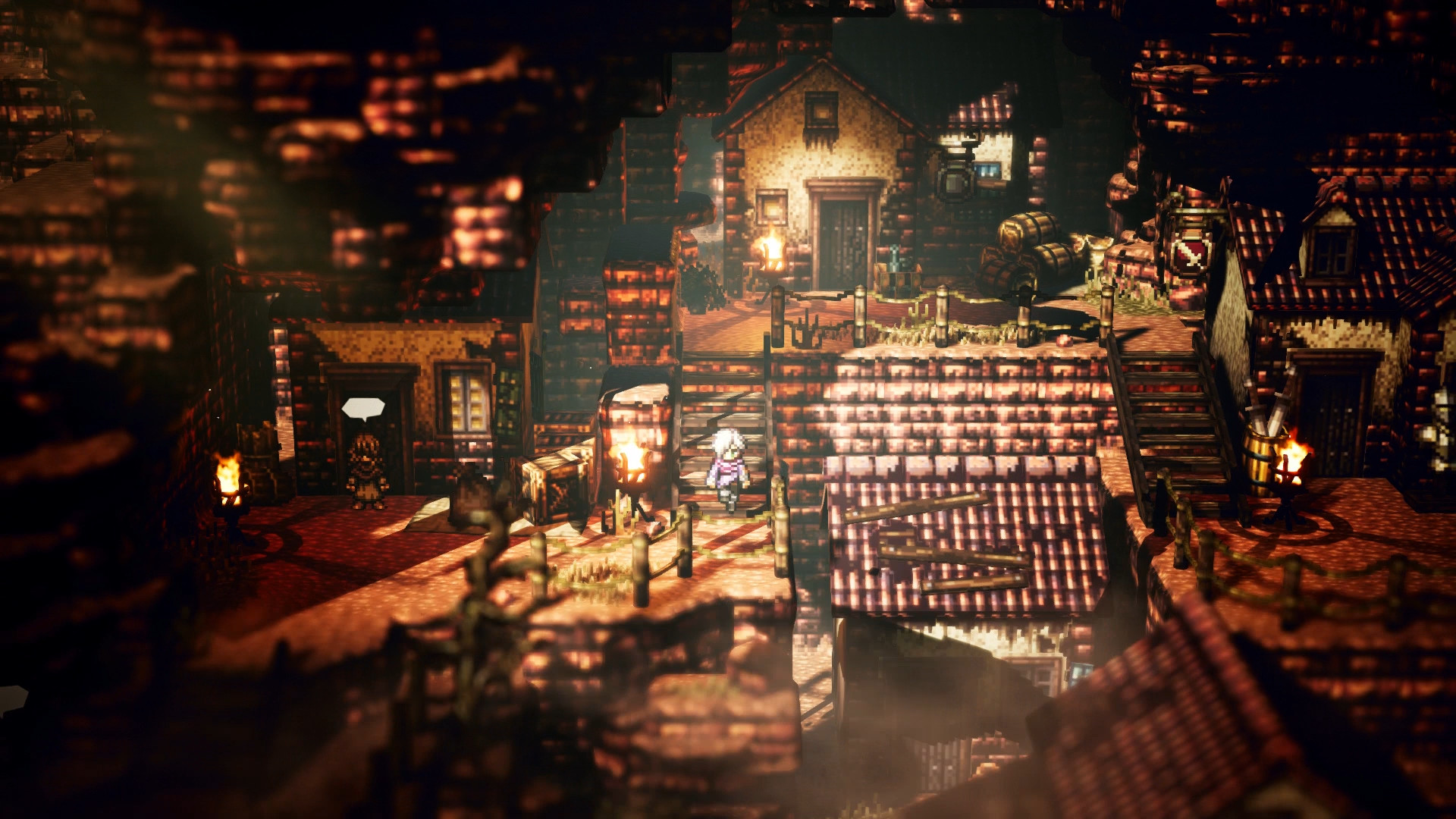
Octopath Traveler's visual style also makes its older role-playing structure legible in a new form. Small, expressive sprite characters occupy environments with three-dimensional depth, lighting and effects. A stone square, an evening town or a distant mountain can retain the clear silhouettes of pixel art while light and perspective give the place a different sense of scale. The journey moves between character-led chapters, exploration, resident encounters and set-piece fights rather than staying in one mode for hours at a time. This page concerns the original Octopath Traveler, first released on Nintendo Switch in 2018 and later brought to PC and other platforms. It is not Octopath Traveler II, with its different cast, nor Octopath Traveler 0. The core invitation remains the same regardless of where you play this original adventure: choose one person's beginning, meet the other seven on the roads of Orsterra, and decide how their distinct stories and abilities will travel together.
- Developer
- Square Enix and ACQUIRE Corp. (PC listing)
- Genre
- Turn-based role-playing game