
About OCTOPATH TRAVELER II
In Solistia, eight travelers begin separate journeys across two continents divided by the sea. Choose one to start, meet the others, and pursue their goals through towns, roads and waterways. Day and night change Path Actions, while turn-based battles hinge on exposing enemy weaknesses, breaking shields and timing boosts and Latent Powers.
OCTOPATH TRAVELER II is a standalone role-playing game set in Solistia, a world split into eastern and western continents by an ocean. Its bustling era brings large ships along established sea routes and new steam-powered technology, while prosperity and hardship coexist: entertainers attract crowds as war, plague and poverty affect others. The story follows eight travelers from different regions, each with a personal reason to set out. Hikari is a prince seeking a path to peace after a coup sends his kingdom toward war. Agnea is a village dancer who wants to bring joy to a wider audience. Merchant Partitio hopes to relieve poverty after seeing his hometown decline. Scholar Osvald escapes imprisonment after being framed for the deaths of his wife and child, seeking the person responsible. Throné, a thief in a guild marked by crime and death, wants to free herself from its leaders. Temenos is an inquisitor whose investigation into a tragedy at his church changes his life. Hunter Ochette seeks three Creatures of Legend to prevent a catastrophe, while Castti, an amnesiac apothecary found adrift at sea, sets out to recover her identity. The stories begin separately, so the player chooses an opening traveler and gradually encounters the others rather than starting with a fixed ensemble.
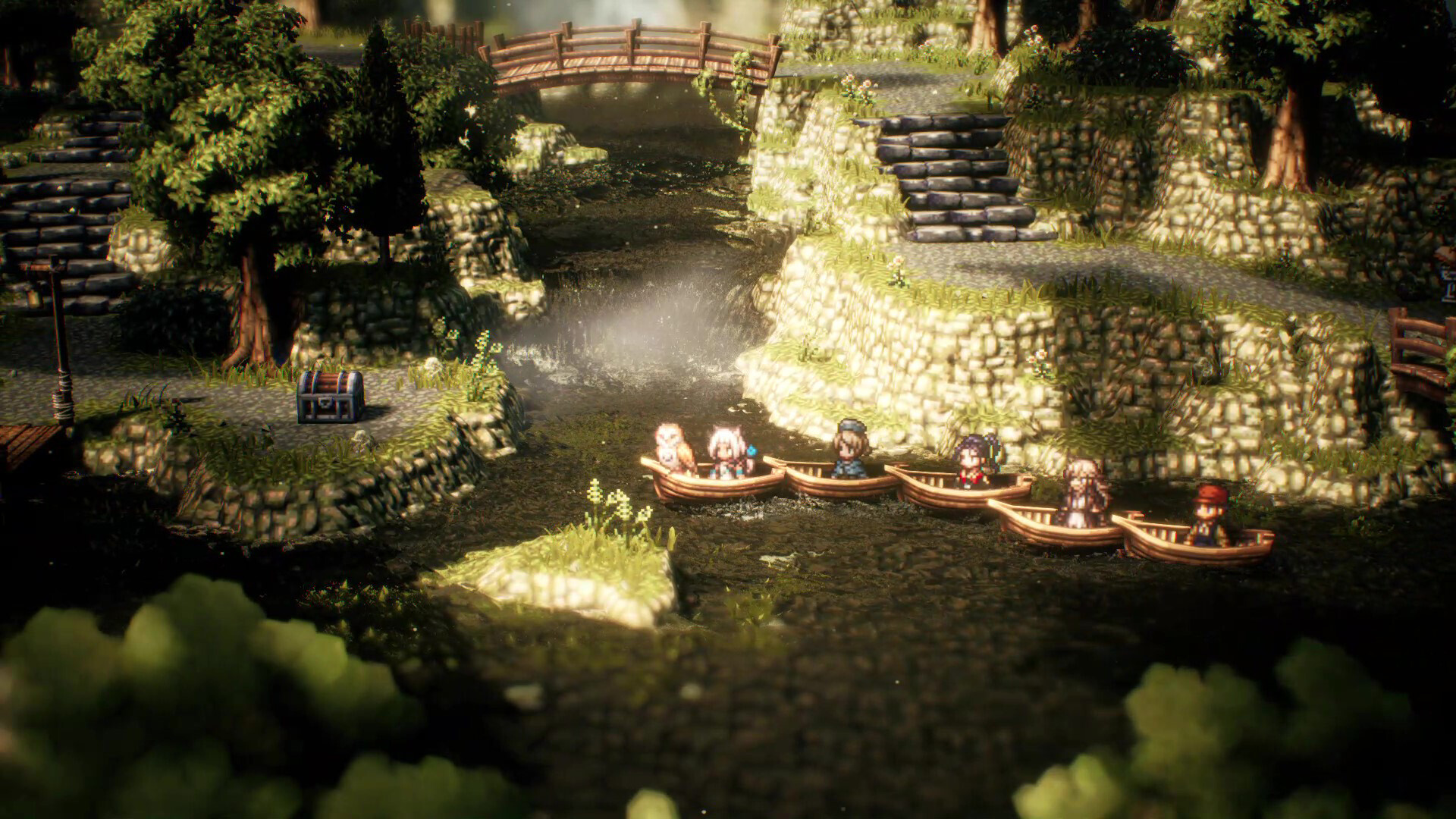
Travel joins these individual routes into an expansive map. Solistia’s two continents are separated by navigable water, and a boat lets the party move between them; Acquire’s developers describe the world as larger in scale than the first game, with more transportation and rewards for exploring each map. On foot, ladders, canoes and boats create different ways through the landscape, while railways and steam trains signal the setting’s advancing technology. Towns, fields, dungeons and coastlines occupy a fixed-camera 2.5D world, with the developers designing a single screen to show points of interest the player may want to reach. The day-night cycle changes what happens in those settlements: non-player characters follow different movement patterns, and travelers have separate daytime and nighttime Path Actions. This makes exploration a sequence of observations and choices, not only movement toward the next story marker. A person blocking a door, an item held by a local, or a character who may know something can be approached in different ways depending on the traveler and the time. The cycle also affects presentation, with distinct lighting and music themes reinforcing the shift in time across each area.
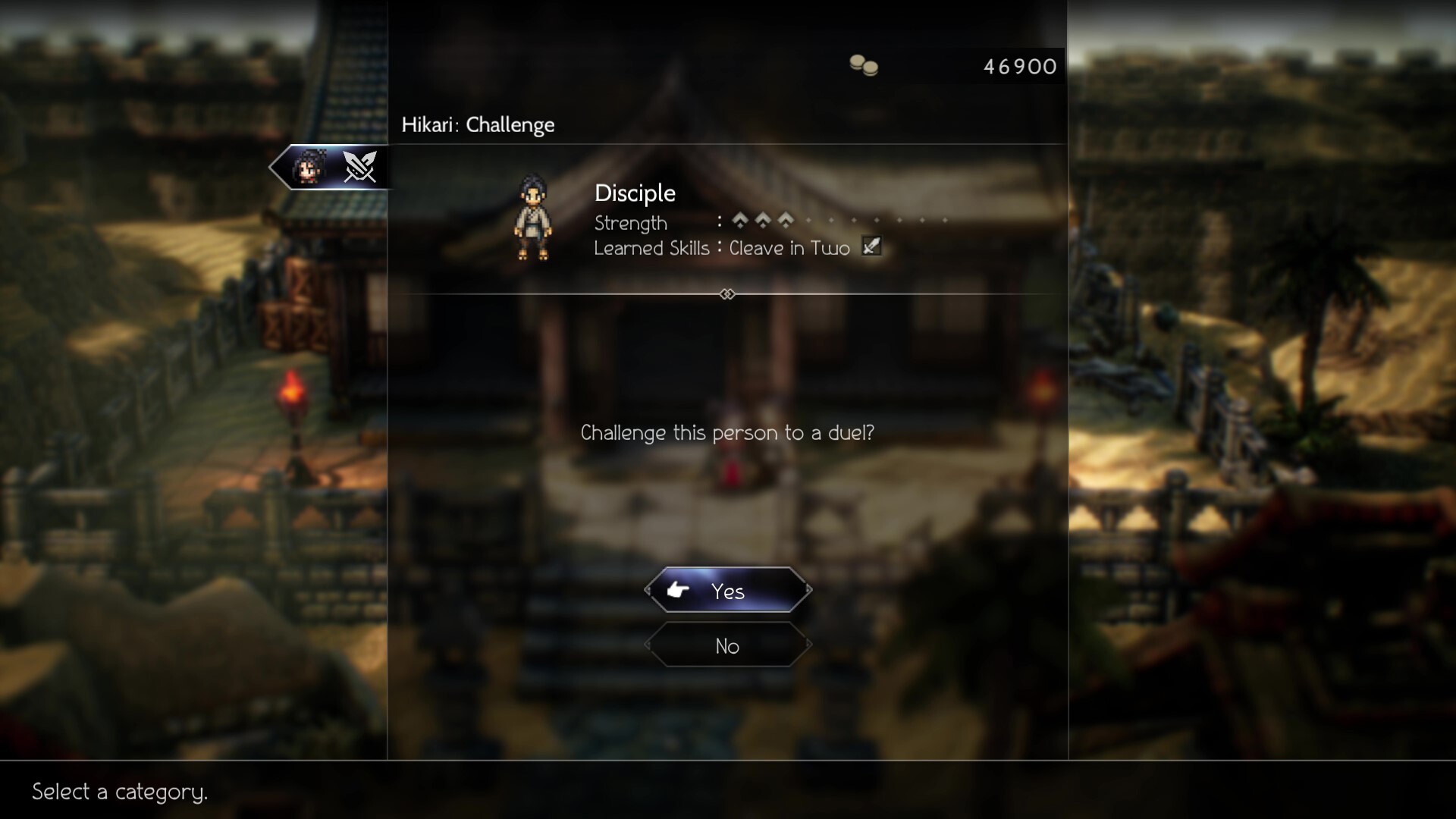
Each traveler brings a different personal goal and a pair of Path Actions that let them engage with people outside battle. These abilities can provide information, recruit or summon help, acquire objects, challenge characters, or otherwise affect the town; which option is available depends on the character and whether it is day or night. Partitio can pay for an item during the day, while Osvald can mug its owner at night, offering different routes to a similar outcome. The actions connect exploration with the travelers’ identities and can change how the player deals with a local obstacle. They are not simply dialogue choices: some directly test the party’s strength or resourcefulness. The developers cite Hikari’s Challenge, which lets the Warrior learn skills from defeated opponents, and Agnea’s Dance Session, which can follow a successful Allure action and bring an NPC into combat. Some actions may require money or depend on a contest, so choosing a traveler can alter the cost or method of an interaction. Cross Stories add another layer to the ensemble: paired travelers share events that reveal sides of their characters beyond their separate main chapters, and Travel Banter continues to provide conversations during the journey. These interactions help the eight routes feel connected while preserving their distinct starting motivations.
Battles use turn-based commands and Break and Boost tactics. Enemies have Shield Points that fall when the party hits their weaknesses; reducing the total to zero breaks and stuns the target for a turn, leaving it exposed to critical damage. The player must identify which weapons or magic exploit the enemy, then decide whether to spend turns lowering defenses or protect the party until an opening appears. Boost Points arrive during combat and can be spent to repeat basic attacks, strengthen attacks or empower other actions, so saving a point can be as consequential as spending it immediately. The system rewards coordinating the travelers’ skills: one character may expose weaknesses, another can exploit the resulting opening, and a third can use the window to deliver a high-cost technique. Latent Powers provide a further, character-specific option. Their gauge fills during battle, and every traveler has a different special ability that can turn a difficult exchange around. Rather than being interchangeable super attacks, these powers reflect the cast’s different identities and encourage the player to consider timing. The battle system therefore links enemy observation, turn order, resource conservation and party composition. Against a powerful foe, the player can build toward a break, save Boost Points, then combine the exposed turn with a traveler’s Latent Power.
Progression expands the travelers through a job system that changes their available weapons, skills and tactical role. Each character starts with a primary job and can combine it with a secondary job as the journey advances. Guilds across Solistia grant licenses for basic secondary jobs; completing a guild’s requests can earn up to three licenses for the same job, allowing it to be shared among multiple travelers. Some guilds are visible in towns while others are hidden in the world, making exploration relevant to party development. Special jobs work differently: a character needs a specific proof item, and only one traveler can use each of these powerful jobs at a time. Skills learned from jobs can also unlock support skills. A traveler can equip up to four support skills, which trigger automatically and can be combined across jobs to reinforce a preferred build. For example, a secondary job can expand the weapons a character can use, making it easier to target more enemy weaknesses and break shields. The system lets the player broaden a traveler’s strengths or cover a weakness, while guild licenses and one-user special jobs create decisions about which party members receive a role.
The presentation combines pixel-art characters with three-dimensional environments and effects, a visual approach Square Enix calls HD-2D. The map art uses high-resolution scenery, dynamic day-and-night lighting, and more active camera movement during battles and story scenes; during travel, the camera holds a location in frame while its depth and light change around the characters. The sound and musical identity also follows the cycle of time, with day and night themes for areas. The Steam edition lists English and Japanese full audio, with interface and subtitle support across nine languages. Guild requests therefore connect exploration with combat planning: licenses widen weapon access, making it easier to cover weaknesses and break enemy shields. Support skills learned across jobs can reinforce a build even when the character’s active secondary job changes. The three-hour prologue demo lets players start with any of the eight travelers, carries save data into the full game, and restricts travel beyond the starting areas. In the complete adventure, the sea, roads and railways link far-flung locations as the characters pursue their separate aims and encounter one another along the way.
- Developer
- Square Enix and ACQUIRE Corp.
- Genre
- Role-playing game