
About OCTOPATH TRAVELER 0
In Orsterra, a customizable hero survives the destruction of Wishvale and sets out against the three Masters tied to the tragedy. Travel between towns, use Path Actions, recruit allies and rebuild a home base. Turn-based battles use Break and Boost, transferable skills and a party of up to eight.
OCTOPATH TRAVELER 0 begins in Wishvale, the protagonist’s home, during its annual Sacred Flame Festival. As the community gathers to light the blue flame associated with peace, the town is attacked and consumed by fire. The player creates the central hero, choosing details such as appearance, voice, hair, mannerisms and favorite food, then follows a journey shaped by both retaliation and recovery. The destruction gives the story a personal starting point, while the wider setting is Orsterra, a continent with towns, roads, dungeons and people whose lives are affected by the power struggles surrounding the divine rings. The premise links the hero’s private loss to a larger conflict without making the player one of eight separate protagonists.
The first major thread follows three Masters whose influence reaches into different communities. Herminia, the Master of Wealth, controls immense riches and is associated with Valore; information about a ring connects her to the chain of events behind Wishvale’s destruction. Tytos, the Master of Power, rules Emberglow by force and is identified as the person who burned the hero’s home. Auguste, the Master of Fame, is a celebrated playwright in Theatropolis whose interest in art turns horrifying when he treats the people fleeing the attack as material for his work. These antagonists give the early conflict distinct social settings: wealth, coercive authority and public acclaim each shape how power is exercised. The journey is therefore about confronting people who have made their influence part of everyday life, not simply tracking an abstract enemy across a map.
Travel connects those story chapters through familiar role-playing activities. The hero crosses Orsterra, visits settlements, speaks with residents, follows quests, explores dungeons and fights groups of enemies along the way. Towns are useful places to gather information and discover potential allies, while their inhabitants also become possible targets for the protagonist’s field commands. The chapter structure centres on named antagonists, so each stretch of the journey brings the wider revenge-and-restoration premise into a particular location and set of people. The HD-2D presentation combines pixel-art characters with three-dimensional scenery, giving roads, buildings and battle spaces layered depth. Exploration is not limited to moving toward the next story marker: talking to people and examining what they can offer creates practical choices about who joins the settlement, what items can be obtained and which encounters are worth pursuing.
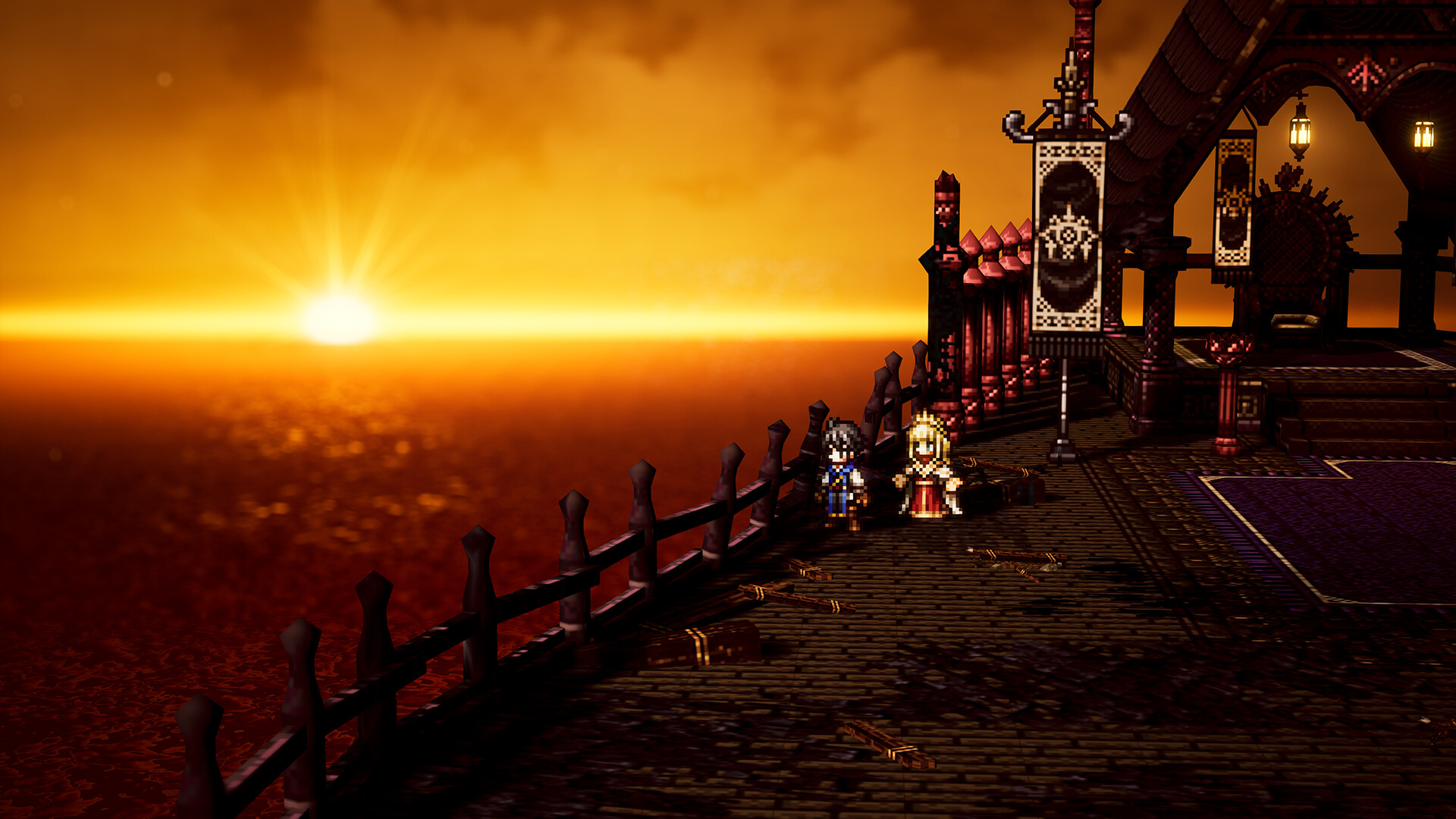
Path Actions make conversations into decisions with concrete outcomes. Depending on the person and situation, the protagonist can obtain items, challenge townspeople to battle or invite someone to move to Wishvale. The action system supports different approaches to the same inhabited world: residents are not only quest-givers, because an encounter may also provide supplies, a fight or a new community member. These commands connect town visits to the restoration system, since recruiting people can strengthen Wishvale and bring their abilities into the settlement. Residents have town abilities of their own, which makes the choice of whom to bring home meaningful beyond filling empty streets. A traveller might visit a town for the next story chapter, then spend more time speaking with its people to find someone or something useful for the rebuilding effort. The journey across Orsterra and the work at Wishvale are linked through those meetings.
Combat uses turn-based command battles built around Break and Boost. Enemies have shield points and vulnerabilities; striking a weakness reduces those points, and breaking an enemy temporarily prevents it from acting while lowering its defence. That window gives the party time to concentrate attacks or recover before the foe can respond. Boost Points accumulate over turns and can strengthen an action, adding hits or power to attacks and improving healing or support effects. The party can draw from more than thirty allies, with up to eight arranged across front and back rows. Members can switch places as turns unfold, so the active line can answer an immediate threat while reserves remain available. The protagonist can eventually choose from eight jobs with different weapons and techniques. Special moves add another resource to manage, with a gauge that can be charged for stronger effects. Skills and roles differ among allies, making the roster useful for matching weaknesses and balancing damage, recovery and support rather than relying on a single fixed quartet.
Wishvale’s reconstruction gives the journey a second kind of progression. The player restores the damaged hometown by placing buildings and welcoming companions and people met on the road to live there. Residents contribute individual abilities, and facilities turn the settlement into a working base: a field or ranch can support materials and harvests, a shop can offer goods whose selection grows with information gathered elsewhere, and cooking provides prepared food for the road. The training facility links the town directly to character development. Select Abilities are learned as transferable skills, and training lets one ally master an ability so another can equip it. Alongside the story’s travel and battles, this creates a repeated connection between exploration, recruitment and rebuilding: people found across Orsterra can become part of the home the protagonist is trying to restore, while its facilities support the party’s next departure.
- Developer
- Square Enix and DOKIDOKI GROOVE WORKS
- Genre
- Single-player HD-2D turn-based RPG