
About Observer: System Redux
Observer: System Redux casts neural detective Daniel Lazarski into a cyberpunk Kraków in 2084. Investigate a murder case with augmented vision, interview residents, and use the Dream Eater to enter damaged memories, while expanded side cases and rebuilt presentation deepen the original game’s world.
Observer: System Redux is a first-person cyberpunk horror detective story set in Kraków in 2084. You play Daniel Lazarski, an elite investigator known as an Observer, whose case takes him into a decaying apartment block. The city sits in the aftermath of the Nanophage, a digital plague that killed many people who had augmented their minds and bodies, and a war that left East and West shattered. Corporations have filled the power vacuum, while ordinary residents try to escape through virtual reality, drugs, and neural implants. The case begins as an investigation into a mysterious killer, but the world around Daniel makes every search feel like a meeting with the systems that govern its people. His work relies on technology that can expose evidence and violate the privacy of a person’s inner life.
The apartment building gives the investigation a compressed, lived-in setting. Daniel moves through corridors and rooms, examining crime scenes and piecing together what has happened from objects, electronic traces, and biological evidence. The tenants are not simply sources of case information: their conversations and private circumstances show different ways people endure the city’s conditions. Computers and other interactive objects can provide additional context, while access codes and environmental puzzles turn close inspection into practical problem-solving. The spaces connect a personal case to a wider social picture without requiring a tour of the whole city. Much of the story’s texture comes from this contrast between the building’s ordinary routines and the intimate, sometimes disturbing information available to an Observer. Daniel’s investigation repeatedly asks where inquiry ends and intrusion begins.
Daniel’s augmented vision gives field investigation two distinct scanning modes. Electromagnetic Vision helps locate electronic devices, while Bio Vision highlights organic material such as tissue, hair, or blood. Switching between them lets the player search a room for different kinds of evidence and inspect details that are not immediately visible. A clue may be technological, biological, or part of the room’s ordinary contents, so scanning is paired with looking closely and interacting with objects. The game’s crime-scene work is local and deliberate: move through a compact space, examine what stands out, and connect findings to the case rather than relying on a single combat tool. That detective routine gives Daniel a role beyond simply walking through the setting, and it establishes the contrast with the far stranger investigations that follow when he uses his neural equipment.
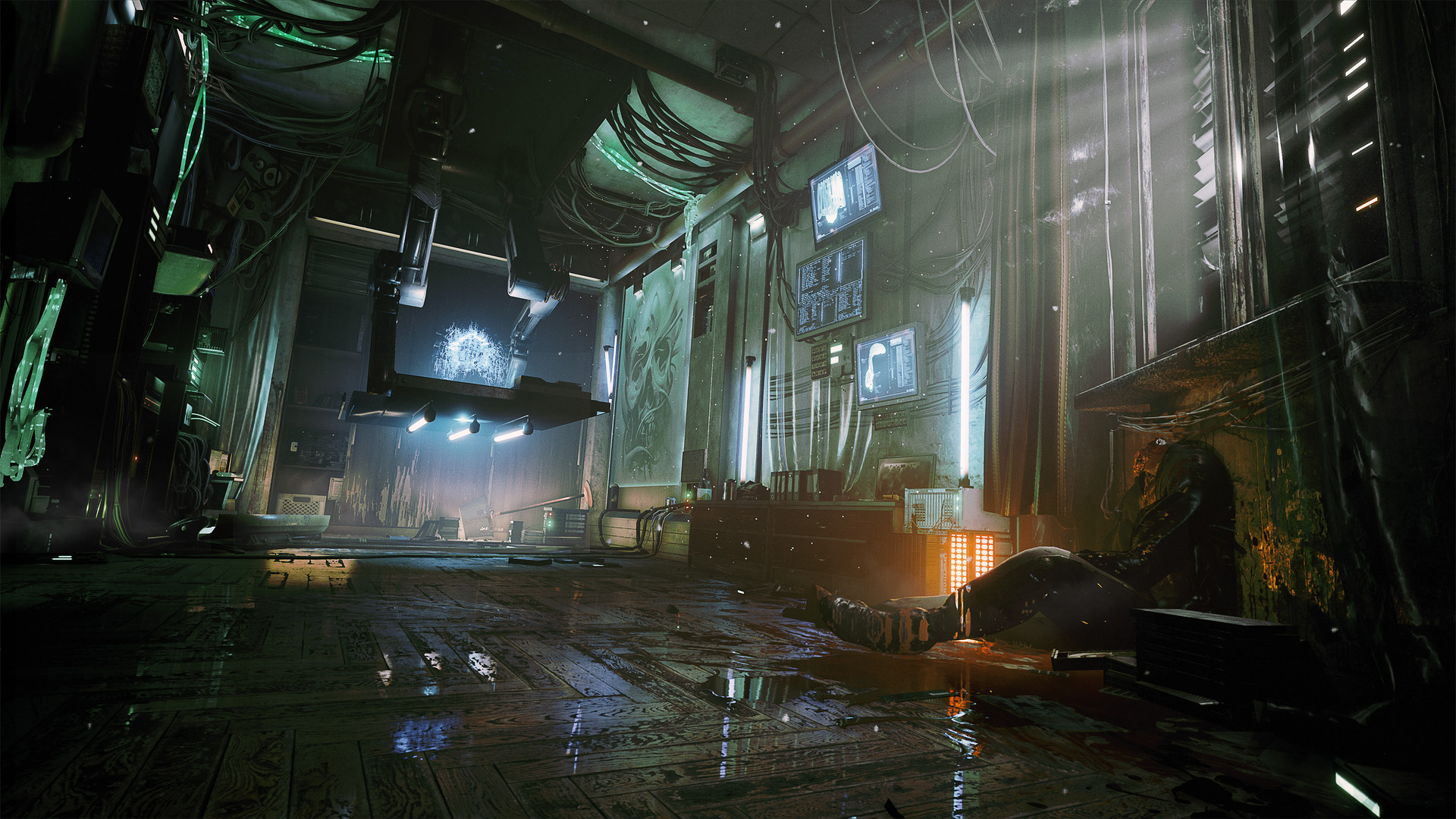
The Dream Eater is an Observer’s device for connecting to a person’s neural implant and investigating memories. With the dead and dying, Daniel can relive fragments of their final moments, exploring distorted mental spaces shaped by fears and obsessions. These dives present evidence through imagery and spatial changes rather than a straightforward interview: the player moves through a memory, follows what it reveals, and searches for clues that can help solve the case. The experience carries a personal cost in the fiction, since deeper entry risks Daniel’s sanity and can bring the subject’s troubled thoughts into his own consciousness. The device turns interrogation into a different kind of investigation, one where memories are both useful evidence and an unstable environment. Each dive changes the visual language and pace of the detective work while adding new clues to the case.
Neural investigations sit alongside conversations and other evidence gathering. Daniel speaks with residents whose accounts, silences, and personal circumstances help fill in what the physical clues cannot explain. The player can read records and messages on computers, inspect the environment, and work through interactions that connect one discovery to another. These activities keep the main case grounded in a particular building even as its dream sequences move through stranger spaces. The distinction matters: a biological trace or an electronic device offers something concrete to examine, while a memory dive may communicate through metaphor, fear, or a distorted recollection. Daniel’s job is to bring those different kinds of evidence together. The story’s questions about truth and personal boundaries emerge from the methods of investigation themselves, not only from the crimes he is asked to solve.
System Redux expands the game with three additional side cases: “Errant Signal,” “Her Fearful Symmetry,” and “It Runs in the Family.” They add investigations that explore other aspects of the dystopian setting and the people living in it. The edition also includes expanded gameplay, new mechanics and secrets, redesigned stealth, additional neural interrogations, and quality-of-life changes. These additions belong to the System Redux edition, widening the view of the world Daniel works within while keeping the main story at the center. The revised presentation also updates textures, animation, models, effects, lighting, and post-processing, supporting the return to Kraków’s densely layered interiors and the unsettling visual shifts of neural sequences. The new cases add more people and situations to investigate without changing Daniel’s essential role as a detective searching for evidence.

The city’s material details give those investigations a social frame. Residents inhabit a world where augmentation has become both a means of coping and a source of vulnerability, while corporations hold power after public institutions have been weakened. Some people retreat into virtual realities or mind-altering substances; others live with implants that expose their memories to an Observer’s scrutiny. Daniel is therefore both investigator and instrument of a system that can use private thoughts as evidence. The case asks what can be learned by entering another person’s mind, but also what such access costs the subject and the person doing the looking. System Redux develops that premise through environmental investigation, conversations, and surreal memory spaces, keeping the detective procedure tied to questions of identity, authority, and privacy.
- Developer
- Bloober Team
- Genre
- First-person cyberpunk horror detective adventure