
About Observation
After a blackout leaves the Observation space station damaged and its crew missing, station AI S.A.M. works with Dr. Emma Fisher to uncover what happened. This science-fiction thriller uses S.A.M.’s cameras, station controls, environmental puzzles and remote movement to investigate an unexplained crisis and questions about the AI’s own identity.
Observation places the player inside a low-orbit space station as S.A.M., its artificial intelligence, after an unexplained event knocks systems offline. Dr. Emma Fisher is the only crew member S.A.M. can find. The two depend on one another: Emma can move through the station, while S.A.M. can see through its cameras, operate connected equipment and restore parts of the facility. Their immediate work is practical—recover power, open routes and determine what has happened to the mission—but the mystery grows beyond a damaged station. The crew has vanished, the station is far from where it should be, and S.A.M. begins to question its own state and role. The story keeps its focus on the uneasy partnership between a human astronaut who can enter the rooms and a machine that can watch from many angles yet depends on her to reach what lies beyond its controls. The title refers both to the station and to the act of watching from within it.
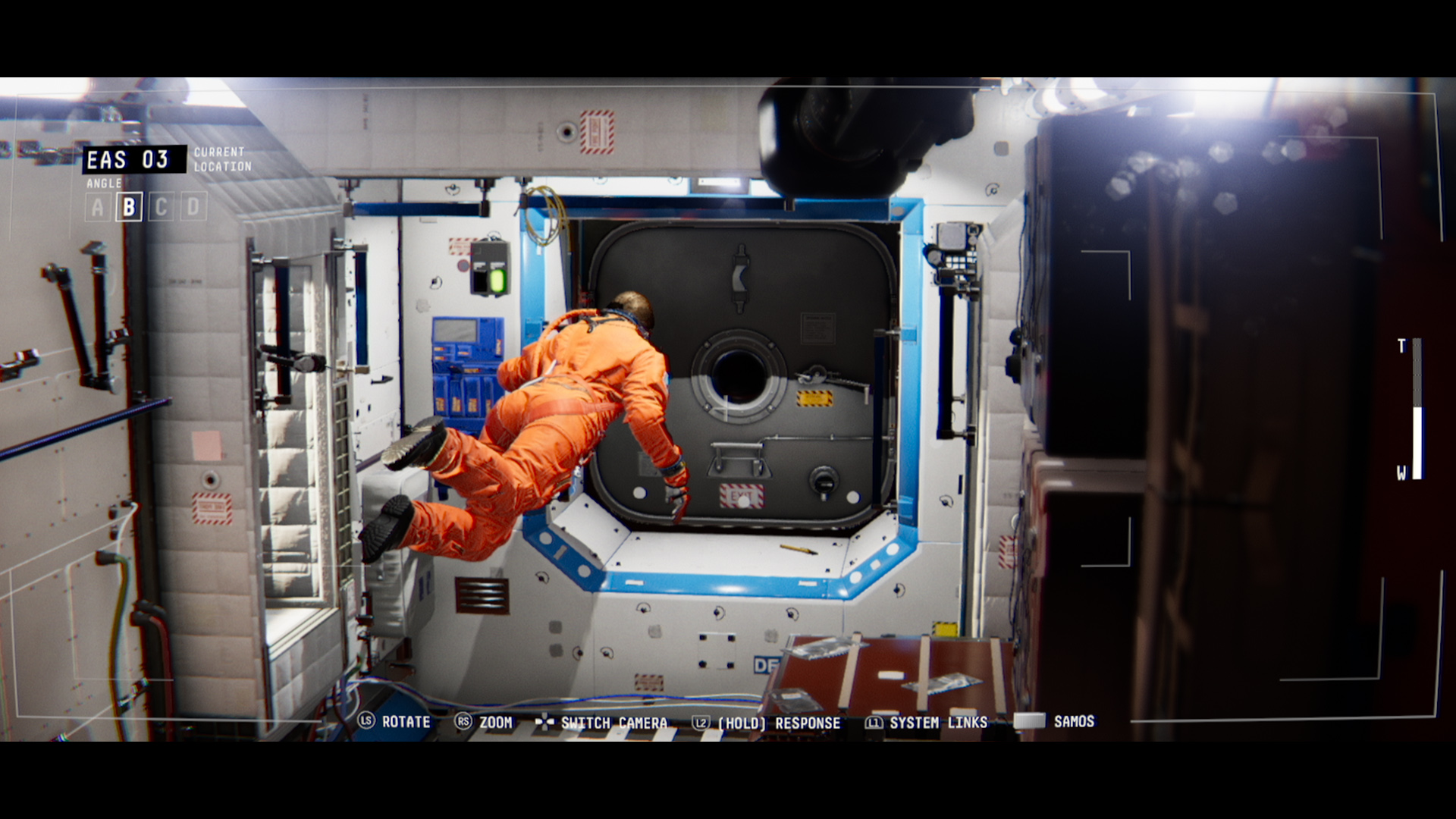
The station is explored through a deliberately restricted point of view. S.A.M. cycles among fixed camera feeds distributed across rooms and corridors, with each view showing only a slice of the environment. The player scans these views, tracks Emma and looks for details that may matter to the current problem. This creates a different kind of navigation from directly steering a human character: rooms are reached by switching cameras and following the station’s network, while Emma supplies movement through the physical space. A feed may reveal an object, a damaged panel or a route that is hidden from another angle. Camera changes also shape how the player reads the station, because blind spots and incomplete views are part of the investigation rather than a temporary inconvenience. S.A.M. can move between connected cameras, monitor Emma’s progress and use those viewpoints to guide her. Individual feeds can make the same room feel different as Emma crosses its frame or a system changes status. The player’s attention moves across the station’s systems as much as across its floor plan.
S.A.M.’s interface links observation to action. The station’s control systems expose functions such as doors, hatches, power and communications, and using them can help Emma proceed through a blocked or unsafe area. Restoring a connection or activating a device is not simply a menu task: it asks the player to notice what is offline, select the relevant system and work out how its controls fit together. Some challenges present a panel or interface with symbols, sequences or other information to interpret. Others require looking across camera feeds, checking the state of nearby equipment and connecting what is visible to the request at hand. The game places these operations within the fiction of an AI managing a real station, so menus and diagnostic displays act as S.A.M.’s working environment. They also provide clues about what the station can still do and what has failed. The puzzles therefore grow from the same tools used to watch and assist Emma, rather than appearing as an unrelated set of abstract rooms.
When the fixed cameras cannot reach a useful angle, S.A.M. can take control of a small spherical maintenance drone and pilot it through station modules. The drone gives the player direct movement through three-dimensional spaces, including areas where Emma is absent or a camera is poorly placed. It can inspect objects from nearby, pass through gaps and interact with points that a stationary feed cannot reach. The change in control is important: the usual view is a network of mounted cameras, while the sphere offers free movement and a close look at the station’s surfaces. Puzzles may ask the player to move between these forms of access, using a camera to understand a room and the drone to reach a control or examine a detail. This is the game’s main active traversal system; it remains tied to inspection and problem-solving rather than becoming a combat vehicle or general-purpose character. Emma’s own movement occurs as part of the unfolding scenes, while the player’s direct navigation is through S.A.M.’s cameras and drone.
Progress follows the recovery of station functions and the investigation of the crisis. As S.A.M. and Emma gain access to more of the facility, new rooms, systems and information become available, letting the pair pursue the next question. The structure is narrative and puzzle-led: solutions open a route or reveal a piece of the situation, rather than awarding experience points, equipment builds or a branching skill tree. The interface also gives S.A.M. several ways to act—camera selection, system controls, communication and drone piloting—and the situation determines which is useful. Emma’s requests and observations help direct attention, but the player still has to interpret the available views and systems. Returning to the control interface can mean checking a subsystem, searching another camera or sending a command. These repeated actions create a steady investigative rhythm in which the station itself is both the place being explored and the set of tools used to explore it. There is no conventional combat progression; tension comes from uncertainty, limited information and the consequences of keeping a damaged station operating.
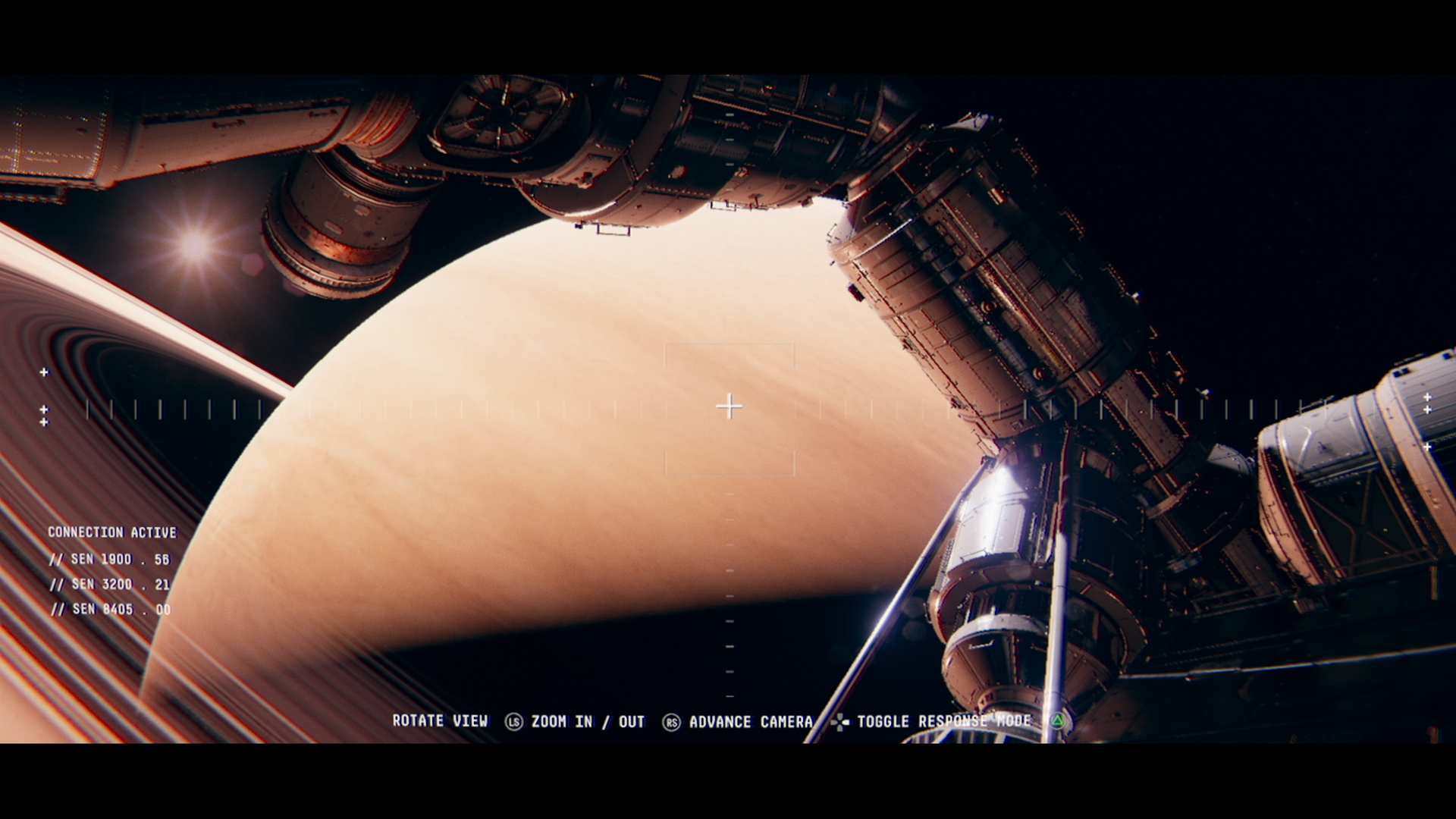
Observation presents the facility as a working habitat, with narrow modules, storage areas, equipment bays and connected passages built around the needs of a small crew. Details in the rooms and the control displays give a sense of how people lived and worked there before the blackout. S.A.M.’s camera network shapes the visual style: fixed, security-camera-like framing, data overlays and stripped-back interfaces make the player feel located within the station’s systems. The drone’s viewpoint adds a contrasting close-range perspective, but the main camera feeds preserve the sense that S.A.M. watches from particular installed positions. This visual language also helps the story control what the player knows. A room may be visible without being fully understood, and the player has to compare viewpoints and system readouts to build a clearer picture. The station’s grounded technology and familiar equipment keep the setting legible even as the mystery moves into stranger territory. Small differences between a darkened module, a lit control surface and a system readout help the player track which parts of the station have recovered. The game is a single-player narrative adventure with exploration and puzzles, and it contains no player-versus-environment combat loop or character build system.
Observation was created by the studio then called No Code, now credited as Screen Burn on Steam, and published by Devolver Digital. Its central perspective gives the player access to the station without putting them in Emma’s suit: S.A.M. can watch a corridor and operate its systems, but it cannot know what an unseen crew member intended or what lies outside a camera’s frame. Emma supplies a human interpretation of the evidence and a body capable of acting in places S.A.M. cannot reach. That division gives even a practical instruction—open a hatch, restore a link, find a lost feed—narrative weight. Every recovered function makes the station more useful to Emma and reveals a little more of the event that disrupted it. The experience is available on PC, PlayStation 4 and Xbox One. Its mystery remains in the player’s hands through the changing relationship between observation, action and trust.
- Developer
- No Code (now listed as Screen Burn on Steam)
- Genre
- Single-player science-fiction narrative adventure with exploration and puzzles