
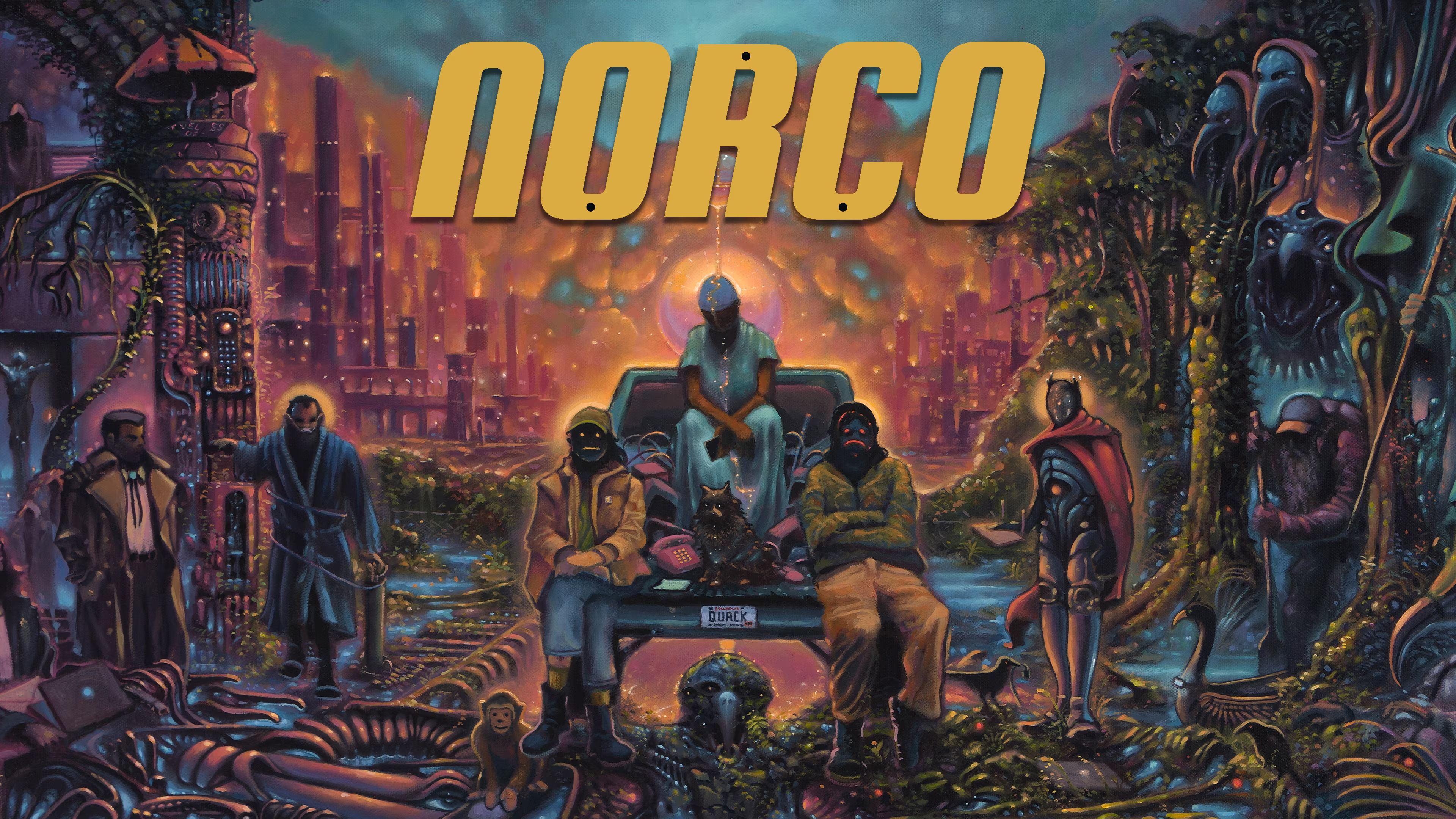
About NORCO
After returning to Norco following her mother’s death, Kay searches for her missing brother Blake across the industrial swamps and sinking suburbs of South Louisiana. This point-and-click adventure combines dialogue, environmental puzzles, character-led investigations, swamp travel and brief combat encounters in a near-future mystery shaped by the region’s landscapes and communities.
Kay’s return brings her into a landscape both recognizable and altered. The fictionalized South Louisiana draws on Norco and the Greater New Orleans area: refinery corridors, drainage ditches, strip malls, wetlands and neighborhoods pressed against industrial infrastructure. The opening mystery is personal—Kay has come home after her mother’s death and learns that Blake is missing—but following the trail takes her through a wider network of people and places. A fugitive security android, a local private investigator, a bayou pirate and figures connected to an abandoned mall’s online-minded youth group enter the investigation. Their roles are not simply a roster of helpers: each belongs to a different social corner of the region, and conversations with them reveal overlapping histories, loyalties and grievances. The story’s odd technologies and cult activity sit beside everyday concerns such as work, family, religion and environmental change. Rather than separating its speculative elements into a distant science-fiction world, NORCO places them among familiar businesses, roads and homes, making the search for Blake a way to move between intimate family questions and the unstable public world surrounding Kay.
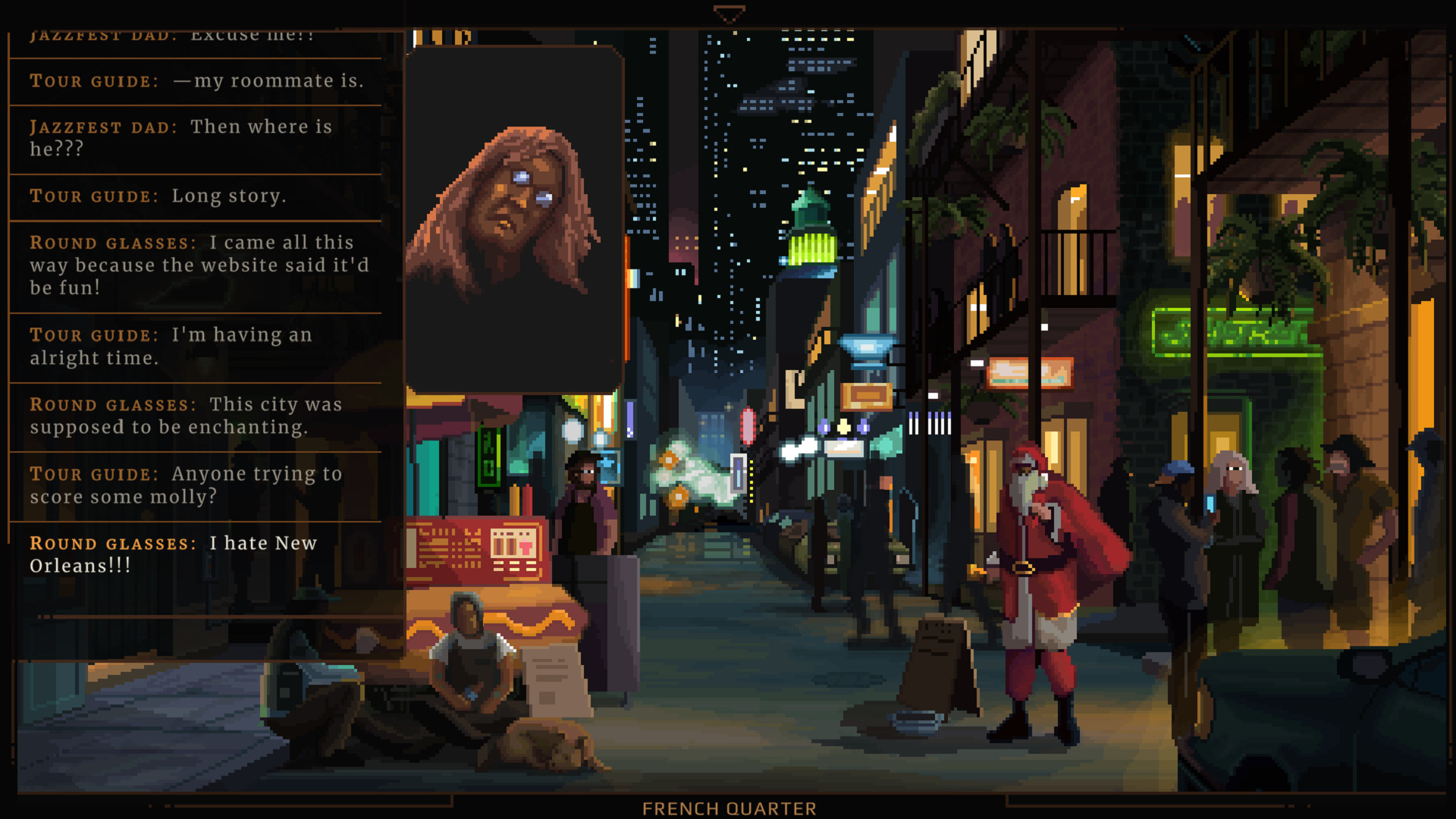
The main rhythm is that of a dialogue-focused point-and-click adventure. The player moves through illustrated scenes, examines objects, speaks with residents and follows leads that open further conversations or locations. Progress depends on paying attention to what people say and on noticing details in their surroundings; puzzles and quests punctuate the investigation rather than replacing it with a separate action loop. Some information is conveyed through the written scene-setting and exchanges between characters, so exploration means reading as well as clicking. The cast ranges from familiar community members to more eccentric figures, including an escaped corporate security machine and a self-styled detective who works from a bar. Their accounts can be partial or colored by their own interests, giving the player context without turning every conversation into a clear exposition dump. As the search moves between Norco, nearby suburbs and more unusual outposts, the locations function as social spaces: a conversation at a bar, an encounter near industrial property or a visit to a mall each places Kay among different groups with their own language and assumptions. The sequence of clues carries the mystery forward while keeping attention on the region and its inhabitants.
One of the investigation’s distinct character systems appears around the Garretts, the boys who gather at the abandoned Promenade Mall under the influence of Kenner John. Their section uses a Voice Memo mechanic: notes and recorded impressions become a way to engage with the group’s shifting identities and the performances they put on for one another. It turns listening into a player-facing activity, fitting the mall’s mixture of online posturing, peer loyalty and improvised community. The Garretts are not presented only as an obstacle or a faceless cult. Their arguments, habits and stated ambitions give the player material to interpret as Kay navigates their social world. The abandoned shopping complex itself supplies the setting for these interactions, with its corridors and vacant commercial spaces repurposed as a base. The broader search also brushes against an influencer-led belief system and an app-based alternate-reality game; in one sequence, Kay uses a phone to scan scenes for augmented-reality symbols. This changes the usual object-inspection routine by layering digital clues over the landscape. It is a self-contained investigative device within the larger point-and-click structure, connecting a contemporary interface to a group that builds its own mythology from fragments and shared speculation.
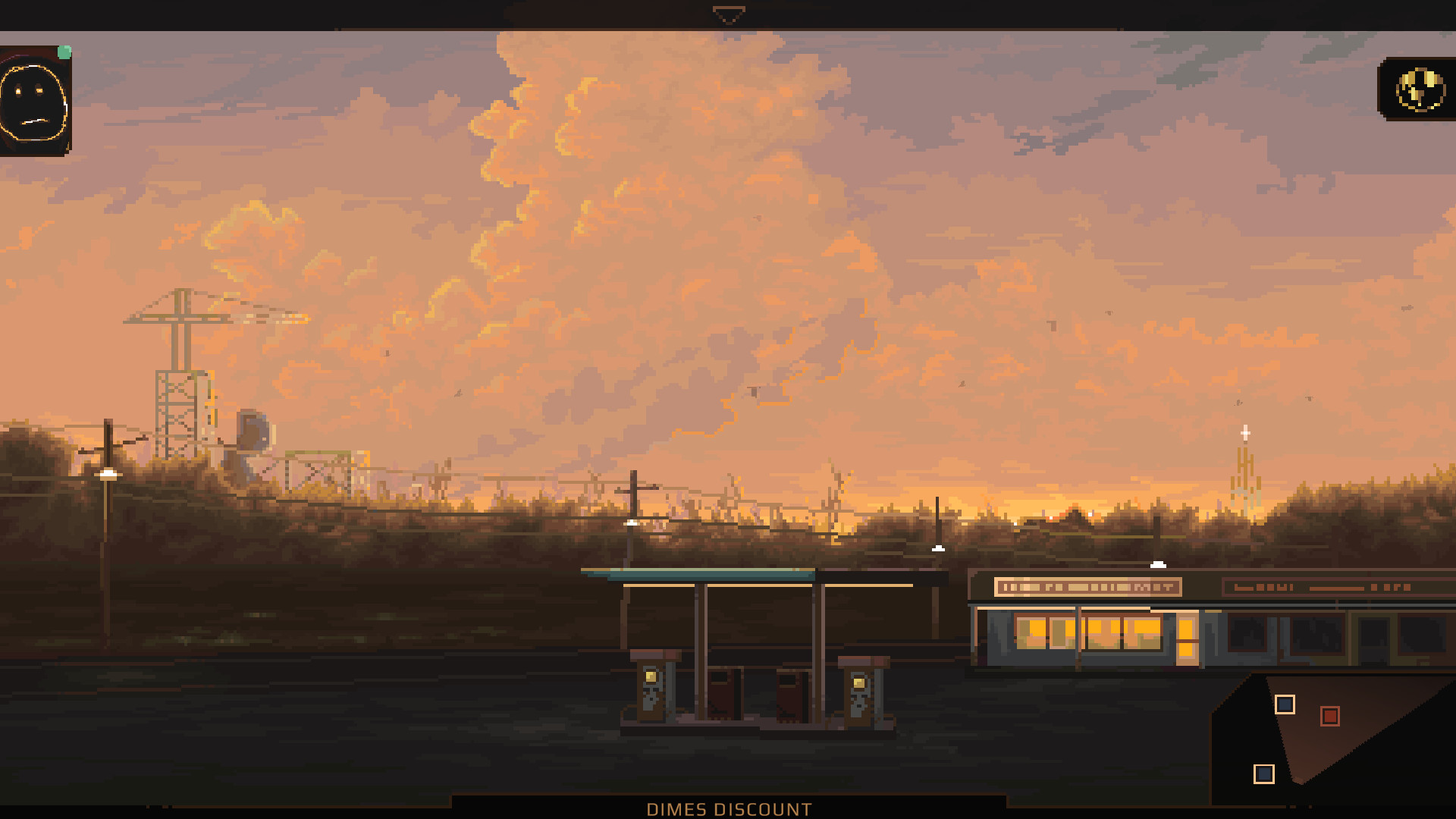
Not every stretch takes place in a fixed interior or street scene. The game includes travel through the swamp overworld, with diving moments connecting isolated parts of the region. These passages give the player a different scale of movement from examining a room: the route crosses water and vegetation, while the surrounding landscape becomes part of the journey rather than a painted backdrop between dialogue scenes. The timing of a dive matters during swamp travel, making movement through the wetlands an active part of exploration. Such travel sits within the adventure’s larger progression, linking locations and allowing the investigation to pass from settled neighborhoods toward less familiar terrain. The scenery keeps a recognizable local texture even when the story becomes uncanny: wetlands, birds, insects and industrial structures share the frame. The game’s treatment of the area as a lived environment matters to navigation because the town, refinery edges and marsh routes are connected parts of Kay’s home region. Exploration therefore alternates between deliberate inspection of individual scenes and movement through a broader overworld space, with the latter emphasizing how communities and industrial sites occupy the same vulnerable landscape.
Combat appears in short encounters rather than defining the game’s central activity. The player may have to fight corporate security goons, and these moments serve the narrative as much as they test combat skill. That framing fits its place among dialogue, puzzles and investigation: confrontations interrupt the search at particular points, but they do not turn the overall structure into an action game. A later official update added an Autocombat option through the Gameplay settings submenu. It automates combat encounters except for the optional Crouton encounter, allowing players to reduce direct involvement in these sequences while keeping the story moving. The same update added Expert Mode, which removes hint highlighting, several dialogue hints and signposting, and some visual cues that assist with puzzle solving. These options change how much assistance the interface provides without altering the central premise or introducing a separate campaign. The game also includes other brief interactive variations—such as the phone-based augmented-reality search—so its play shifts among conversation, scene inspection, puzzle-solving, travel and occasional conflict. Each mode remains tied to the characters and investigation rather than expanding into a broad combat or progression system.
Presentation is closely tied to the particular geography. NORCO uses detailed pixel-art scenes with a cinematic arrangement of foreground, buildings and distant refinery lights; the art draws on photographs and on-site observation of places around the developer’s Louisiana home region. Its palette and compositions move between inhabited interiors, roadside commerce, industrial structures and dense wetlands. Sound supplies another layer of place: the team describes using field recordings of marsh environments, native birds and insects, alongside a post-industrial electronic score by Gewgawly I and sound design by fmAura. This mixture keeps the extraordinary events rooted in an audible everyday environment. The writing likewise shifts between plain conversation, regional speech and descriptive passages that suggest what lies beyond the edge of a scene. Near-future devices and strange religious imagery appear against those grounded details, allowing the story’s mystery to remain tied to the material setting. The game was developed by Geography of Robots and published by Raw Fury. On Steam, the listed release is the single-player PC game for Windows and macOS; the store also lists an Act One Demo separately. NORCO has also been released for PlayStation 4 and PlayStation 5, with the console version described by its creator as including controller support, Expert Mode and Autocombat. This combination of fixed scenes and transitional journeys gives the adventure several ways to present evidence: a clue may be attached to a character account, an object in a room, a digital overlay or the changing terrain outside town. Together the fixed scenes and transitional journeys show a region in which family memory, commerce and industry occupy the same ground. A roadside store, an industrial canal and the swamp beyond it can each supply a different part of the story without becoming a disconnected chapter.
- Developer
- Geography of Robots
- Genre
- Dialogue-focused point-and-click narrative adventure