
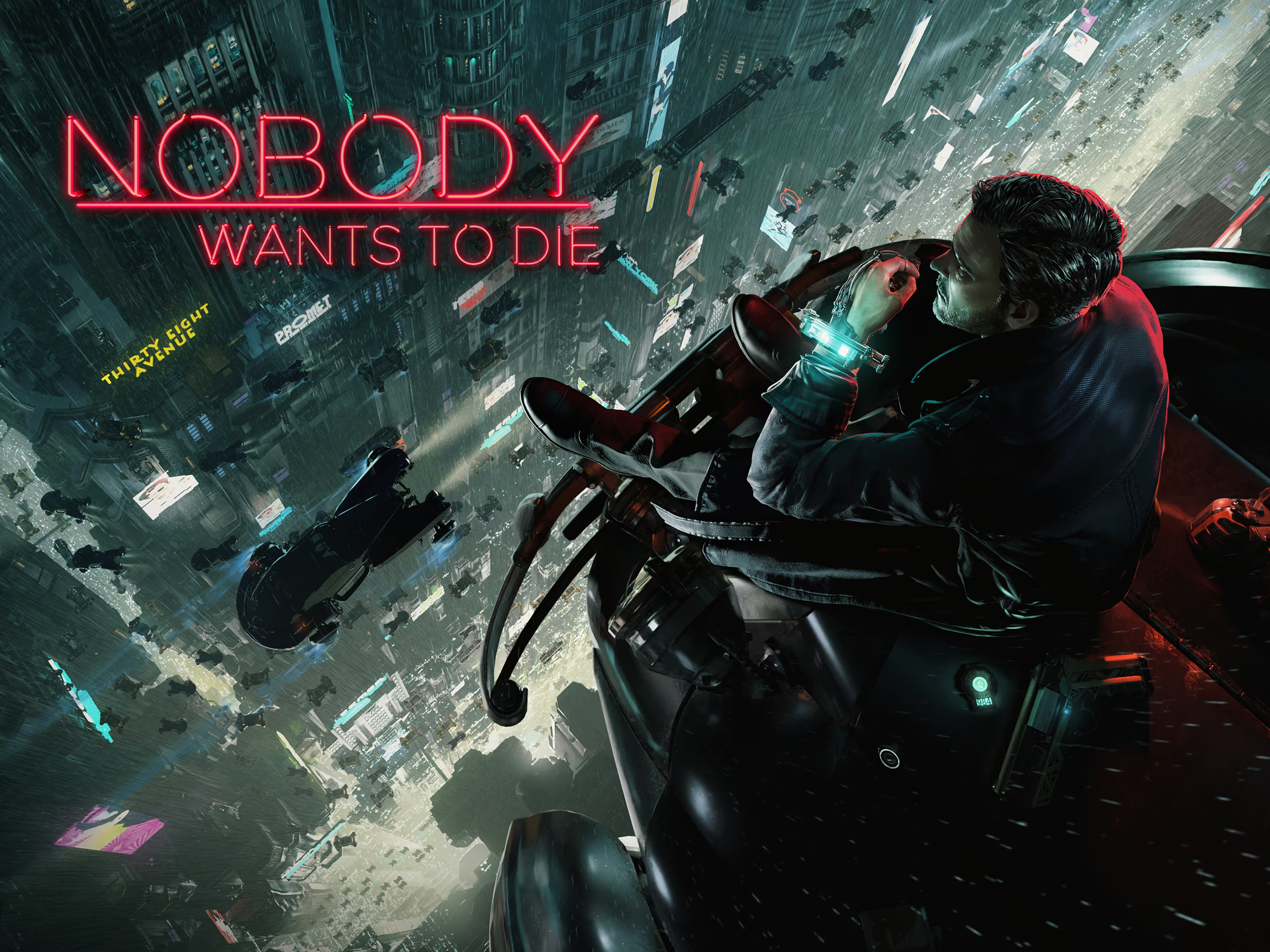
About Nobody Wants to Die
In 2329 New York, Detective James Karra investigates a series of murders targeting the city’s elite in a society where consciousness can be transferred between bodies. Working with liaison Sara Kai, he examines crime scenes with time-reconstruction technology and forensic tools while confronting choices about the case and the cost of immortality.
Nobody Wants to Die is a first-person, single-player detective adventure set in New York City in 2329. The city has made death conditional: people with enough money can preserve their consciousness in memory banks and transfer it into another body, extending life across decades or centuries. Access to that technology is tied to wealth, however, and the system shapes who controls a body and who can afford to continue living. When a person dies, continued existence depends on having the means to retain stored consciousness and obtain another body; immortality is therefore presented as an economic arrangement rather than a universal cure. The premise turns a familiar noir investigation into a look at a society where bodies, identity and mortality have become matters of administration and cost. The case at the centre of the game involves murders of prominent citizens, and the trail leads Detective James Karra into the power structure surrounding the city’s elite. The near-future setting is not an open-world city to roam: its social order is revealed through the investigation and the places Karra visits.
Karra is a Mortality Department detective who has recently survived a near-fatal accident and returns to work in a transferred body. His investigation begins with an off-the-books assignment from his chief: examine a death that appears to have been written off as an accident. The request gives the case an institutional dimension from the outset, since Karra is asked to look closely while keeping the inquiry unofficial. The official explanation and the requested private scrutiny pull in different directions, making the circumstances of the first death part of the investigation rather than mere background. His partner in the work is Sara Kai, a young police liaison who supports him remotely through a communications link. The two investigators therefore occupy different positions in the same inquiry: Karra enters the crime scenes and operates the equipment, while Kai stays in contact, discusses findings and helps him interpret what he encounters. Their exchanges provide a continuing line of dialogue while Karra is separated from her by the physical locations he examines. The game uses this partnership as its principal interpersonal frame for the case.
The player moves through discrete locations and examines staged crime scenes rather than freely traversing the whole city. Investigation is conducted at close range, with clues placed among objects, bodies and environmental details. A handheld X-ray device can reveal information inside or behind a target and help trace a projectile’s path, while a UV lamp exposes otherwise difficult-to-see blood traces. These tools make the scene legible in different ways: one provides a view through material, another distinguishes traces left on surfaces. They are used to inspect specific evidence, not as weapons or general-purpose combat abilities. Looking around and activating relevant objects builds a record of evidence that can be discussed with Kai and connected to the case. Movement serves this inspection loop, carrying Karra between points of interest and between set-piece locations as the narrative advances. The world’s wider skyline and traffic establish the scale of New York, but the playable investigation concentrates on interiors and authored locations. This keeps attention on what happened at each site and how it fits the developing sequence of murders.

The central investigative device is the Reconstructor, a wrist-mounted time-manipulation tool that lets Karra revisit a recorded moment at a crime scene. He can rewind or move through a reconstruction and pause it at a particular point, inspecting events as they unfold instead of relying only on the static aftermath. This creates a practical sequence of observation: use time to locate a moment, stop the reconstruction, then examine what is visible with the relevant forensic device. Some moments contain objects or actions that become useful evidence when viewed at the right time. This temporal view complements the X-ray and UV tools: the Reconstructor helps establish sequence, while the other devices examine physical traces within that sequence. It can expose how an object came to be positioned or how a fatal event progressed, giving context to what the remains alone show. The investigation often guides the player toward relevant time points and interactive clues, then asks them to inspect the scene and collect what can be learned from it. The main challenge is assembling a coherent account from these directed observations, rather than managing combat or survival resources. The gadgets provide ways to interpret evidence rather than a progression system built around skill upgrades or consumable resources.
Between crime-scene visits, Karra and Kai’s evidence can be brought together on an investigation board. Clues are arranged and linked to questions or deductions, creating a visual representation of how one observation relates to another. The board converts collected traces into case-level propositions: a clue from a reconstruction can be considered alongside a physical finding from the same or another scene. Completing a connection advances the inquiry and gives the pair material to discuss, so the board is both an organizational tool and a bridge from exploration to story. Dialogue also carries information that is not reducible to physical evidence: Kai’s conversations with Karra provide context, reactions and alternate exchanges as the case develops. The game’s forward movement is narrative-led, with investigation sections, conversations and transitions to new scenes forming a sequence rather than an open-ended city simulation. Each new development adds another reason to revisit the evidence in light of what the investigators have learned. The available descriptions identify no combat system; the player’s active work is examining evidence and making decisions in conversations and events. Progress is consequently tied to understanding the case and reaching the next story beat, not to building combat statistics or collecting equipment.
Choices give the investigation consequences beyond selecting which object to inspect. Dialogue options and major decisions can affect how events unfold, including choices about what to do with evidence and how Karra responds to people involved in the case. Some decisions occur under a timer, while others are framed as consequential moments in the inquiry. Smaller choices can change the available conversation, and more substantial ones steer the story in different directions. This gives the player a role in shaping Karra’s conduct even as the crime-scene investigation remains guided. The choices sit within a story that asks how legal and technological systems affect human judgement: a body can be transferred, stored or controlled, but that does not settle questions of culpability or grief. The narrative also follows personal threads alongside the murders: Karra’s memories of his wife and the trauma connected to her death intersect with his work, while Kai’s own experiences become part of the developing story. These threads make the case about more than identifying a perpetrator; it also concerns what immortality does to relationships and responsibility. Those later choices and revelations emerge as Karra’s investigation progresses.
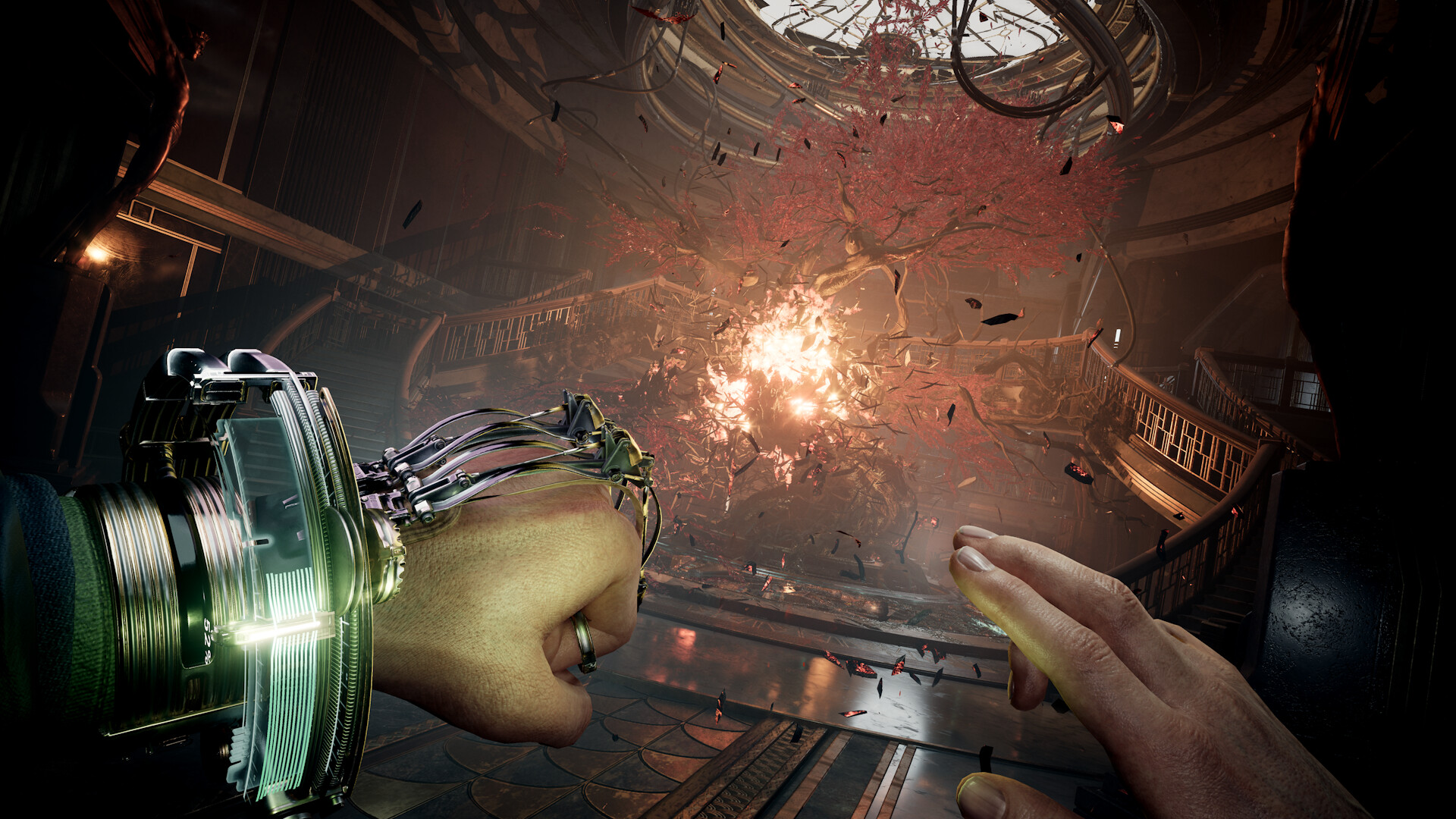
New York’s visual design combines futuristic infrastructure and investigative technology with the ornament and geometry of 1930s-inspired art deco. The Green Tower apartment, the first crime scene described by the developers, uses ornate patterns and hard-edged detailing to frame a wealthy interior; Karra’s own apartment presents a contrasting, worn environment of exposed brick, smoky air and built-in technology. Across these spaces, old-fashioned silhouettes coexist with advanced devices and elevated city traffic, giving the setting a deliberately mixed period character. Unreal Engine 5 supports detailed interiors, lighting and city vistas, while the composition of each location keeps attention on the people and clues within the investigation. The game is available as a full PC release on Steam and on PlayStation 5 and Xbox Series X|S; platform availability and storefront features vary by edition.
- Developer
- Critical Hit Games
- Genre
- Single-player first-person narrative detective adventure