
About Neo Cab
In the automated city of Los Ojos, Lina Romero is one of the last human cab drivers. When her friend Savy disappears on the night they are meant to reunite, Lina keeps working to earn money, find somewhere to sleep and seek clues from her passengers. Their conversations change her emotional state, shaping which responses and paths are open.
Neo Cab places Lina Romero among the last human drivers in a near-future city where autonomous transport has displaced much of the work once done by people. On her first night back in Los Ojos, her close friend Savy disappears, leaving Lina with little money, no settled place to stay and an urgent reason to keep looking. The two friends were meant to reconnect, and Savy had been Lina’s best friend; her absence therefore puts personal concern beside the immediate problem of surviving in a city where Lina’s job is precarious. The game frames that disappearance as the mystery connecting the story, while most of its scenes unfold through the passengers Lina chooses to carry. Their individual accounts reveal different parts of the city and its pressures, from distrust of gig workers to the influence of corporations and law enforcement. Lina’s goal is to find out what happened to Savy, but the route toward that answer runs through ordinary paid rides and the small moments of trust or friction inside them.
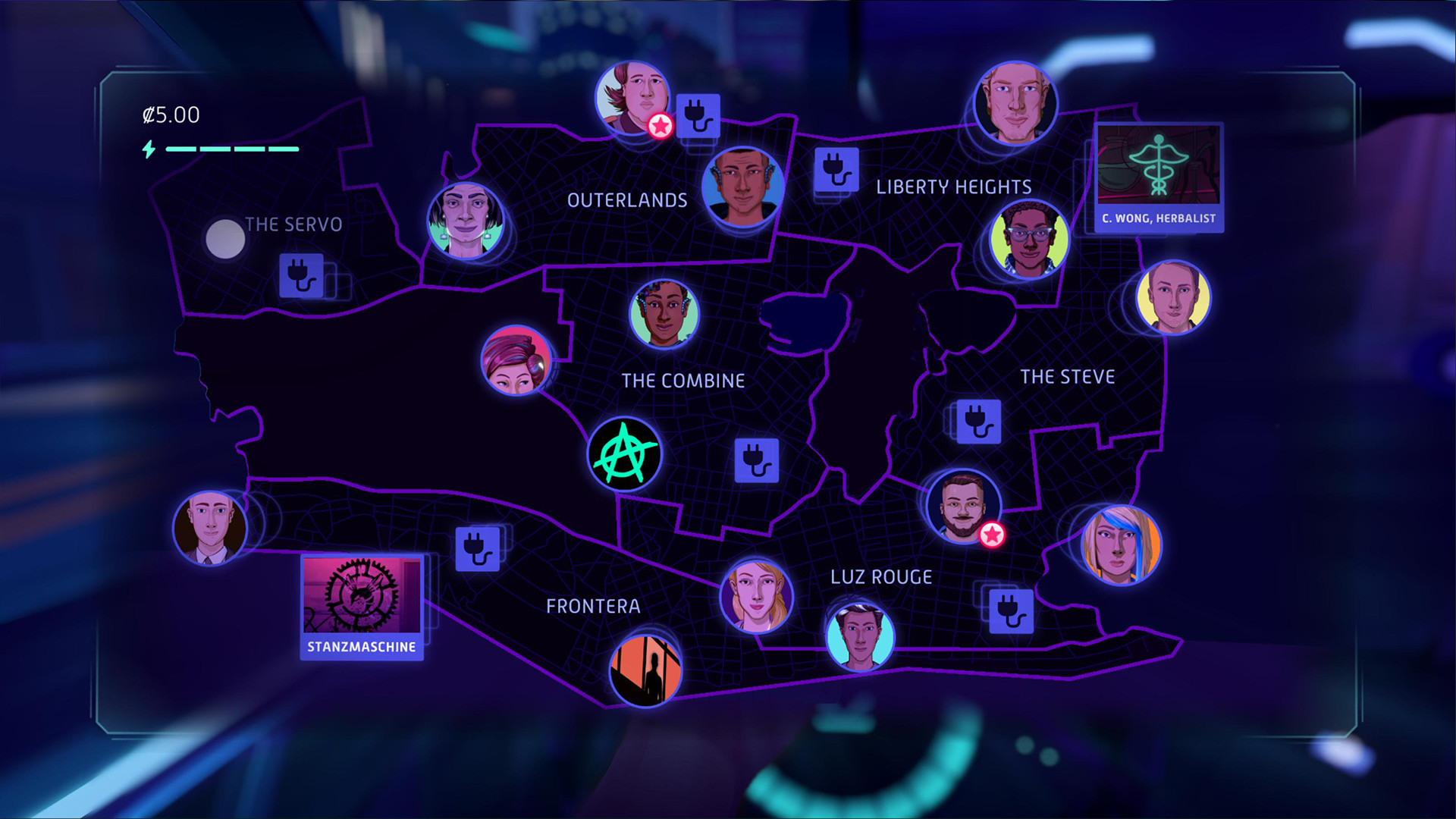
A shift begins with Lina consulting the Neo Cab map and choosing from available passengers. The city is presented as a navigable grid of districts and destinations, but the central activity is selecting whom to pick up and deciding what to say during the ride. The map offers a limited set of possible rides at a time rather than asking the player to seek out every citizen in an open world; a later day can present different people and choices. Each map decision offers roughly three to five potential passengers, giving the player a choice about whose story to hear next. Every passenger brings a different situation and conversation, so a fare is a short narrative encounter as well as a source of income. The driver app, cash and customer rating place Lina’s work within a service economy: she needs enough money for a place to sleep and must maintain a viable rating to keep earning. The game does not make vehicle handling its core challenge, and the developer described acceleration as less central than the Feelgrid. The map and cab provide the structure for choosing encounters, while dialogue and the consequences of those choices drive the playable loop.
Passengers are the main way Lina learns about Los Ojos. Each has a personal story and a reason for accepting a ride, and Lina can respond with honesty, empathy, guardedness or other tones that alter how the exchange develops. Some people are suspicious of a human driver, including anarchist punks, while corporate yuppies and police bring different pressures into her working day. The cast is built around distinct passenger threads rather than one continuous group traveling together. The developer described a cast of eighteen, with some characters available to meet again on later shifts. Most passenger material sits outside the critical path, so Lina can follow the stories that interest her without completing every thread. A selected person can return so Lina can continue a conversation; a different passenger can be chosen when she wants to follow another thread. The game’s passenger stories have separate writers, making each ride a distinct authored encounter. The missing-friend plot gives these meetings a shared context, but an individual passenger’s story is not necessarily a clue to Savy’s disappearance. The narrative allows Lina to continue selected threads while leaving other possible rides unexplored. The player decides which strangers to hear out and how much emotional attention Lina can give them while trying to stay afloat.
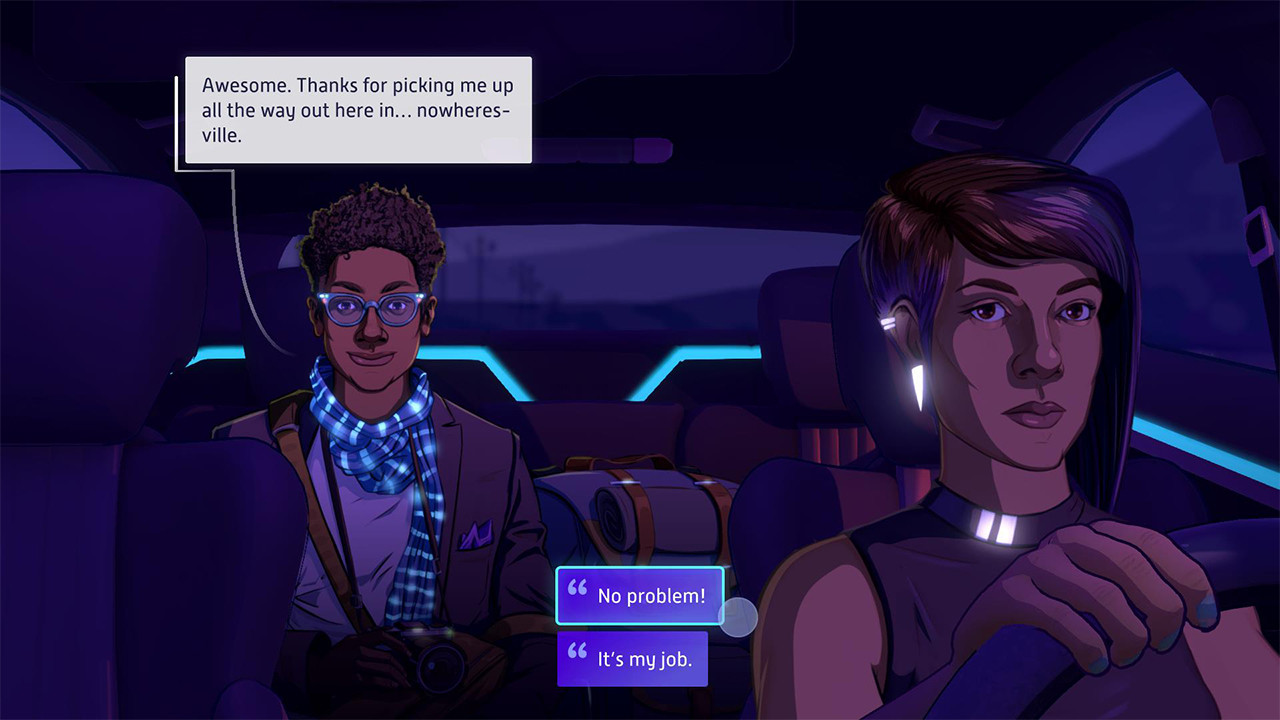
Lina’s Feelgrid makes her emotional condition visible as a shifting color, and ties that state directly to dialogue options. Choices and events can move her mood to a neighboring state; intense moments can send it across the grid more sharply, a swing that can happen when a scene affects Lina strongly. A response may become unavailable when Lina is in a particular mood, while a different state can reveal a special option that was not previously present. The state can therefore change the wording and emotional register available to Lina in a later encounter, not just annotate a conversation that has already happened. Some blocked choices appear glitched, so the player may only discover their status by trying to use them. A glowing option signals that it is available because of Lina’s current Feelgrid state. Lina’s passengers may wear Feelgrids too, making emotional display part of the city’s technology as well as Lina’s interface. The Feelgrid describes both what Lina is feeling and what she can manage to say in that moment. It is not a simple good-versus-bad meter: maintaining emotional health can preserve options, but particular moods also create paths that would otherwise be closed.
Money, star rating and emotional health form a connected survival system. Lina needs fares to secure somewhere to sleep, while the rating represents how passengers respond to their service and can threaten her ability to keep driving. The three pressures do not always point to the same response: preserving a rating means navigating passengers’ reactions, but constant accommodation can leave Lina in a state that changes what she can say next. The player weighs a passenger’s expectations against honesty, empathy and the effect a conversation may have on Lina’s state. Keeping the rating around five stars is part of avoiding the risk of losing the job. Choosing whom to pick up also matters, since each ride brings a different social demand and potential income. If she avoids the most negative, low-energy Feelgrid states, she can gain the option to push on into a unique late-night ride, extending the shift. Daily selections and relationship threads make progression less about accumulating upgrades and more about which encounters Lina pursues, the practical resources she retains, and the emotional condition in which she meets the next person.
The presentation centers on a graphic, neon-lit city seen through the map, passenger portraits and the conversational space of the cab. Los Ojos feels larger than the sequence of rides because its dense urban districts, residential areas and technological systems appear around Lina’s individual encounters. The Feelgrid doubles as an in-world biometric device and a clear visual interface for changes in her emotional state, while the dialogue choices keep the consequences of those shifts close to the surface. The passenger stories are credited to Leigh Alexander, Kim Belair, Bruno Dias, Duncan Fyfe, Paula Rogers and Robin Sloan, emphasizing that the cast’s encounters are authored narrative threads. An original soundtrack by Obfusc accompanies the city and its riders, and the passenger-focused framing gives conversations the visual emphasis usually reserved for a driving view. On Switch, players can tap dialogue choices on the touch screen, while HD Rumble can echo shifts in the Feelgrid; the map works more smoothly with a controller. The Feelgrid’s in-world role also reflects the society Lina works in: other characters wear the device too, so the displayed emotional state can affect how two people read one another during a ride. Passenger stories are written as separate branches that can be encountered in different combinations, with the Savy mystery acting as the framing arc rather than replacing those personal stories. Neo Cab is a narrative adventure built around this ride-and-conversation loop across PC and Mac, Nintendo Switch and Apple Arcade releases; it is not a driving simulator focused on steering or traffic challenges.
- Developer
- Chance Agency
- Genre
- Narrative adventure / visual novel