
About My Friend Pedro
A masked stranger wakes in a basement with a talking banana named Pedro offering advice and a violent route through a criminal underworld. My Friend Pedro is a side-scrolling action game built around aiming, acrobatics and slow motion, where each encounter turns movement, weapons and nearby objects into parts of a moving gunfight.
A masked stranger wakes in a basement with a bump on his head and a floating, talking banana called Pedro. Pedro offers advice as the stranger begins a fight through a violent criminal underworld. Their pairing gives the game its odd tone: the fruit is a composed companion while the masked figure moves from one hostile room to the next. The story plays with friendship and imagination, but stays light beside the action. Gangsters provide a recurring threat, with other groups and settings changing later encounters. The game uses this unusual duo to connect compact action scenes. The player’s goal is immediate: read each space, get past its enemies and find the route forward.
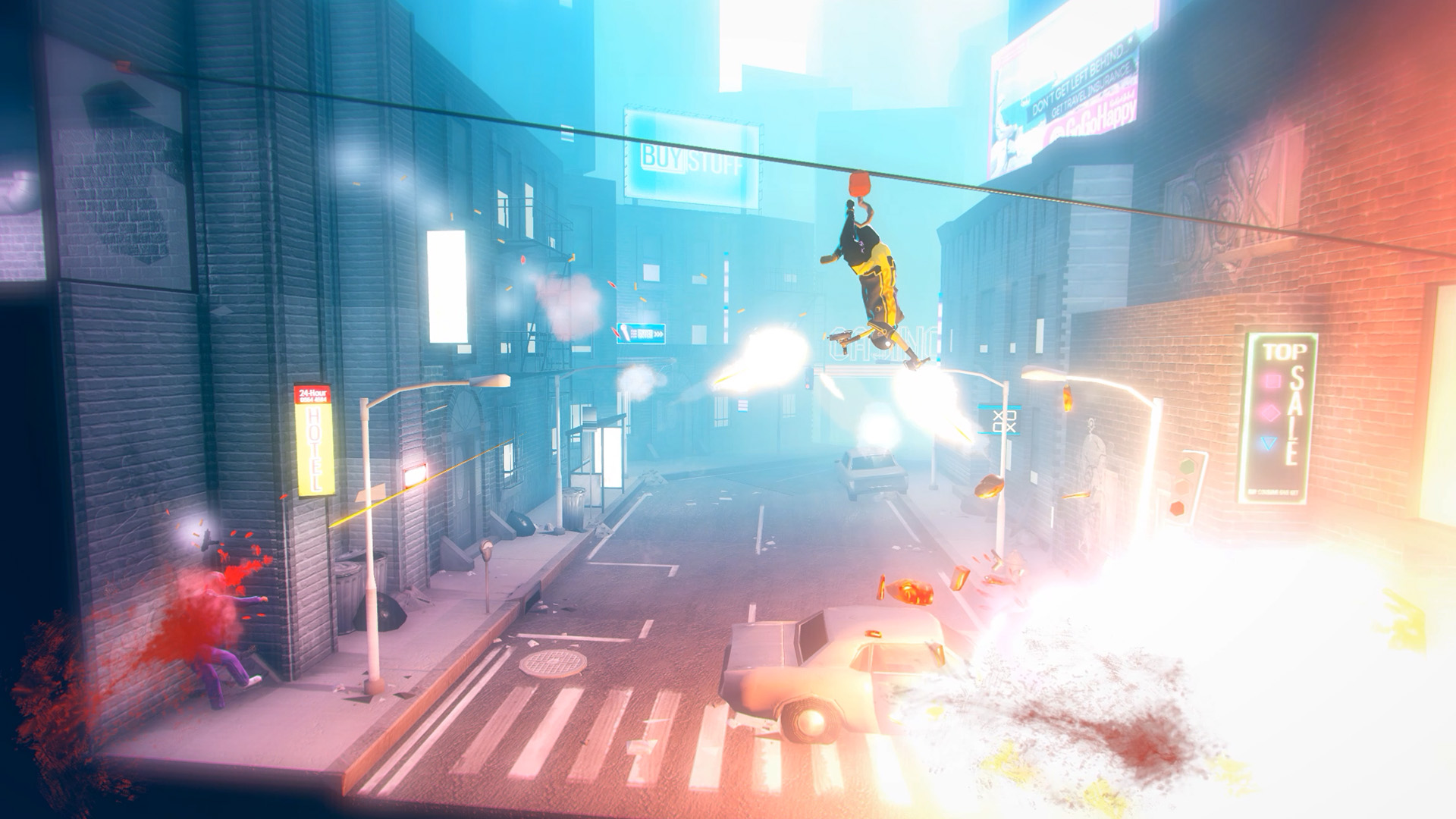
My Friend Pedro is a side-scrolling action platformer and shooter where movement and aim are separate. The hero can run or jump one way while pointing a weapon in another, so threats can arrive from more than the direction of travel. Kicking and wall-jumping help navigate stages, while ropes and gaps make traversal part of the fight. A player might cross a doorway, pass above an enemy or approach from an angle while keeping a gun trained elsewhere. Position matters as much as firing: a shaft can expose enemies on either side, while an open room leaves several lines of fire to manage. The campaign advances through connected scenes rather than an open map, combining platform obstacles and combat in each stage.
Focus is the game’s slow-motion ability, giving the player more time to adjust a move during a fight. It can be used while dodging or aiming, letting an exchange unfold through deliberate corrections: shift position, pick a target and decide when to act again. The hero can also dodge in a pirouette that avoids bullets; firing while turning sends shots along the directions the weapons face during the animation. Focus alters the pace of the surrounding action, while the dodge changes the character’s movement and can spread shots into an arc. The player must track nearby threats while combining both actions. Focus has a generous meter, but still asks when to spend more time on a crowded moment. It makes a fast firefight something the player can shape through timing and movement.
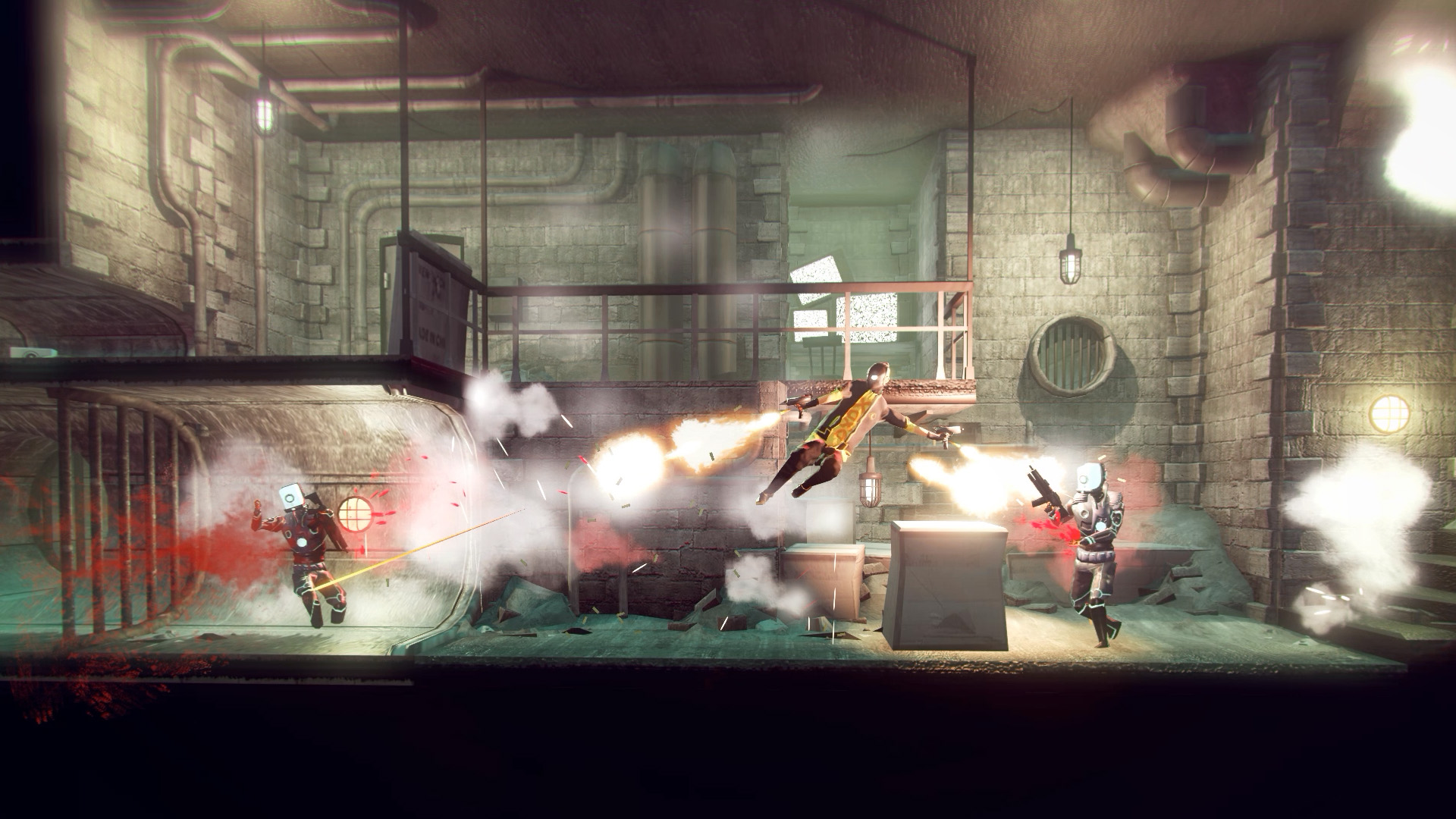
With dual-wielded guns, split aiming lets one weapon stay trained on a selected target while the other follows the player’s normal aim. This creates two lines of attack, useful when enemies stand at different heights or opposite sides of a drop. A jump or dive can be both a way past danger and a chance to cover two threats. Weapon pickups add options for handling encounters, and firearms change the rhythm of close and distant combat. Pistols, shotguns and automatic weapons each give a different way to manage pressure, while a kick or dodge can fill the moment when a weapon is unavailable. The layout and number of opponents determine whether to keep aiming, move toward another gun or cross the space. Combat depends on coordinating both hands with movement rather than standing still to fire.
Objects around a level can become part of a fight. Kicking one can send it into an opponent, interrupting a target while the player follows with gunfire. Frying pans can be knocked into the air and hit with bullets so their surface redirects shots toward an enemy around a corner. Barrels and skateboards carry the character through stages, and a skateboard can also be kicked at an opponent. Window breaches turn entrances into attacks, while machinery and traps alter the safe route through a room. These interactions reward noticing what is within reach and what can change an enemy’s position or break up a line of fire. One prop might serve as transportation in one moment and a projectile in another. Its use depends on the arrangement of that particular scene.
The campaign varies its confrontations with movement and hazard challenges. Some sections emphasize enemies and props that can be rearranged through kicks and gunfire; others focus on platforming, mines, lasers or spinning platforms. Motorcycle chases, freefalls and boss encounters interrupt the room-to-room rhythm. Those changes redirect attention: follow a firing line, find a safe path through a trap, or time movement during a chase. The player’s basic actions remain available, but each level asks for a different combination. Pedro provides brief tips and commentary as mechanics appear; progression comes from moving between stages and becoming more familiar with aiming, jumping, dodging and environmental objects. Settings change along the route, while each scene keeps the player focused on its layout, enemies and exit.
Each completed level shows a score and grade with a short replay of a standout moment that can be saved or shared. Chaining eliminations and finishing quickly contribute to score chasing, so a clean route and an improvised stunt can both matter. Players can return to refine a sequence, improve a grade or try a more demanding difficulty. Some scoring conditions reward completing a level without dying, and harder settings can reduce assists such as Focus and health regeneration. Steam also lists leaderboards, letting score-focused runs be compared. These replay systems provide another goal after reaching an exit: build a longer chain, cut time or work with fewer aids. They keep attention on the movement, aim and object interactions that drive the campaign, while changing the constraints applied to a familiar stage.
- Developer
- DeadToast Entertainment
- Genre
- Single-player side-scrolling action platformer and shooter