
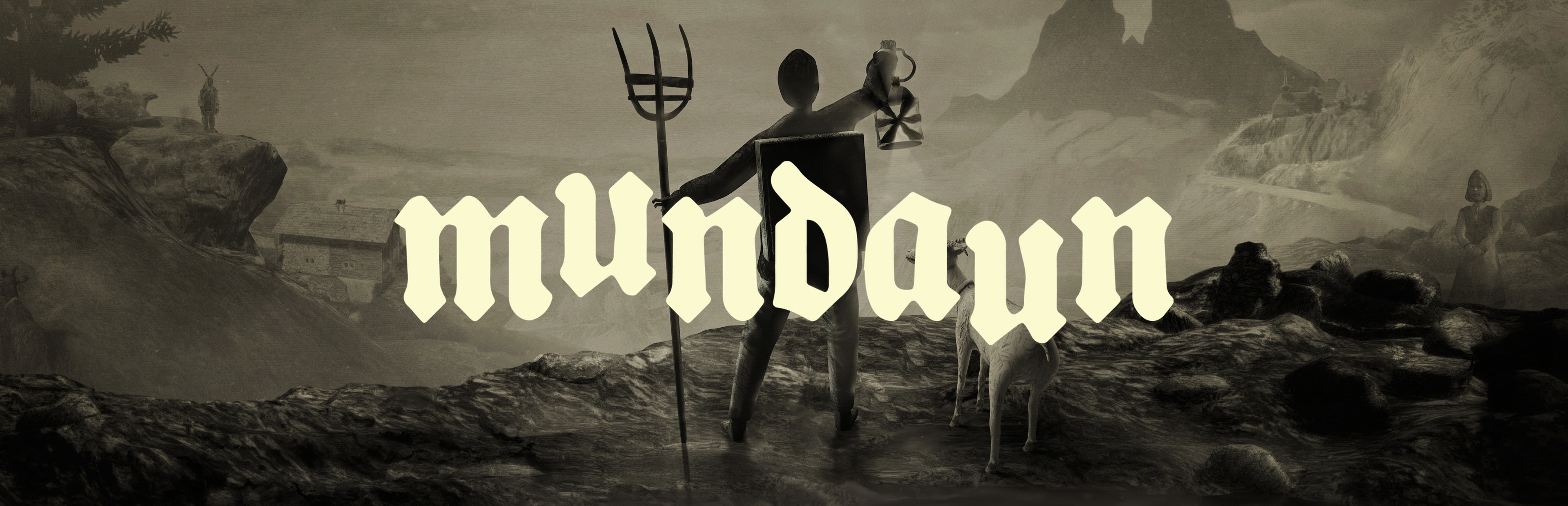
About Mundaun
In Mundaun, Curdin returns to his grandfather’s remote Alpine village after the old man dies in a barn fire, only to find the funeral and burial shrouded in unanswered questions. Explore a hand-drawn mountain landscape, solve environmental puzzles, manage supplies and fear, and decide when to evade or confront the hostile presences on the climb toward the summit.
Mundaun follows Curdin, a young man returning to the Alpine village where he spent time as a child after learning that his grandfather died when a barn burned. The expected funeral does not settle matters: the priest says the grandfather has already been buried, yet Curdin finds a charred body in the barn and an empty grave. The chapel and rooms in the family house are locked, turning the apparent homecoming into an investigation that leads upward through the valley toward the mountain’s twin peaks. A dark figure marks Curdin with a black hand, and the evidence around the death points beyond an ordinary accident. As he searches for what happened, the village’s inhabitants and strange signs make the boundary between local history, folklore and supernatural threat increasingly uncertain. The story uses these contradictions to give the player practical questions as well as a long mystery: where to find a key, how to open a route, and which resident might help explain an unfamiliar sign. A hay-covered creature and other uncanny figures make the valley dangerous even before the cause of its troubles comes into focus. These details make the horror part of the objects and customs Curdin meets, rather than a threat confined to a single distant antagonist.
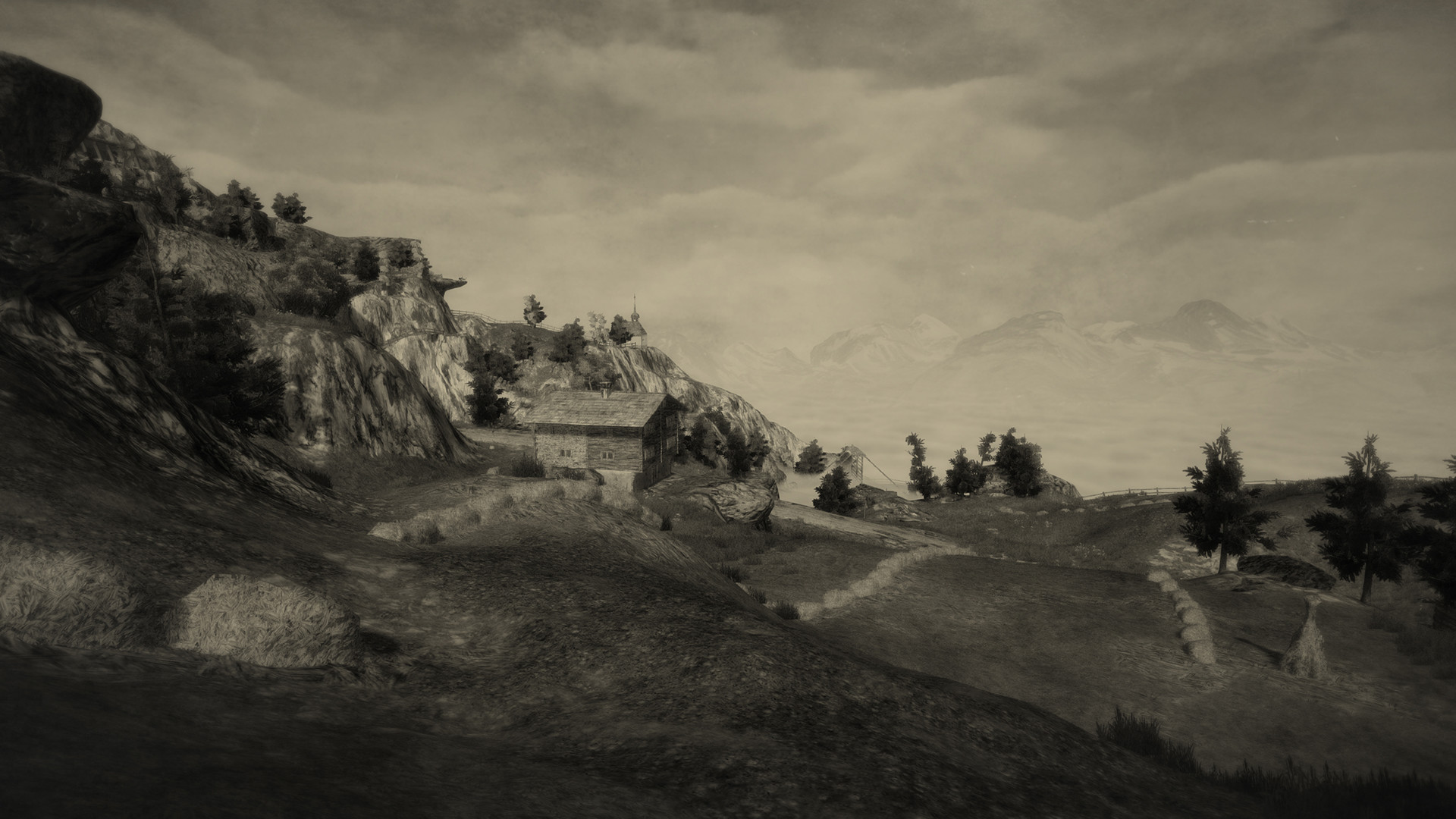
The mountain is a connected landscape of open areas and routes rather than a sequence of isolated rooms. Curdin travels from the village and its houses into meadows, rocky fields, wooded slopes and snowy high ground, following the trail of the mystery while looking for keys, tools, notes and other useful objects. Locked doors give distant goals a physical presence: the grandfather’s study, for example, remains an unanswered question while the chapel can be a nearer obstacle. Small errands and optional discoveries sit alongside the main climb, so exploring can provide supplies or context even when it does not immediately advance the central story. Vehicles change how Curdin covers that ground; after the village segment, his grandfather’s hay truck lets him move more quickly along mountain roads, while other stretches call for travel on foot or through snow. The route has distinct rhythms as it rises: an early village hub gives way to wider mountain paths, and then to colder, more exposed terrain. The twin peaks remain visible as a directional landmark, but they do not make every immediate objective obvious. A player may be moving toward a known story destination while also searching nearby buildings for practical supplies, listening for a sound that hints at an interaction, or checking an overlooked path for a useful object. This combination gives the mountain both a broad sense of ascent and local reasons to pause and look around.
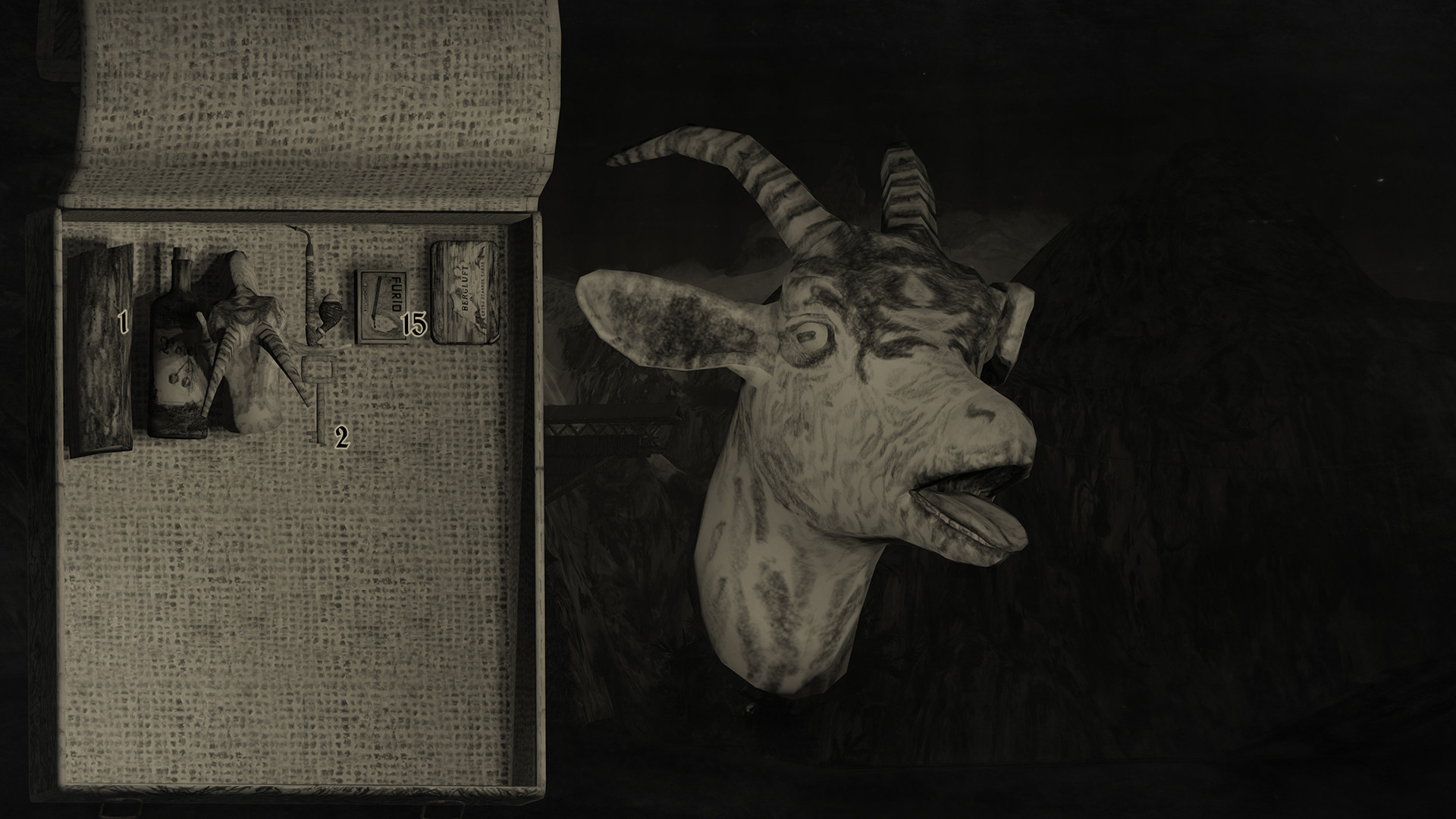
Environmental puzzles make the landscape itself part of the problem solving. Progress commonly depends on noticing how an object, symbol, sound or route relates to a blocked path, then finding or using the item that fits. Some obstacles ask for a particular sequence or arrangement, while others connect machinery and miniature objects to hidden compartments. One optional task is more elaborate than simply picking up a finished reward: Curdin must find a cup, coffee grounds, a pot, water, a stove, wood and matches before he can brew coffee. Drinking it raises his resistance to fear, giving a side activity a concrete survival benefit. Locked rooms and side paths can hold supplies, so a detour may change how prepared Curdin is for the next stretch uphill. Other puzzles use the same tactile logic in unusual ways: a gate asks for a correct arrangement of symbols on turning wheels. Hanging pieces of meat can also form a musical sequence when struck. The objects may look eccentric, but the player’s task is to observe their placement and test how they fit into a mechanism, rather than solve abstract riddles in a detached menu. Puzzles can therefore reward curiosity about the physical space even when the path forward is locked.
Hostile creatures turn travel into a question of readiness and risk. Curdin may encounter enemies while exploring, and can avoid some confrontations through stealth or choose to fight. His fear resistance has a direct physical effect: when fear rises, he moves more slowly, making it harder to leave a threatening area quickly. The game also includes weapons and defensive methods, but combat is only one response to danger; reading a threat and keeping enough room to retreat can matter as much as striking first. Exploration supports this loop through health improvements and upgrades in branches associated with health, firearm handling and fear resistance. Finding such resources can prepare Curdin for a later encounter, while a player who prefers evasion can complete the journey without harming enemies, according to the reviewed game’s available routes. The environment sometimes provides clues for dealing with a particular presence; observation and an available tool can matter more than a direct attack. These are not a single universal attack routine; the player has to recognize the threat and make use of what the situation allows. A pitchfork may be the first weapon to hand, which gives preparation and retreat a practical role before later equipment becomes available. Health improvements and fear resistance address different parts of survival, while firearm handling supports a more confrontational approach. The game’s choice to allow stealth and nonviolent completion means these upgrades broaden options without forcing every encounter into a fight.
The mystery also reaches backward through playable flashbacks that reveal parts of the grandfather’s past. Curdin’s journey gradually connects the old man’s past to the dangers he faces in the present. This gives the ascent a second line of investigation: opening doors, finding clues and meeting residents build knowledge of both the current crisis and the history that produced it. Conversations with eccentric inhabitants add local character, though some speak in an obscure language rather than plain dialogue. Notes, objects and the sequence of places provide context without turning the story into a conventional quest log of explanations. The early questions about the fire and burial gradually sit beside the larger history of the mountain and the community’s relationship with the uncanny. The flashbacks are playable scenes, so the past is encountered as part of the game’s progression rather than only summarized in a final explanation. Curdin also meets people linked by family or memory to the grandfather’s generation, letting those encounters connect one place to another. Some discoveries contribute more to atmosphere or local lore than to immediate survival, while others point toward a locked route or a concrete objective. The player’s accumulating picture of the valley therefore comes from several kinds of evidence: remembered events, things left in the environment and the reactions of inhabitants who live with its unusual customs.
Every view is rendered in a monochrome, hand-pencilled style, with charcoal-like textures that make the village, meadows and snowfields feel as though they have been drawn onto paper. The same approach shapes the inhabitants and creatures, making ordinary faces, old photographs and hostile figures look subtly wrong within the landscape. Sound reinforces the difference between locations: the quiet of snow travel, the movement of a vehicle and the noises of something nearby all affect how exposed a route feels. Mundaun is a first-person, single-player horror adventure developed by Hidden Fields and published by Annapurna Interactive. The original game is available on PC, PlayStation 4 and 5, Xbox One and Series X|S, and Nintendo Switch; store listings also show GOG and Epic Games Store editions. Its fear, inventory, puzzles and climb are features of the same full game, rather than separate campaign modes. The pencil treatment is not restricted to a still overlay: rough shading, scratched textures and deliberately uncanny faces shape the world as Curdin moves through it. Night and snow alter the visual field, while quiet stretches make the sound of movement conspicuous. The combination keeps the player attentive to small cues, including the approach of a threat or a sound that seems to come from beyond the visible path. Dialogue is not always fully intelligible, since some residents use an obscure spoken language; place, gestures, objects and the surrounding clues carry part of the communication. Steam lists a Windows PC edition with minimum and recommended requirements, while the publisher’s official page lists the named console and PC storefronts. The systems described here belong to the complete single-player adventure, not to a separate survival or multiplayer mode.
- Developer
- Hidden Fields
- Genre
- First-person horror adventure