
About MULLET MADJACK
In a future where humanity and the internet have merged, people need a fresh dose of dopamine every ten seconds to stay alive. As Mullet Madjack, the player fights upward through a tower of handcrafted, shifting stages, killing enemies to extend a countdown while choosing upgrades that shape each floor.
MULLET MADJACK places its single-player first-person shooter inside an exaggerated 1980s and 1990s anime future. Humanity and the internet have merged into a new being, and people now require dopamine at regular ten-second intervals or they die. The player controls Mullet Madjack, whose survival depends on killing enemies before his remaining time runs out. That premise turns the campaign’s central resource into a visible countdown: combat means removing threats and finding the next target quickly enough to remain alive. The story follows a climb through a tower toward its upper floors and the mysterious powers behind the crisis.
Each encounter takes place in a handcrafted stage whose room arrangement can vary, with new obstacles appearing as chapters progress. The player moves through these spaces at speed, locating enemies and attacking to replenish the ten seconds of life. Because the timer is always active, hesitation has a direct cost; a route that is easy to remember can help the player reach the next fight with time to spare. The game encourages memorising room layouts and improving completion times, turning repeated attempts into opportunities to learn where threats and obstacles are positioned. Its first-person perspective frames the action like an interactive anime sequence, with animated cutscenes carrying the narrative between bouts of frantic shooting.
Progress is divided floor by floor, and each floor gives the player a chance to build the character with a power-up choice. The available upgrades number more than fifty and can change how a run plays, making the selection a meaningful part of the climb rather than a cosmetic reward. One choice may complement a preferred weapon or approach, while another can alter how the player deals with the next set of rooms; the value depends on the problems ahead and the chosen set of abilities. These decisions add a light roguelite structure to a story campaign: the player keeps pushing toward the final floor, but the route through its combat is shaped by the powers selected along the way.
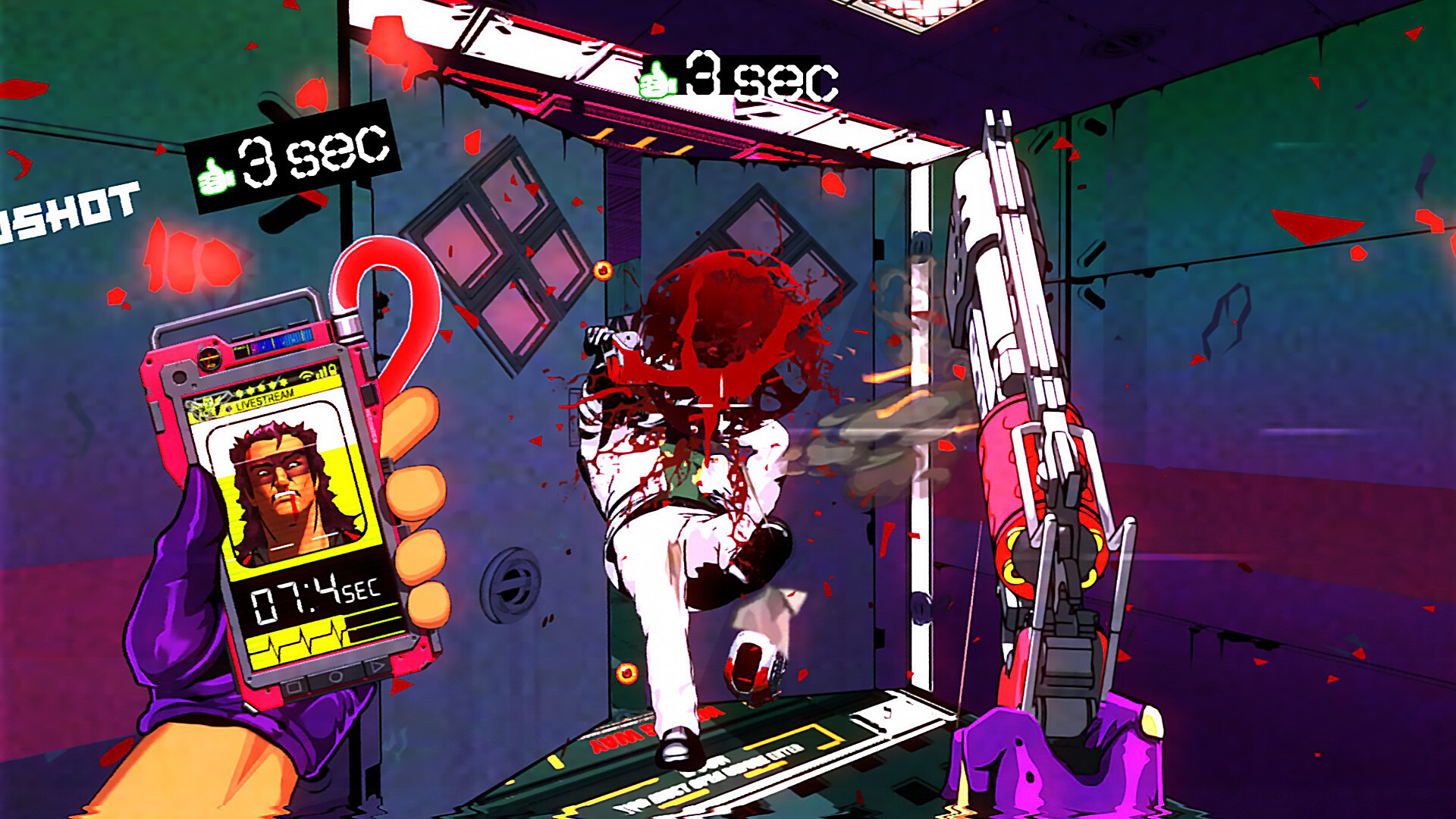
The moment-to-moment loop links target choice, movement and time management. Killing an enemy restores the countdown, so the player must keep making progress instead of clearing a room cautiously from one safe position. Obstacles complicate the route and can force a quick adjustment in direction or aim, while memorised rooms let repeat attempts become more efficient. Weapon choice is also part of the tactical picture: the game invites the player to pick a favourite arm and build around the weapons and upgrades available. A strong run combines quick recognition of the environment with deliberate upgrade choices, using each fight to buy enough time to reach the next one.
The full release includes a narrative campaign with fully animated, old-school anime cutscenes, placing the tower climb inside a larger story rather than presenting it as an endless series of disconnected arenas. The player confronts mysterious masterminds as the plot develops, with the game drawing on the presentation and pacing of classic anime. That framing makes chapter transitions part of the experience: action rooms provide the repeated survival challenge, while animated sequences advance the conflict and establish what lies farther up the building. The premise’s futuristic merger of people and internet, its dopamine-driven survival rule and its retro visual language give the campaign a distinctive science-fiction setting without requiring the combat loop to slow down.
Beyond the standard timed campaign, the game provides Endless Mode, which continues with randomly generated levels, and Classic Mode, which removes the timer for a more traditional campaign structure. These modes change the conditions of play in clear ways. Endless Mode extends the room-to-room challenge beyond the authored story path, while Classic Mode lets the player experience the campaign without the ten-second survival pressure. The main campaign remains the focused climb through handcrafted chapters, with upgrades selected floor by floor; the extra modes let that shooting and movement system operate under different pacing rules. Together they make the game’s identity rest on both a tightly timed central mechanic and options for continuing or revisiting its action.
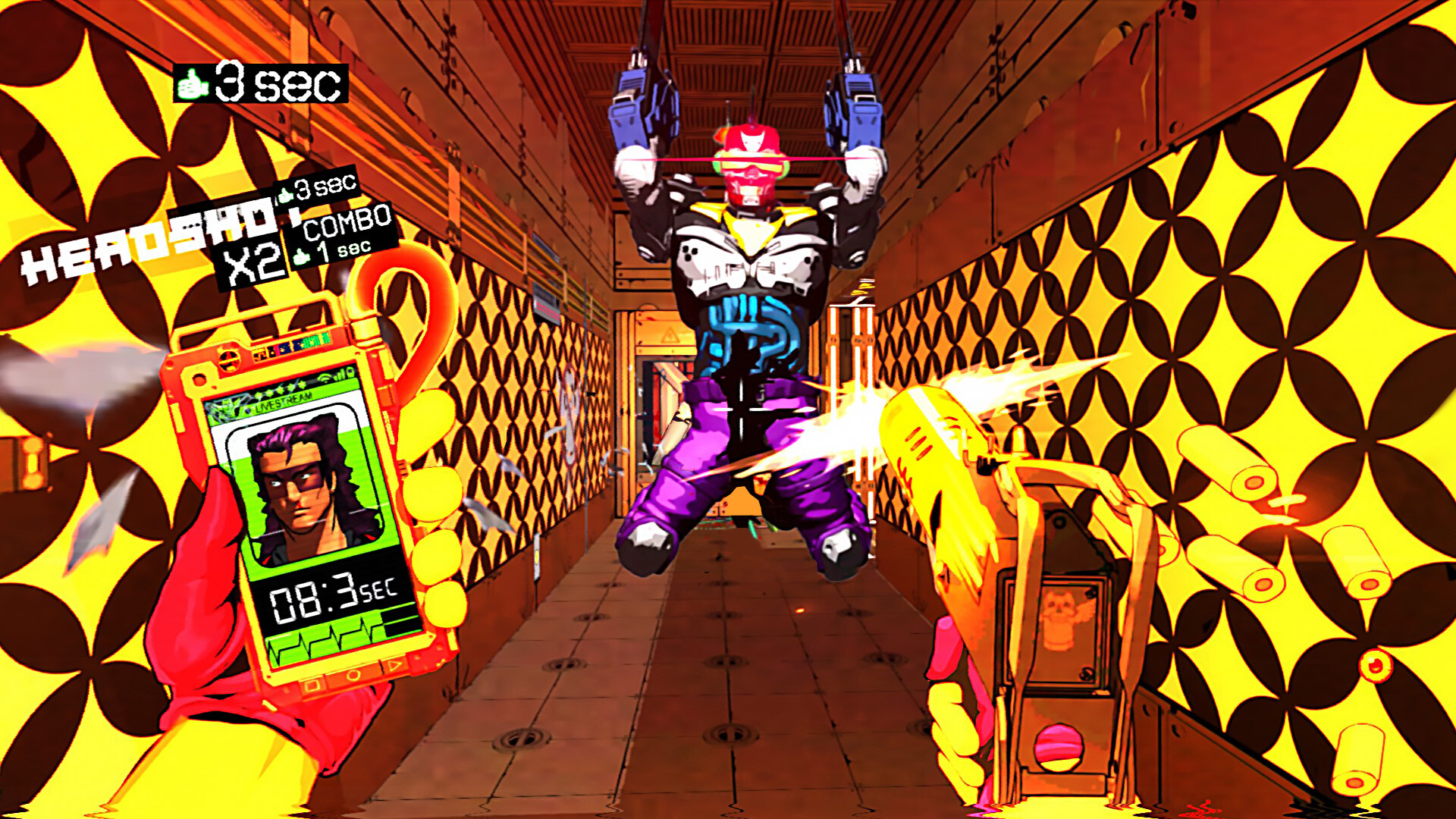
MULLET MADJACK includes several control and display settings suited to different play setups. Steam lists full controller support, ultrawide display support, and the ability to rebind keys and buttons or adjust mouse sensitivity. Custom aim options let players alter how aiming behaves, while the interface can be adapted to the controls they use. Those settings matter in a shooter built around rapid target acquisition and a countdown: the player can configure input and screen layout around the demands of moving and firing quickly. The store also lists custom volume controls for sound effects, music and voices, so these parts of the presentation can be balanced separately.
Visual options include a purple-blood mode and settings to disable camera shake and flashes. These give the player control over some of the effects that accompany the game’s violent, brightly animated action. The available options sit alongside the campaign’s old-school anime cutscenes and its deliberately retro presentation, but allow the intensity of particular visual and audio elements to be adjusted. The Steam release also includes a digital, virtual big PC game box styled after the 1990s, an extra presentation piece that extends the game’s period framing beyond the levels themselves. Together these options and extras add detail about how the title is configured and presented outside its floor-by-floor combat loop.
- Developer
- HAMMER95
- Genre
- Single-player first-person action shooter with small roguelite elements