
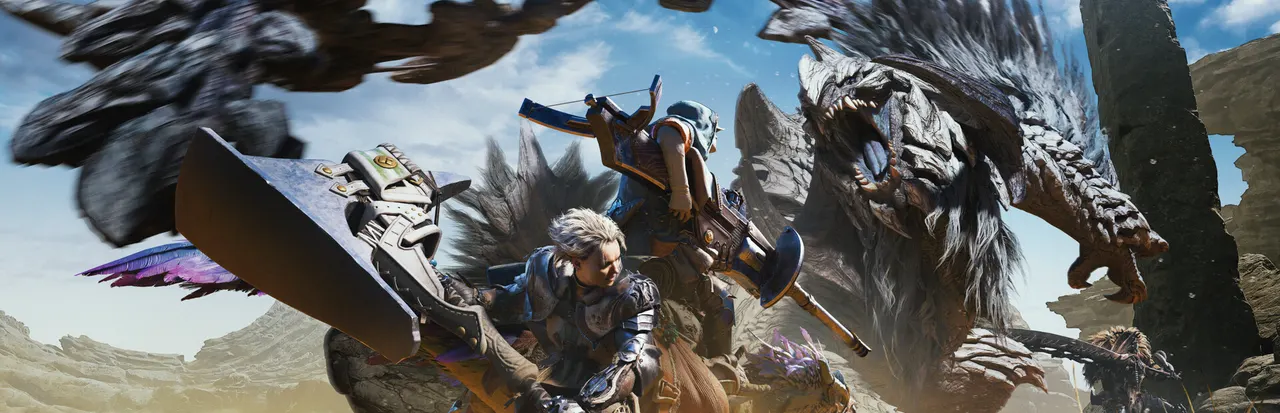
About Monster Hunter Wilds
Monster Hunter Wilds sends a hunter with the Forbidden Lands Research Commission into a changing frontier where people and monsters compete for resources. Hunts combine tracking, weapon mastery and environmental awareness; materials from each quarry become stronger gear, while the Seikret and field camps support longer investigations.
Monster Hunter Wilds follows a hunter assigned to the Forbidden Lands Research Commission, whose work is to investigate an unexplored region and protect its ecosystem while hunting dangerous monsters. The story introduces Nata, a mysterious boy accompanying the expedition, and Alma, the Handler who manages requests and quests. Gemma, the Commission’s smithy, turns gathered materials into weapons and armour. These people give the hunts a working context: the Commission studies the region, the Handler directs assignments, and the hunter’s field work supplies both information and resources needed for the next stage of the journey.
The Forbidden Lands are organized around changing environments rather than a static wilderness. The Windward Plains begin with open grassland, desert and twisting rock formations; other locales include the Scarlet Forest, Oilwell Basin and Iceshard Cliffs. Areas shift through Fallow, Inclemency and Plenty, which alter the landscape and the conditions under which monsters live. Predators compete for scarce resources during harsher periods, while periods of Plenty bring abundant life. An apex predator appears during a region’s Inclemency. The same route can therefore offer a different mix of wildlife and hazards depending on the state of the environment.
A hunt begins with an assignment or an investigation into a monster’s presence. The hunter follows signs, uses the environment and prepares equipment before engaging the target. Large monsters behave as inhabitants of the region, and their movements can intersect with other creatures or the changing weather. Once a quarry is defeated, its parts and other collected materials become the basis for crafting. Optional quests let the hunter pursue another encounter with a known species to earn additional resources. The cycle connects research, combat and preparation: information helps locate the next hunt, and the result supplies components for equipment that expands the hunter’s options.
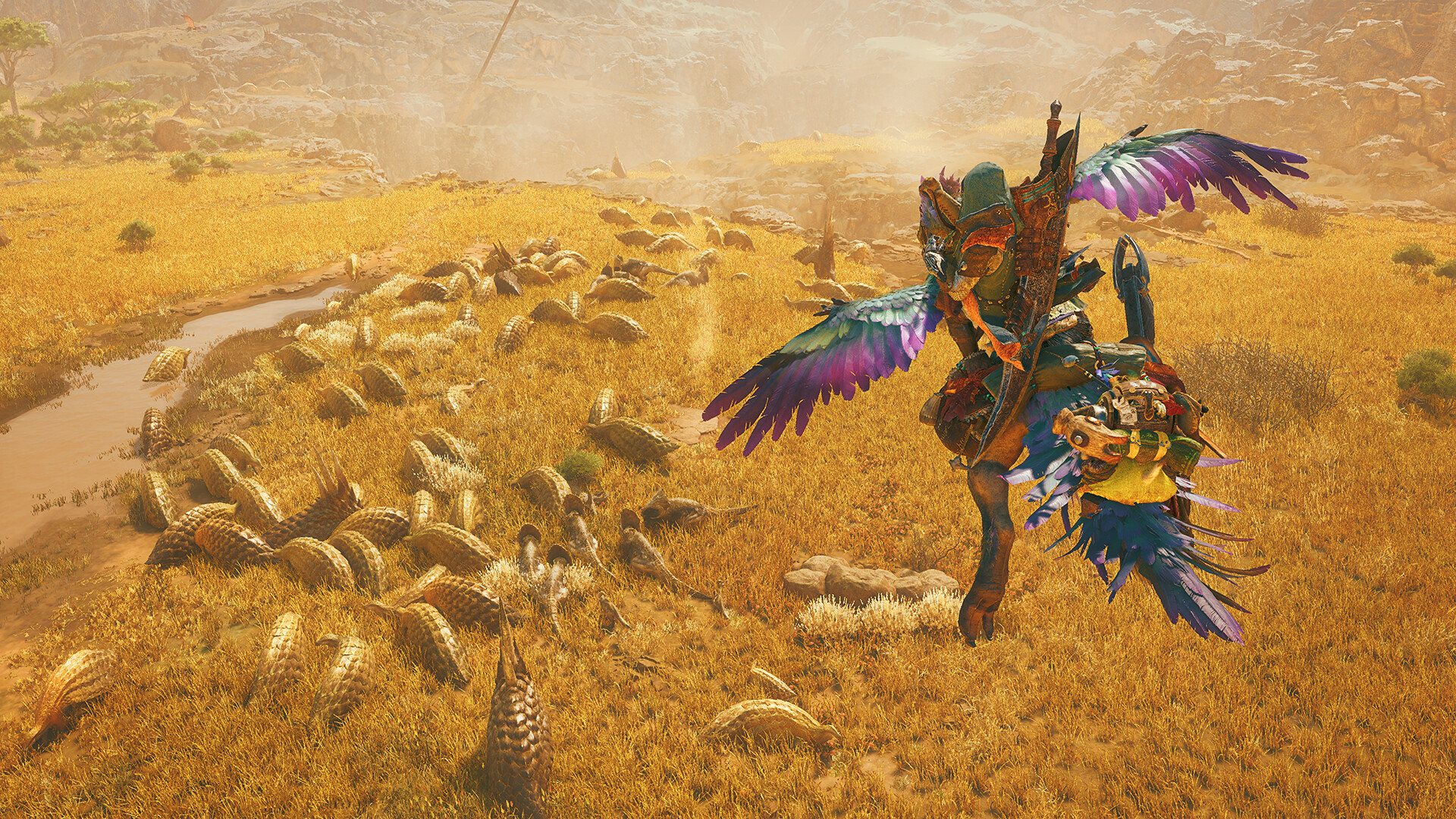
Weapon choice defines a hunter’s moves and the kind of opening they seek. Wilds includes fourteen weapon types, ranging from close-range blades and blunt weapons to bows and bowguns. The Seikret can carry a second weapon, allowing a hunter to change tools during an expedition or even in the middle of a fight. A different weapon may suit a monster’s movement or a breakable body part, while two weapons of the same type can be prepared with different properties. The choice is backed by crafted armour and skills, so equipment preparation responds to the expected target rather than serving as a simple damage increase.
Focus Mode makes aiming and targeting specific monster parts more deliberate. It helps line up attacks and highlights wounds that have opened through repeated strikes. A Focus Strike aimed at a wound can destroy it, stagger the monster and provide bonus materials. Wounds make sustained attention to one part valuable, while the hunter still has to account for the monster’s attack pattern and range. Breaking parts can also yield additional rewards. This layer gives hunters a reason to read the body of the target during battle, switching between general pressure and a more precise attempt to exploit a temporary weakness.
Travel and recovery are woven into the field routine. A Seikret carries the hunter across a large locale and can be called during an encounter to create space for sharpening a weapon or using supplies while moving. Its item pouch provides field resources, and the mount can hold the second weapon chosen for the hunt. As the campaign progresses, the hunter can establish Pop-up Camps at suitable sites. These offer many of the services of a base camp without requiring a return across the map, but a location’s risk rating reflects the chance that a monster may discover and damage it.
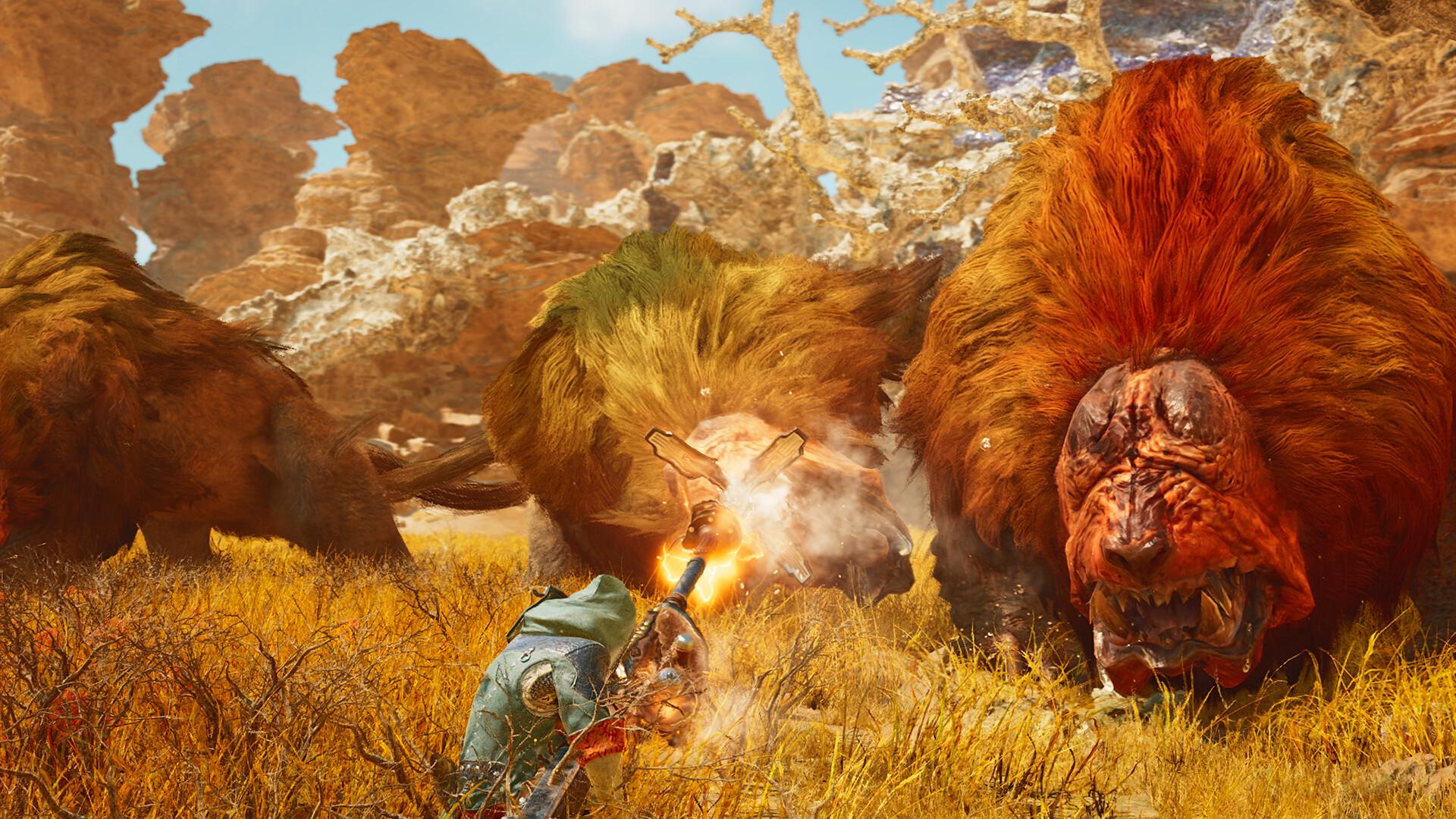
The expedition includes a Palico, a speaking Felyne partner who provides support, and other Guild members can assist as Support Hunters. Olivia, a hammer-wielding member of the Forbidden Lands Expedition Team, can join a quest to fill an opening in a hunting party. The support characters keep quests populated and provide useful assistance even when another player is not part of the hunting party. Alma’s assignments and Gemma’s smithy also provide a stable rhythm between field trips: accept a new objective, select or improve equipment, then head back into the environment with a more considered loadout.
Smaller field tools create activities beyond fighting the main quarry. The Capture Net collects endemic creatures for the Endemic Life Field Guide and earns Guild Points, making tiny animals part of the expedition’s discoveries. The Slinger can gather resources from a distance and fire pods with different effects; dung pods can disperse a pack or drive a monster away. Food has its own preparation system, with ingredients supplying temporary statistics and passive skills. The Portable BBQ Grill allows cooking in the field, so a meal need not wait for a return to camp. Between collecting wildlife, selecting pods and preparing food, the hunter carries tools that interact with the ecosystem in several different ways.
Released at the end of February 2025 on PC, PS5 and Xbox Series X/S, Monster Hunter Wilds is Capcom's most accessible entry and its least demanding. Those two facts are the same fact.
Two decades of clutter, mostly swept up
Monster Hunter has always had a strange bargain at its centre. The premise is simple enough to fit in the title — track a huge animal, hit it until it stops, wear its parts — but the systems wrapped around that premise have grown ridiculous. Elemental weaknesses, augmentations, buff stacking, cooking that measurably changes your performance, inventories full of baffling items with names like a joke. Even veterans open a browser regularly.
Monster Hunter: World started pulling that back in 2018. Wilds goes a great deal further: almost nothing here is untouched, from how you travel to how you eat to how much friction sits between you and the next hunt. The result is the cleanest this series has ever played. It's also, in the same motion, the least demanding, and whether that trade is good depends entirely on what you came for.
The combat is the best it has been
Whatever else has been sanded down, the fighting hasn't. The changes to combat are smart rather than generous — faster to get into, more flexible in how you approach a monster, and crucially less fiddly in the moments where the old games made you fight the controls as much as the animal. Landing a hammer or a greatsword on something enormous has rarely felt this good, and that's the thing the entire series exists to deliver.
What's missing is the resistance. You're rarely pushed into rethinking your equipment, and the hunts don't escalate the way they used to. For newcomers that's a soft landing. For anyone who has played these games for years it removes the part where you discover you've brought the wrong setup and have to adapt — which is a genuine loss, not just a difficulty preference.
The campaign is shorter, and better for it
The story is still broadly an excuse to go somewhere new, but the characters carry it in a way Monster Hunter has never managed before. Your team — an excitable engineer, a handler with an actual personality, a biologist who is entirely elsewhere — has arcs and a reason to be on screen. It made the campaign more engaging than any previous entry, and it's a shorter one, running to credits in the region of fifteen hours without forcing a repeat fight.
The pulse
Reception has been warm with a consistent caveat, which is a fair reflection of the game. The combat gets near-universal praise — best-in-class monster fighting compensating for a wilderness that's a touch too streamlined is the argument in one line. The criticism is where the streamlining bites: it's too easy too often, the campaign ends before you've really had to learn a monster, and the post-launch grind takes a while to become the thing veterans come back for. There's also a technical note people keep raising independently of the design, and it's a real one — this is temperamental software, with PC stability issues and crashes noted at launch.
Should you play it
Yes, and if you've bounced off Monster Hunter before because it felt like homework, this is the entry that finally asks you to just play it. The fights are outstanding and the onboarding has never been kinder.
Hold off if you play these games for the wall — for the hunt that punishes greed and the loadout you got wrong. Wilds will not give you that in anything like the quantity you're used to, and the post-game is where it eventually starts to. And check the current state of the PC version before committing, because stability complaints have dogged it since release.
Go deeper with V4mp
- Developer
- Capcom
- Genre
- Action RPG
Explore Monster Hunter Wilds further
Explore the wiki for detailed reference pages on the game's world, systems, items and locations.