

About Mob Control
Mob Control is a mobile strategy game about firing crowds through gates and using those forces to break through enemy mobs or reach a base. Cannons, Mobs and Champions form an upgradeable armory, while Base Invasion, Revenge, Counter-Attack, Boss Levels and Champions League offer separate objectives.
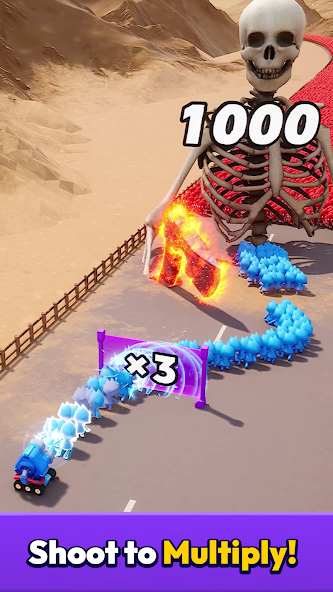
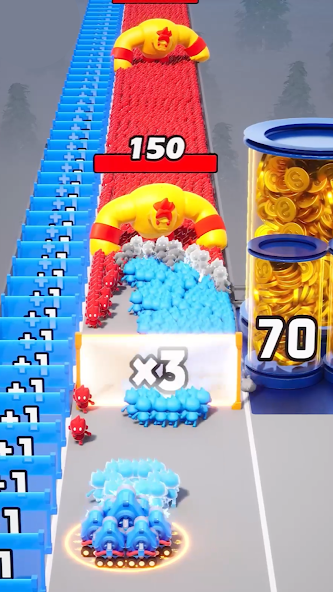
Mob Control begins with a cannon and an opposing force. The player aims and fires Mobs into a lane where gates can multiply the crowd, while moving gates and speed boosts alter the route or pace of an advance. The growing wave must break through enemy Mobs and reach a base; the player is not directly steering every unit, so aiming and timing the cannon are the important controls. The level elements make the path itself a tactical choice: a stronger gate can produce more units, but the crowd still has to pass through resistance and arrive at the target. That is the main battle loop the game builds its other systems around. For example, a doubling gate makes a surviving crowd larger before contact with defenders; it does not guarantee that every added unit reaches the base. That difference separates numerical growth from completing the attack.
The Armory separates three roles. Cannons launch the force, Mobs supply the mass that grows through gates, and Champions are larger units deployed to break through enemy crowds and reach bases. The player can unlock and level each category with collectible cards; wins provide booster packs of differing rarities, and the cards support evolutions as units advance. These roles can be combined rather than treated as interchangeable upgrades. The cannon influences how a wave starts, ordinary Mobs create its numbers, and a Champion adds a more powerful unit to the push. Progression therefore expands the available combinations while keeping the choice of firing lane and timing relevant in each encounter.
Base Invasion gives the cannon battle a rival stronghold as its goal. The player raids another base to take coins and claim bricks, turning the opposing structure into a resource target as well as the endpoint of an advancing crowd. That is a different objective from a standard stage, where the focus is breaking through the enemy force and reaching the base. Invasion makes the identity of the target matter: the player is attacking a rival position and seeking the rewards attached to that raid. It is a named mode with its own base-versus-base frame around the shared crowd and gate mechanics.
Base defense is handled through fortification and shields. Winning battles can earn shields that protect a base from raids, creating a defensive progression beside the offensive invasion mode. The two sides are related but ask for different results: the raid is about taking coins and bricks from another stronghold, while fortifying and shielding protects resources at home. This gives the base a role outside an individual lane encounter. The shield reward also connects match wins to defense, so a successful battle can contribute to a position between invasions rather than only improving the attack force.
Revenge and Counter-Attack are responses to hostile action. Revenge gives the player a chance to turn against an earlier attacker, while Counter-Attack offers another route to fight back against players who challenge the base. They use the same cannon-led crowd contest but place it in a retaliatory context instead of asking the player to select an unrelated arena objective. These modes add a social thread to the base system: an attack can lead to a response, and the response is resolved through the familiar choices of cannon fire, gate routes, Mobs, and Champions. They are distinct activities alongside Base Invasion.
Boss Levels replace the rival stronghold with a featured adversary and a special level layout. Their arenas are unique and award extra bonuses when the player overcomes the challenge. That makes them a separate target from Base Invasion, even though both ask the player to build a crowd and push through an arena. The boss encounter foregrounds the layout and the featured opponent, while the invasion emphasizes another base and its resources. Each special layout must be read on its own terms: a route that suits an earlier encounter may leave the crowd poorly positioned against the next adversary.
Championship Stars connect battles, base fortification and tournaments to the Champions League. Players earn stars through victories and other competitive activities, then use them to climb league standings. This is account-level progression above a particular stage: a Boss Level has its own adversary, an Invasion has a rival base, and the league supplies a longer-term competitive destination. Tournaments add another setting for earning stars, while base defense makes fortification part of the ranking path. The competition spans more than a single match type, even though each activity still depends on building a crowd and choosing a route through the arena.
The Season Pass adds quests and tier progression, with unlocks such as heroes, Cannons and skins. It is separate from Armory cards: the pass advances through quests and tiers, whereas cards level Cannons, Mobs and Champions and provide their evolutions. Keeping the two paths distinct explains how a player can work toward cosmetic or roster unlocks through pass tasks while improving battle units through card progression. Pass contents vary over time, so the lasting system is the relationship between quests, tiers and unlocks, not a particular seasonal reward. This provides an additional progression track alongside league stars and the Armory.
Voodoo's tower defence swaps placement for aim. Opening gates multiply the crowd, champions break the enemy line, and the progression behind it all is a card collection and an armory rather than a level map.
The aiming loop
Mob Control is published by Voodoo, and its own description is precise about the shape of the game: a tower defence where you grow your mob, deploy powerful champions and break through enemy bases. The growth happens by aiming and shooting at gates, and the level itself is built out of elements that make that decision matter — multipliers, speed boosts and gates that move.
That makes for a narrower tactical space than a traditional tower defence: there is no base to lay out before the fighting starts. The trade is that the whole battle wants your attention at once, because the line that was correct when you fired is not necessarily the line the mob is on by the time it arrives.
It is not only aim
The part that takes a while to notice is how much of the game happens outside the battle. Cannons, mobs and champions live in an armory where you unlock them and level them up through evolutions, and winning fights drops booster packs of varying rarity that feed a card collection used to strengthen your loadout. There are modes built around the meta as well: Base Invasion sends you at other players' strongholds to take their coins and bricks, Revenge turns the tables on whoever attacked you, and Boss Levels set up their own layouts with extra bonuses attached.
A monthly Season Pass sits on top of that with quests, tiers and unlocks for heroes, cannons and skins. So the honest description is a game with a short, legible battle and a longer collection behind it — the first impression of "aim at gates" is real, but it is the entry point rather than the whole of it.
Ads, passes and two places to buy
Mob Control is free and supported by ads, and the publisher offers two ways to quieten that. One is a permanent no-ads package or the Premium Pass, which disables the pop-up ads that appear automatically between battles and menus. The other is worth understanding before you buy anything: the optional rewarded ads stay in place, and they are opt-in buttons for things like doubled or quadrupled post-battle rewards, extra card upgrades, energy refills and speed-ups. They only play if you tap them, so they are a choice rather than an interruption.
The second thing to know is that there are two purchase channels for the same in-game content. Voodoo runs an official web shop on its own site, powered by Xsolla, which you log into with your Player ID, alongside the usual in-app purchases. That is two routes to the same thing rather than the same thing being charged twice — and for the free route, the ads are the price. Support sits under Settings, Help & Support, and your Player ID is at the bottom of the settings menu.
What rotates, and what to check
Progression runs through a league system: you earn Championship Stars by winning battles and fortifying your base, and you climb the Champions League with them. Events and pass content move with seasons, and so do the thresholds and rewards attached to them. If a race or an event sounds interesting in a description, check the version running in your own lobby rather than the one you read about, because the rules and entry conditions are the parts that change.
Should you play it
Yes, if you want short sessions with a mechanical skill you can feel yourself improving at. The gate aiming is satisfying, the level elements stay legible while you are learning them, and the cards, champions and season content give all those small sessions a direction.
Two things to weigh. The monetisation has several shapes at once — ads, a permanent no-ads option, a season pass and a web shop — so it is worth deciding which of those you actually want before you start tapping. And the game is rated 12+ on its official site, which matters if you are the one paying for someone else's account.
Go deeper with V4mp
- Developer
- Voodoo
- Genre
- Arcade strategy
Explore Mob Control further
Explore the wiki for detailed reference pages on the game's world, systems, items and locations.