
About Mirror's Edge Catalyst
Mirror’s Edge Catalyst follows Faith Connors, a Runner navigating the high-rise city of Glass, where the Conglomerate’s polished image hides rigid control over its citizens. The single-player campaign combines first-person parkour, close-quarters encounters and story missions as Faith reconnects with the city’s underground community and challenges KrugerSec.
Glass presents itself as a bright, orderly showcase of technology and architecture, but the city is divided by the Conglomerate’s social hierarchy. Its loCaste residents work for the prosperity of the privileged hiCaste, while KrugerSec enforces the system through surveillance and armed security. Runners live on the rooftops as offGrids, carrying messages and goods beyond the control of the city’s network. Faith Connors returns to this world after time in prison, owing money to Dogen, a local power broker, and reconnecting with Noah, a Runner who acts as a mentor and organizer. The story follows Faith as she takes jobs, encounters KrugerSec and becomes involved in a wider conflict over the people and technology that shape Glass.
The campaign’s missions use Faith’s work as a Runner to connect personal obligations with the larger struggle against the Conglomerate. Noah’s hideout provides a home base and a point of contact with other Runners, including Icarus, whose competitive attitude contrasts with Noah’s experience. Gabriel Kruger leads KrugerSec, the security force aligned with the Conglomerate. Mission objectives range from reaching a destination across the rooftops to entering a controlled facility, helping an ally or escaping an armed response. Because Glass is open to free traversal, objectives can sit within a larger connected district instead of at the end of a sealed level. Story progress opens further places and routes. The central activity remains navigating spaces at speed and deciding how to pass obstacles or avoid the authorities.
Movement is built around momentum: how Faith approaches an obstacle, preserves speed through it and links the next move affects how far and quickly she can travel. Running, jumping, wall-running, climbing, sliding and vaulting combine into continuous routes across rooftops, interiors and service structures. A precisely timed vault can preserve or increase momentum; a springboard jump trades some speed for extra height. Sliding carries Faith under low barriers and can extend farther when she enters with speed, while a landing roll helps retain momentum after a drop. Pipes, ladders, ledges and ziplines offer different transitions, and corner grabs or quick turns can redirect a route without bringing the run to a halt. Some advanced moves are initially unavailable and must be unlocked, so the movement vocabulary grows as the campaign progresses.

Runner’s Vision and the map help with orientation without replacing route-finding. Setting a waypoint lets Runner’s Vision highlight useful geometry in red, and its settings can show a guiding ribbon, mark the relevant objects without that ribbon, or turn the guidance off. The indicated route is one viable way to reach the objective, rather than a guarantee of the quickest line. A ledge may be above, below or behind Faith, and a direct path can involve spotting a pipe, wall or opening the guide does not emphasize. Looking outward across a gap, tracing the next handhold and judging how much momentum a landing will preserve are practical parts of traversal. This turns travel between mission markers into a sequence of small spatial problems, with the same route serving as safe passage, an escape from pursuers or a way to reach an otherwise hidden platform.
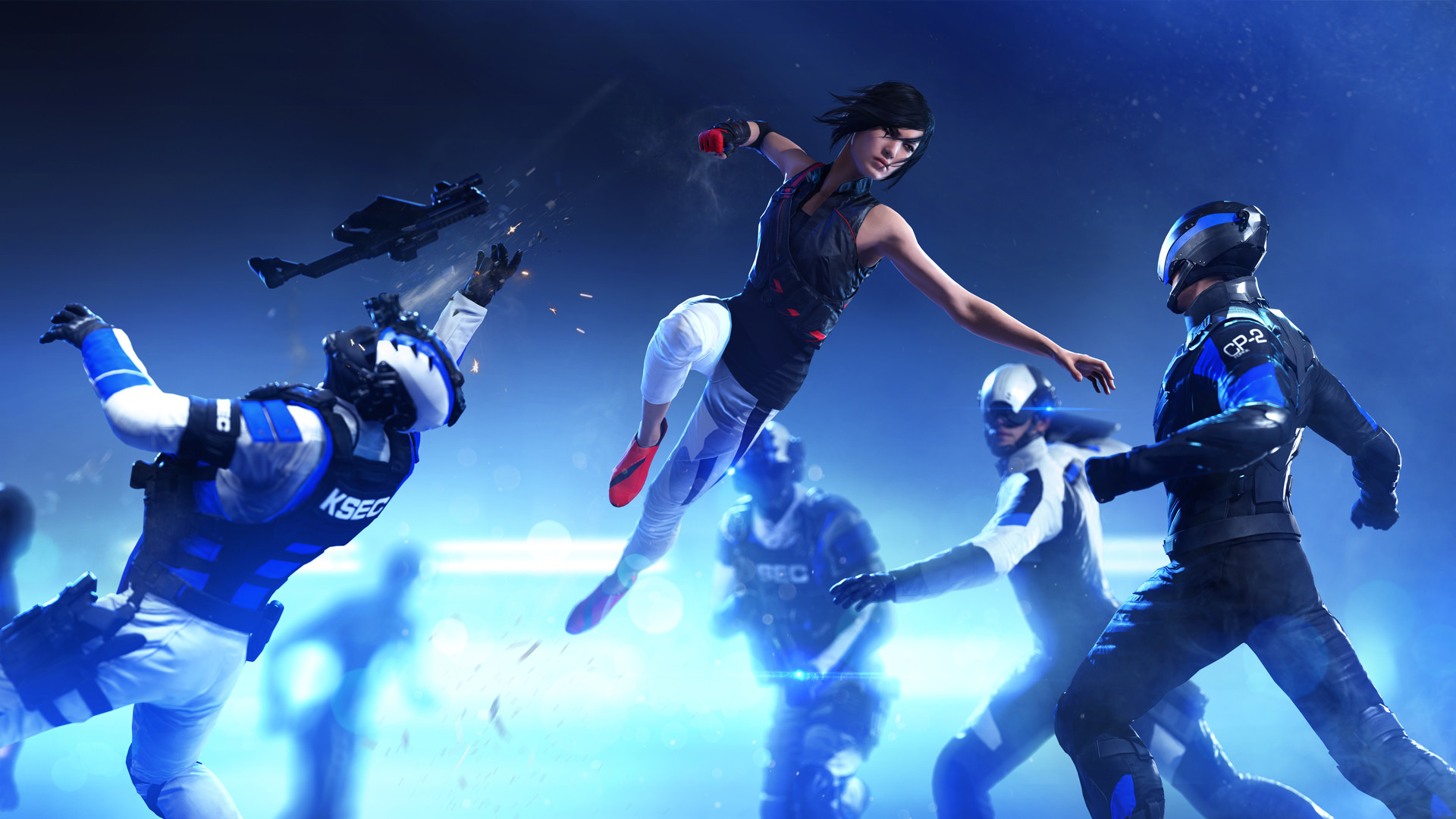
KrugerSec encounters make movement and combat interdependent. Faith carries no firearm; she uses punches, kicks, shifts and attacks performed during traversal. She can try to outrun or evade a group, or use the environment to knock an opponent into a wall, off a ledge or into another guard. A shift dodges incoming attacks and can reposition Faith toward an enemy’s vulnerable side, while a traversal attack combines a wall-run, jump or slide with a strike. Repeating a single attack pattern makes enemies adapt, so varying attacks matters when a fight cannot be avoided. Sustained movement builds the Focus Shield, which protects Faith from attacks while it remains charged; stopping, stumbling or taking damage reduces it. The disruptor is a kinetic gadget charged by movement that can stun nearby security personnel; upgrades extend it to certain surveillance devices and automated threats. These systems make maintaining speed a form of defence as well as a means of travel.
Tasks and campaign progress supply experience, which in turn awards Upgrade Points for Faith’s progression tree. Faith begins with some abilities and learns further moves through the main story, while earned points unlock additional movement, combat and gear options. The city includes district activities such as security hubs, which combine dealing with guards and shutting down a facility, plus opportunities to make deliveries or help other Runners. These activities provide extra experience and additional context about the people of Glass. Main-story contacts can call on Faith again after she has helped them, giving side missions a connection to the relationships established in the campaign. The progression loop therefore links movement practice to new capabilities: completing objectives awards experience, new abilities expand what Faith can do, and those moves help her tackle more demanding routes and encounters.
The game’s delivery work gives its traversal a concrete set of constraints. A fragile delivery must reach its destination before the timer expires, and hard landings or enemy hits damage the carried item; if it is destroyed or time runs out, the task fails. A covert delivery adds the need to stay out of sight of KrugerSec personnel and camera sensors while still moving quickly enough to meet the deadline. Other opportunities ask Faith to help someone evade detection or carry a dead-drop between machines. These objectives change what counts as a good route: a short line through a camera’s view may be less useful than a slightly longer path behind cover, while a fragile parcel rewards controlled landings as much as raw speed. They draw directly on the same wall-runs, vaults, slides and momentum management used in the campaign, giving Faith’s role as a courier a practical expression within the single-player city.
- Developer
- DICE
- Genre
- First-person action-adventure / parkour