
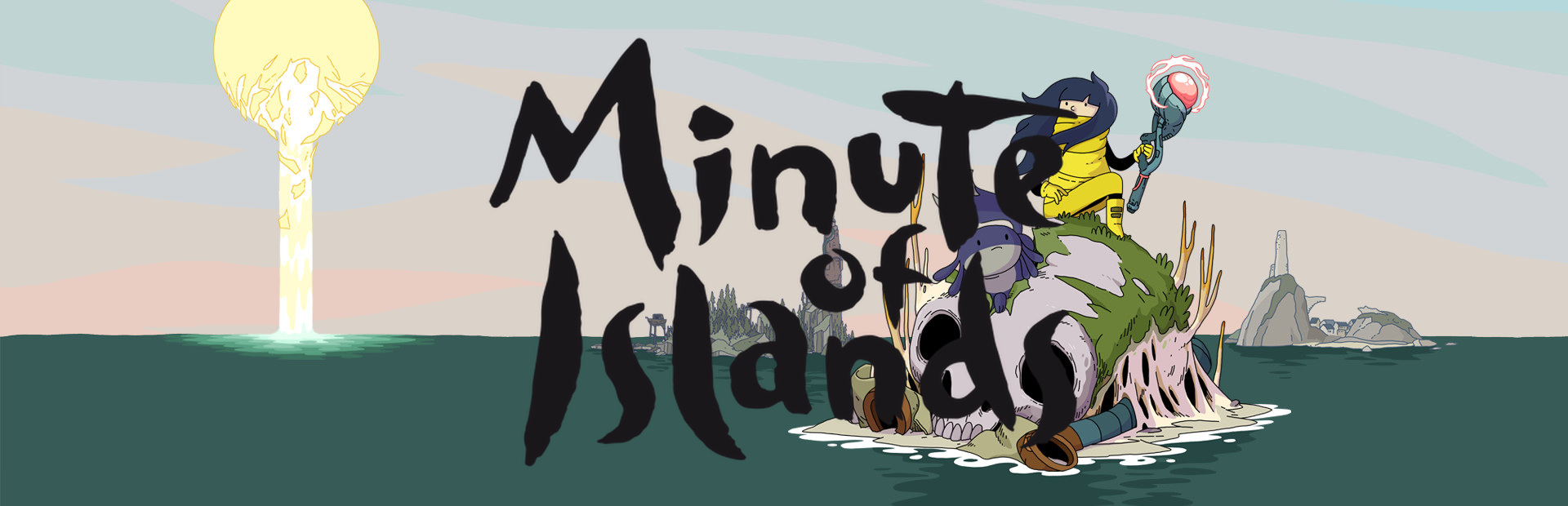
About Minute of Islands
Minute of Islands follows Mo, a young tinkerer trying to keep a spore-threatened archipelago alive. With the Omni Switch, she travels between islands, repairs air-cleaning devices and descends into the buried machinery of ancient giants. The journey links environmental puzzles and platforming with a family story about isolation, memory and the weight of being the person expected to fix everything.
Mo lives with her family on an archipelago whose apparent pastoral calm rests on a failing system. Yellow spores spread through the islands, while machines built by an ancient race of giants have kept the contamination at bay. Those giants now lie dormant below the surface, and the devices that once protected the inhabitants have stopped working. Mo is a skilled tinkerer, so she takes responsibility for restoring the machinery. The crisis gives the adventure a practical shape—each island has a failing system to address—but it also creates pressure around Mo’s belief that the survival of everyone depends on her alone. The setting is not a fresh wilderness to settle: it is a damaged home whose human and mechanical histories remain intertwined, and every repair exposes more of what that dependence has cost.
Mo’s repair work keeps pulling her away from the family she means to protect, and the story lets the gap between those aims remain visible. Her inner monologues show that she can misread people close to her, so the player encounters family history through a perspective shaped by isolation as well as through what relatives say. Memories scattered through the islands add fragments of life before the Exodus and give context to the home Mo is trying to preserve. These recollections do not branch the main route or change the repair objective; they deepen the meaning of the places the player is already crossing. The contrast between public responsibility and private relationships gives the journey its emotional frame: Mo’s role as a mechanic makes her useful to the community, but the story also asks what that role has cost her and the people who remain beside her.
Mo moves along a side-on route, running and jumping over obstacles, climbing onto ledges and finding a path through rocky terrain. Nearby points of interest use blinking prompts to signal an available action, such as examining, picking up or manipulating an object, or speaking with someone who remains on the island. Some objects can be carried and used when the corresponding hotspot appears; the pause menu keeps these items visible. This makes exploration a sequence of physical navigation and contextual interaction rather than a broad search across an open map. A ladder, door or ledge can shape the route as directly as a machine does, and the player must judge where Mo can climb, jump or move onward. When her work in a location is complete, she boards her boat to continue elsewhere. The controls keep the focus on crossing and reading the environment, with the Omni Switch reserved for the giants’ technology.
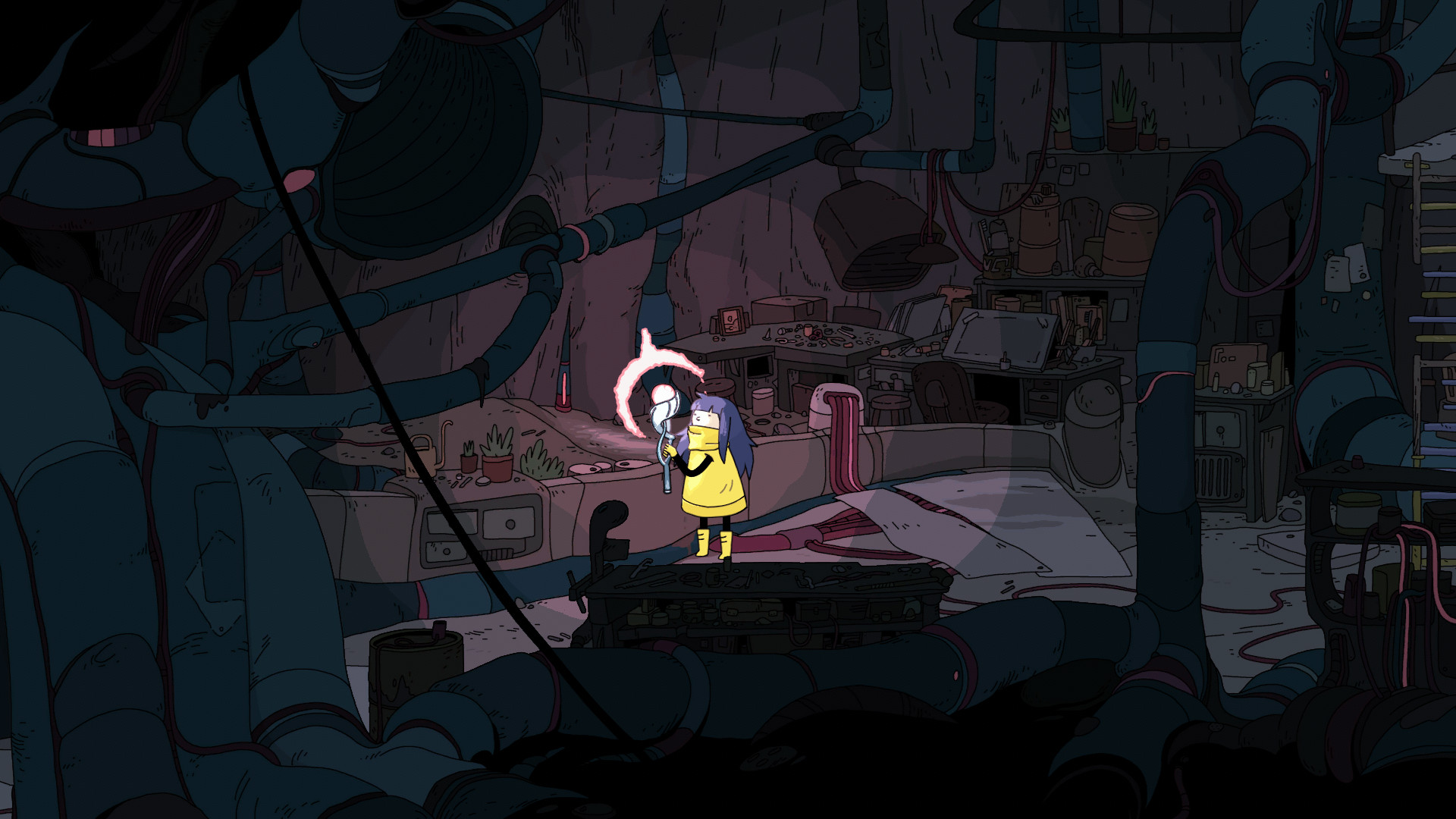
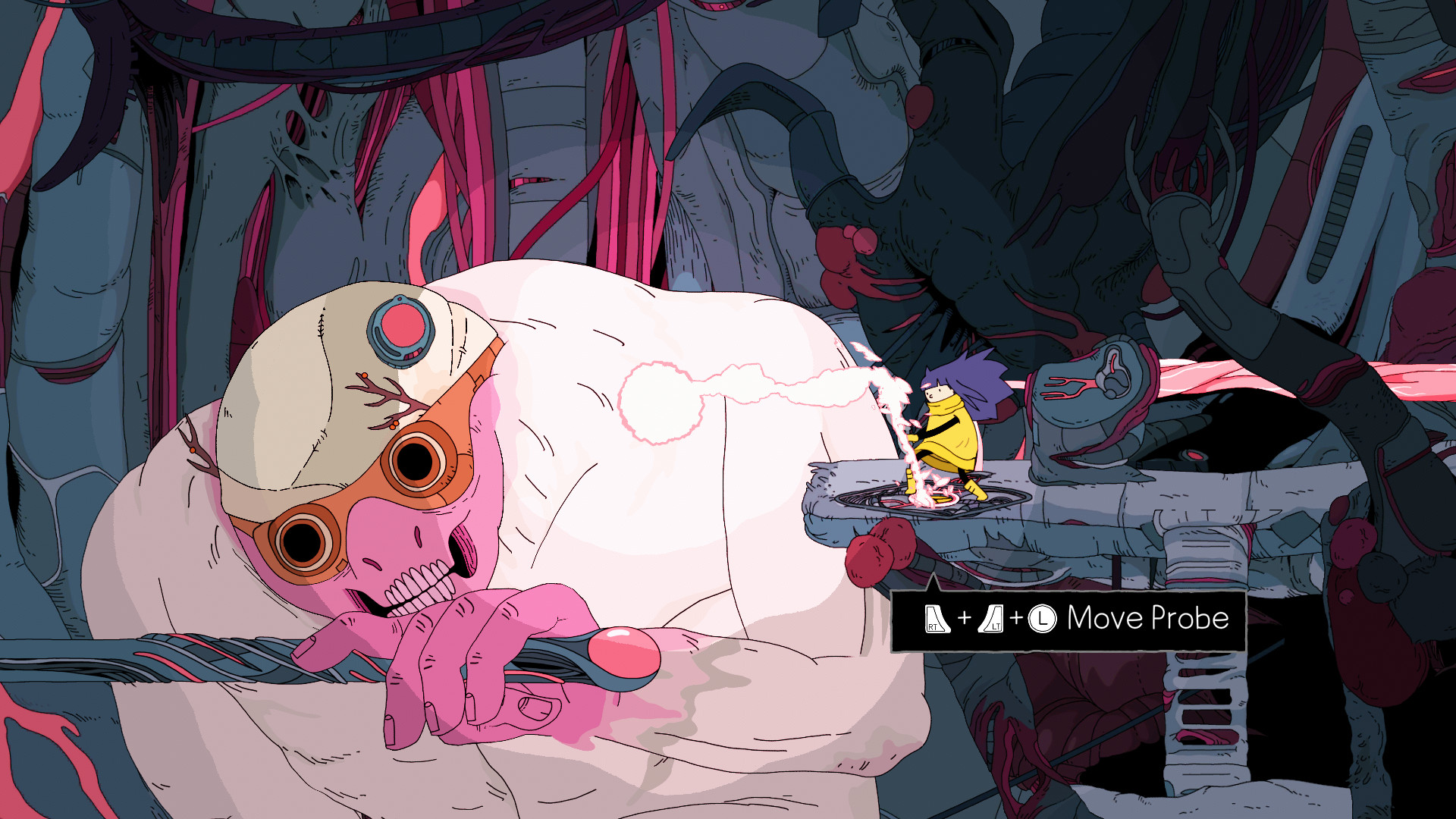
The Omni Switch lets Mo manipulate the devices that keep the giants’ system running. At an air filter, interaction can be a prompted sequence of button presses; larger fuses can be moved only after she has used the Switch on them, and the player then has to work out how the awakened device fits into the surrounding machinery. Underground, the game also uses repairs such as reconnecting circuits, rebooting machines and moving membranes into position. Doors, ladders, climbable ledges and pushable or pullable objects contribute to the same environmental problem-solving. These actions give the tool a precise role: it is a way to access and operate ancient technology, not a generic combat weapon. The player learns what a device can do from its position and response, then uses that information to get through the next part of the machinery. Restoring the filters and giants grows from these small operations rather than from combat or a character-upgrade system.
Memory is also presented as something the player has to encounter in the space. In certain places, Mo can stop and remember; a jellyfish-like orb appears and drifts nearby, and moving through it reveals a short recollection attached to that location. These discoveries are optional, but they add fragments of the world before the Exodus and of Mo’s earlier life. Separate trance sequences make memory part of the platforming itself. While Mo is in a spore-induced dreamscape, she must find and gather memories to emerge from the fugue. Some of these surreal routes ask the player to consider where her shadow falls or how her reflection moves in water, not just where her body stands. That changes the usual reading of a platform: an apparently unreachable spot may be addressed through its reflected or shadowed counterpart. The dream sections therefore give the game a distinct visual puzzle language while tying its strange images to Mo’s condition.
The family’s conversations challenge Mo’s assumption that remaining on the islands proves she must keep carrying the whole burden. Her sister, grandmother and uncle have stayed, yet they make clear that Mo’s refusal to leave has shaped their own decision to remain. Their dialogue can turn bitter because their safety is entangled with her duty and with her conviction that she must continue the repairs. The conflict does not reduce them to people waiting for Mo to fix a machine; their responses question whether her chosen role is helping the family or keeping everyone bound to the same endangered home. The omniscient narration delivers their dialogue as well as Mo’s inner thoughts, letting the player hear the disagreement and the interpretation she builds around it. Memories widen this context, but the tension is present in the exchanges themselves. After these exchanges, the family returns to its work, leaving Mo to continue the repairs while their disagreement remains unresolved.
The islands share a large, rocky character, but the amount of local filter work varies: a location can require attention to between one and four filters. A small on-screen counter marks each one as it comes online, giving a clear sense of how much remains in the current area. The sites also carry the traces of a former tourist destination, with ruined buildings and monuments among fossilized remains and wildlife. Fungal growth changes the surfaces it touches, while grasses, shorelines and moving creatures keep the setting from feeling like a sequence of empty repair rooms. Some machinery appears to use organic forms, so the old technology belongs visually to the same ecosystem it supports. These details provide differences of scale and landmark without assigning the islands unsupported biome names. Mo navigates each site, addresses its filters, and then descends toward the local giant before returning to her boat. The counter and visible landmarks make that location’s immediate task legible as she explores.
Sound carries much of the story’s tone. Megan Gay narrates the characters’ dialogue and Mo’s thoughts, shifting from a measured storybook delivery toward a sharper edge when Mo is alone with difficult feelings. Many quiet passages leave space for wind or creaking wood; ethereal woodwinds and discordant chimes emerge at particular moments, so music can signal an emotional change rather than play continuously over every scene. The environmental soundscape also includes the ocean and scavenger birds, set against mechanical noises and the giants’ laboured breathing. These details make the shift from open island to enclosed underground spaces audible as well as visible. Narration, ambient sound and music work together to keep the player close to Mo’s perspective: the world can sound quiet and exposed on the surface, then heavier and more intimate near the machinery. That contrast gives the restoration work a sensory presence without turning it into a combat-driven adventure.
- Developer
- Studio Fizbin
- Genre
- Narrative puzzle-platform adventure