
About Max Payne 2: The Fall of Max Payne
Back in the NYPD after a routine murder investigation, Max Payne crosses paths with Mona Sax, a woman he believed dead and now a murder suspect. Their search for answers leads through a crime-ridden New York, where underworld forces, shifting loyalties and Max’s past draw the detective into another descent through a film-noir story told alongside slow-motion third-person gunfights.
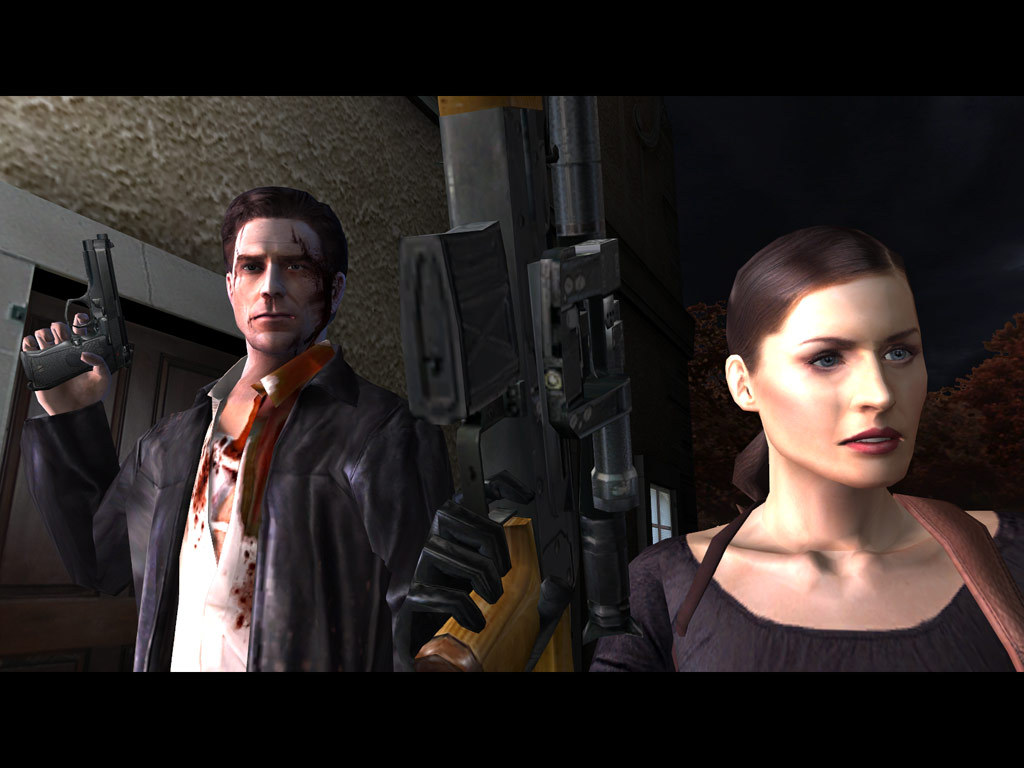
Max Payne 2: The Fall of Max Payne returns to a New York detective whose life has been left in ruins. Max is back in the NYPD when a routine murder investigation brings him face to face with Mona Sax, a woman he thought had died and who is now suspected of murder. She has a connection to the questions that continue to trouble him, but the case quickly reaches beyond a single crime. Armed men from the city’s underworld stand between Max and the answers, while the relationship between the detective and Mona complicates what might otherwise be a straightforward investigation. Remedy frames that premise as a film-noir love story: the plot moves through danger, loss, suspicion and attraction, with Max’s private history shaping how he reads the people and violence around him.
The story unfolds across a sequence of authored locations in a dark, contemporary New York, moving Max from police work into the city’s criminal networks and the private spaces caught between them. The action is punctuated by graphic-novel panels and cinematic scenes, while conversations, television broadcasts and answering machines add details about characters and events. These objects are part of the game’s storytelling texture rather than a separate collection campaign: Max can stop to listen or watch, and some encountered characters may offer information or practical help. The plot deliberately follows a chain of investigations and confrontations, so the player alternates between advancing through hostile spaces and taking in the clues or exchanges that give those encounters context. Mona remains central to that changing perspective as the investigation develops.
Combat is a third-person shooter built around reading a room, choosing a weapon and moving between cover and exposed lines of fire. Max faces enemies with different levels of training and stamina; some wear body armour over the torso, and different parts of a target can take damage differently. Weapons also trade characteristics such as firing rate, damage and accuracy at range, while ammunition has a carrying limit for each weapon. That makes a weapon switch a practical response to the situation rather than a cosmetic choice: a rapid close-range gun, a more precise option or a weapon with remaining ammunition can each suit a different angle or distance. Explosive barrels and ammunition crates provide another combat variable, since a shot can set them off and damage several nearby enemies. Some fights also make vertical space and movement important: a pillar can shield a reload, while a side step or roll changes the angle before a protected torso is exposed.
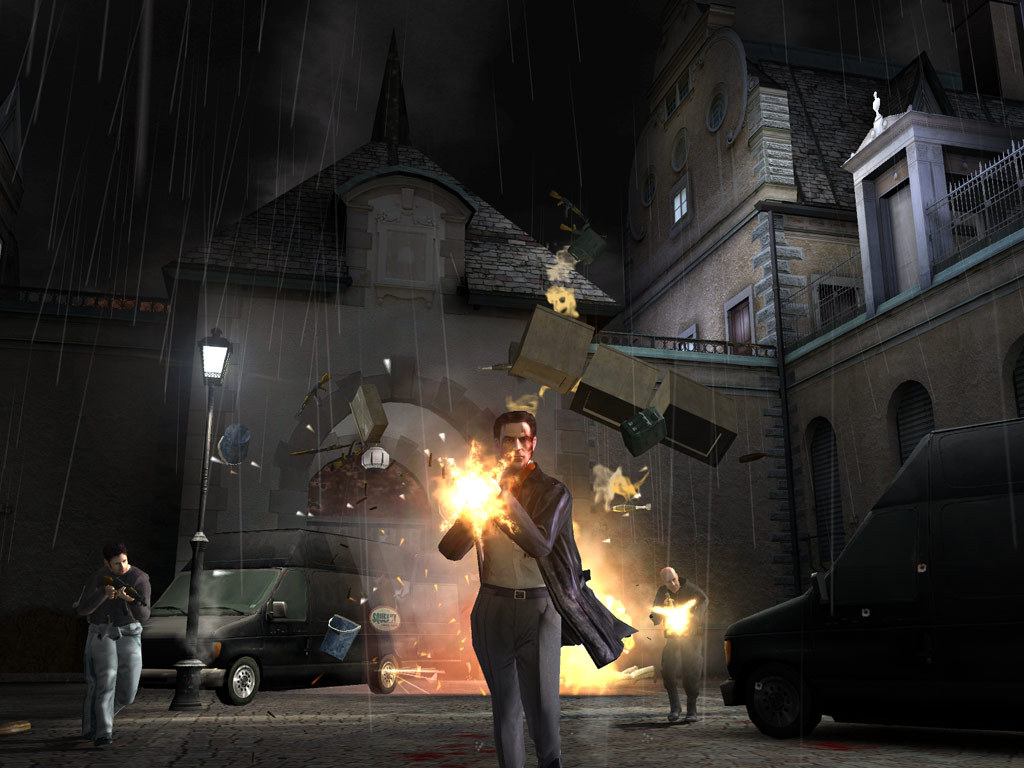
Bullet Time is the signature way Max changes the pace of a gunfight. Activating it slows the surrounding action while Max can continue to aim in real time, giving the player a short window to line up shots, track incoming fire or reposition. Its meter drains while active and replenishes gradually; defeating enemies restores a little of the resource, so moving into an encounter and maintaining pressure can extend its use. Successive quick kills shift the meter through brighter shades of yellow and increase the advantage by slowing enemies further while Max’s own movement remains comparatively fast. Shootdodging adds a physical leap through the fight, combining evasive movement with gunfire. Ordinary dodges, crouching and using walls or other obstacles still matter when the limited slow-motion resource is depleted or a reload is needed.
The player’s route through each encounter also depends on supplies and on other characters who join a fight. Painkillers restore health, while weapons and ammunition can be found away from the main path; Max’s attention may turn toward objects that can be used to advance or reveal story detail. Allies are functional participants in combat, and their actions can change how a room unfolds, so the game encourages the player to keep pace with them instead of charging ahead alone. The Detective difficulty setting adjusts enemy behavior and performance in response to how the player is doing: it can ease pressure when progress is difficult or make opposition more capable when encounters are proving too easy. After the first completion, the Hard Boiled option removes that self-adjustment and sets enemies at their toughest level.
Finishing the campaign also opens distinct ways to revisit its combat. New York Minute places a timer over the action: defeating enemies adds time, while story panels and cinematics pause its progress, and Bullet Time slows the timer in step with the action. The mode records runs so a faster completion can be compared with earlier results. Dead Man Walking turns survival into the objective instead of presenting the story as a timed run. It begins with one enemy, adds more as time passes, and brings defeated enemies back after a short delay; kills add seconds to the clock, while staying alive builds the score. These unlocks give the game’s final stretch a different purpose after the story has ended, turning its established gunplay into separate time-pressure and endurance challenges.
- Developer
- Remedy Entertainment
- Genre
- Third-person shooter