
About Manifold Garden
In Manifold Garden, you explore a stark architectural world where gravity can turn any visible surface into ground and geometry repeats beyond the horizon. Its puzzles ask you to use those rules to move coloured cubes, redirect water and cultivate structures that open routes through the world.
Manifold Garden places its first-person explorer inside a world of bare geometric structures: stairs, platforms, towers and open spaces assembled into architecture that can look impossible from one angle and traversable from another. The central rule is that gravity is not fixed to the floor beneath you. By turning it toward a visible surface, you can walk across a wall or ceiling and treat it as the new ground. The setting gives no dialogue-led explanation for the larger world; instead, its repeating structures and the puzzles built into them carry the experience. Movement, observation and experimentation are linked: a wall that seems to block progress may become a route when it is reoriented, while a staircase can connect spaces in a way that is difficult to read until gravity shifts. Its surfaces use a spare visual language of simple polygons and few textures; stairs may run in several directions, so a close view can read as a small arrangement while the larger pattern only becomes clear across the room.
Changing gravity is also how you reinterpret the same room. A doorway seen from one orientation may sit above a ledge in another, and routes that appear to end can continue when a different surface becomes walkable. Geometry repeats in every direction, so falling away from a structure returns you to the world rather than ending the attempt; the repeated architecture can place you back on a surface that was difficult to reach from the current side. That rule makes the void part of navigation, not a conventional hazard. The player can inspect the structure, change orientation and use the way spaces loop to reconsider how distant platforms connect. As the environments become more layered, solving a room depends on tracking both the immediate floor and the larger arrangement that surrounds it.
Colour-coded cubes introduce a second set of rules. Cubes can be carried and placed on matching switches to activate doors or other mechanisms, but their colours also correspond to how gravity acts on them. A cube only moves under the orientation associated with it, so a puzzle may require changing the room, moving the cube, and then turning the world again to reach a different surface. Later arrangements ask you to use more than one cube at a time. In one puzzle, several cubes have to brace a vital cube in a specific sequence, using their separate gravity properties to hold it in place. A cube can therefore act as a support as well as a switch weight. Stairs, raised platforms and switch combinations make the sequence matter. The task is not simply to find a key and take it to a door; it is to work out which orientation lets each object occupy the place where it can affect the architecture.
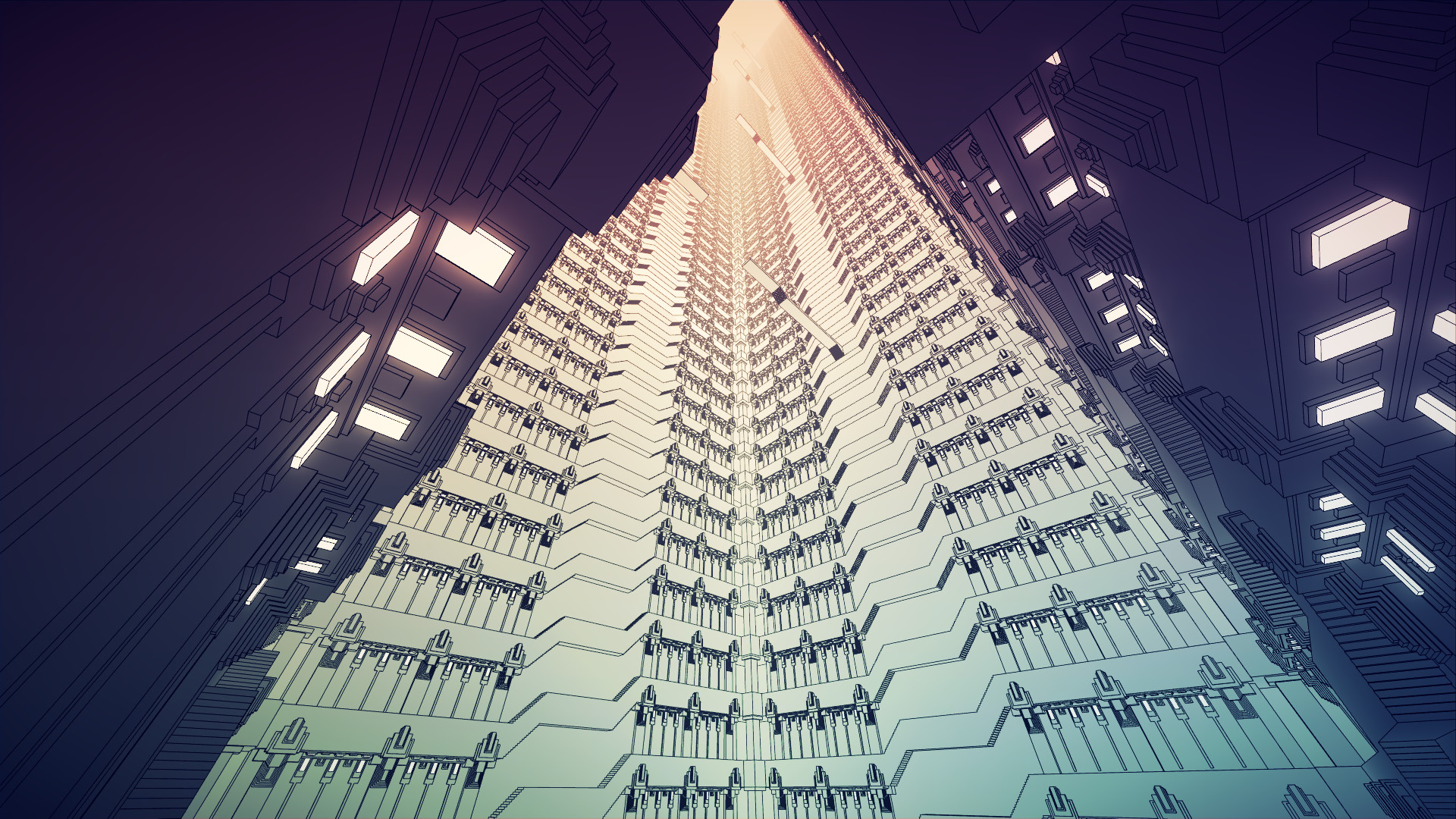
Outdoor spaces function as hubs rather than one continuous corridor. Each hub contains a group of connected puzzles; clearing its route opens a way to the next area. Some environments are short passageways or single rooms, while a few earlier spaces can be revisited when a newly available means lets the player open a door that was previously closed. This makes progression operate at two scales: solve the current room, then read how it fits into a larger hub and the route beyond it. The game is mostly linear, but those occasional returns give an earlier architectural space a new purpose instead of treating every solved area as permanently finished.
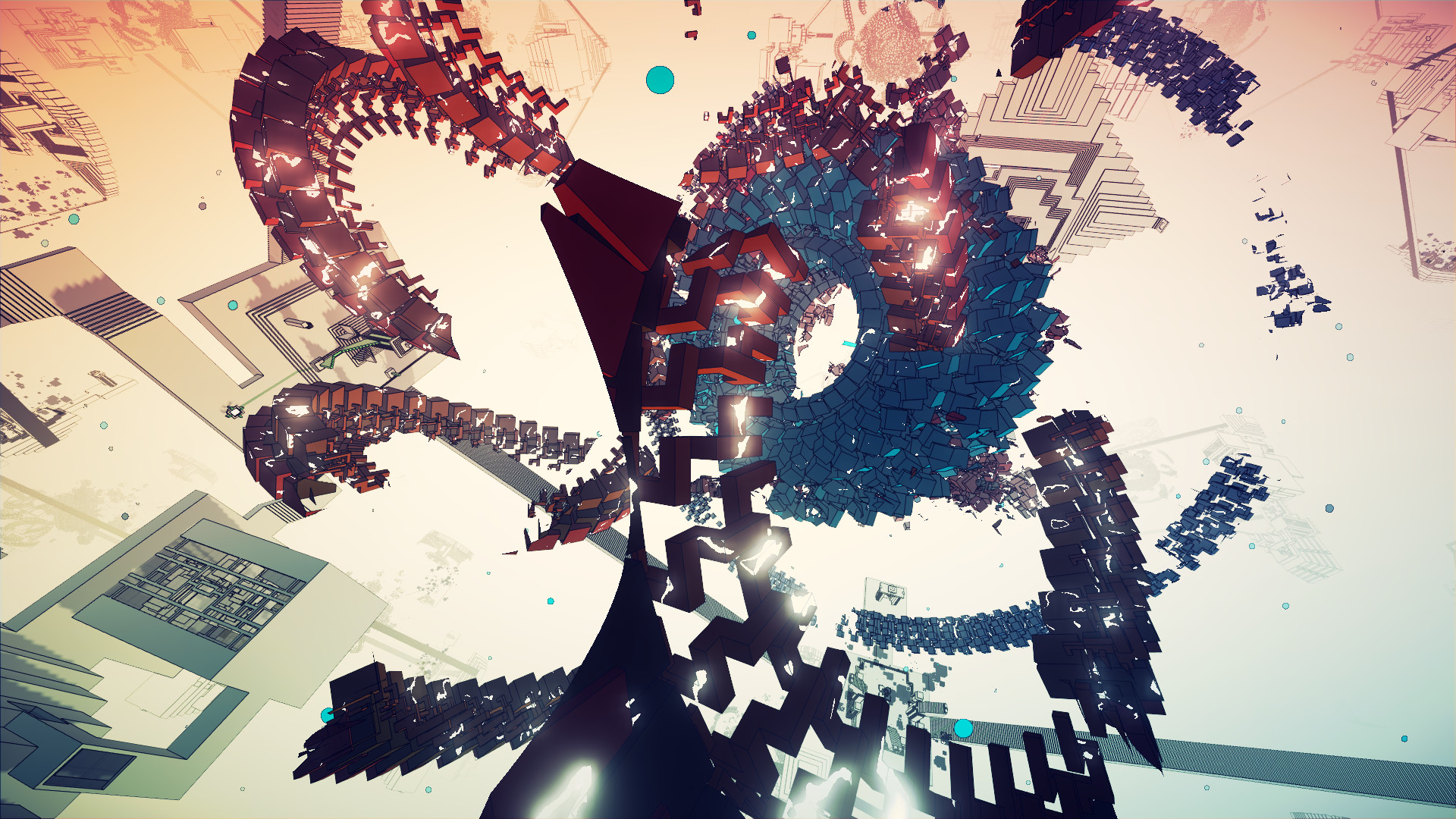
As the puzzles expand, the garden becomes a system that the player can cultivate. Cube trees produce cube fruit; fruit can be planted in special places, and water supplied to those spots helps new trees grow. The resulting vegetation can create further fruit and open paths that were not present in the barren architecture. Growth is tied to where the player places the fruit and supplies water, so the garden changes through a sequence of concrete actions rather than appearing as scenery. A puzzle may ask which planting site can support a new tree and how that new growth changes the surrounding structure. The new tree then produces more cube fruit, extending the same process into later spaces. Vegetation is therefore a resource the player arranges to reshape the route through the architecture.
Water has its own set of puzzle controls beyond serving as a resource for plant growth. Streams can be bent through space, frozen and restarted, so the player can change their path and control when flow resumes. A stream routed into a turbine can power the mechanism that opens a door. That makes water delivery a spatial task: the route has to reach the correct device, and the flow state must be managed as the surrounding architecture is navigated. The stream is not simply a decorative effect or a fixed channel; its direction and movement are part of the puzzle. This system adds a different kind of planning from placing a cube on a switch, since the player shapes a continuing flow through the environment and directs it toward the mechanism that changes access.
- Developer
- William Chyr Studio
- Genre
- First-person exploration puzzle game