
About Mafia II: Definitive Edition
Returning from wartime service to 1940s Empire Bay, Vito Scaletta turns to his friend Joe and the mob as he tries to escape poverty and repay his family’s debts. This remastered crime drama follows their rise through chapter-based jobs, city driving, police attention and increasingly dangerous gunfights.
Mafia II: Definitive Edition follows Vito Scaletta, a young Italian-American who returns from military service to postwar Empire Bay and looks for a way out of the poverty that shaped his childhood. His old friend Joe Barbaro offers a path into organized crime, and the pair begin with jobs that promise money and status but carry escalating consequences. The story moves between the 1940s and 1950s, changing the city’s season, streets and public mood as Vito’s place in the underworld changes. Empire Bay is a fictional New York-inspired port city built around neighborhoods, industrial work and the growing consumer economy of the postwar years. The central drama stays close to Vito’s family ties, friendship with Joe and effort to become a made man, while each new job tests the gap between the criminal life he imagines and the responsibilities it brings.
Progress is organized around story chapters rather than a stream of unrelated open-world jobs. A chapter sends Vito to meet a contact, travel to a location and carry out a task, with conversations and cutscenes connecting smaller crimes to the family’s wider business. Early work includes theft and robbery; later assignments raise the stakes through armed confrontations and more complicated plans. The city remains available as the connective space between objectives, but the narrative determines where the player goes and what must be done next. Joe is both a partner in the criminal work and a contrast to Vito: he is more comfortable with the money, cars and social life that crime can provide. As their standing changes, the missions bring them into contact with other mob figures and competing interests, without turning Empire Bay into a territory-management strategy game.
Driving and car theft are woven into many assignments. Empire Bay’s streets contain sedans, sports cars, delivery vehicles and larger trucks, and each handles differently according to its size and performance. Vito can take a parked or occupied vehicle by breaking a window or picking a lock; the quieter lock-picking interaction uses a sequence of tumblers, so the player balances speed against attracting attention. A speed limiter supports travel within posted limits, while damaged cars become harder to control and can be taken to a body shop for repairs, tuning, paint and wheel changes. Garages let Vito keep vehicles for later use. These details make cars part of the crime loop: a vehicle gets him to a job, provides an escape route, and can draw police scrutiny if its identity is already known.
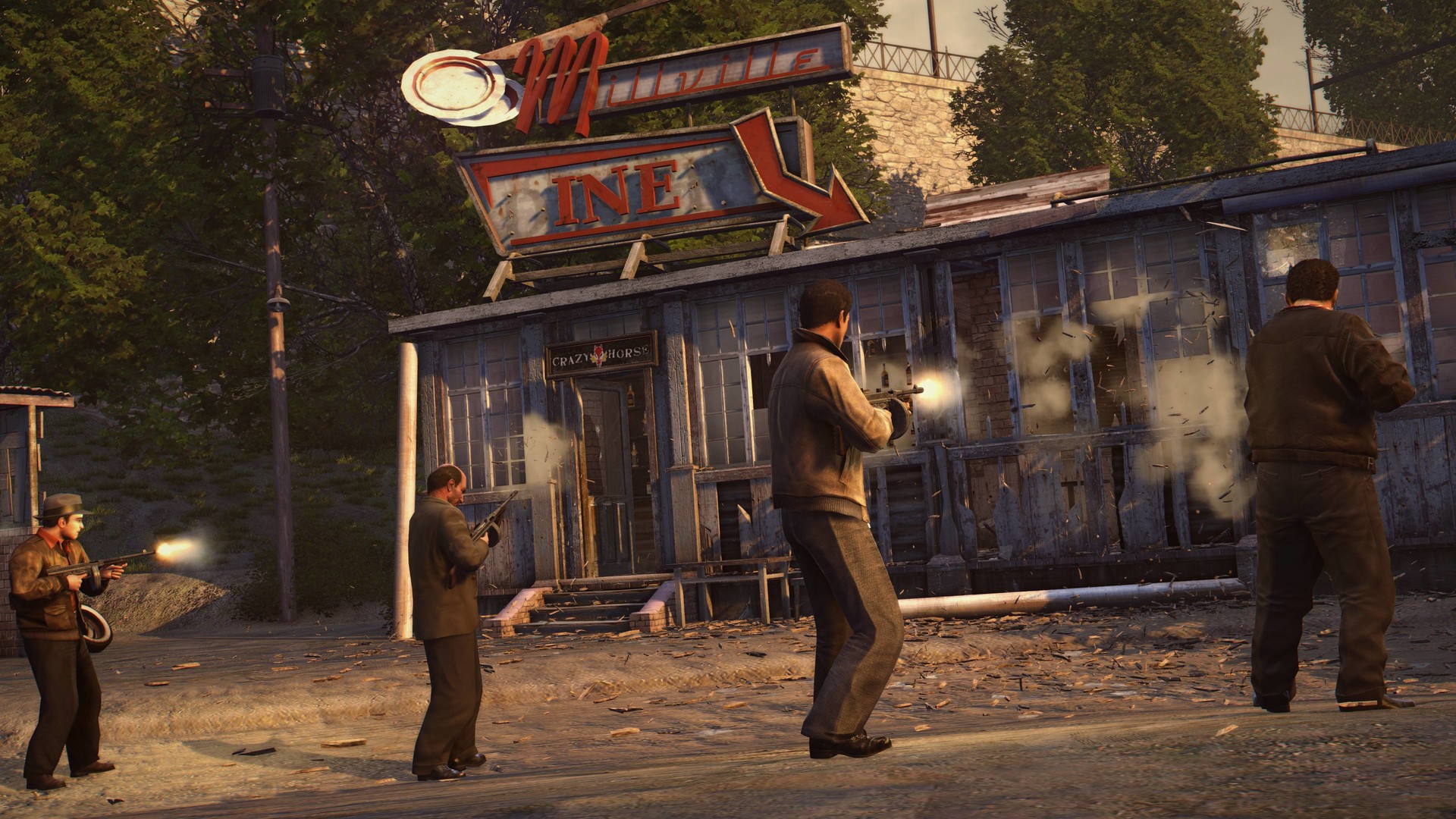
Gunfights use a third-person cover system. Vito can press against a wall or object, fire from protection, then leave cover to change position as enemies move or return fire. The weapon supply includes handguns, revolvers, rifles, shotguns, machine guns and thrown explosives; gun shops sell standard firearms and ammunition, while mob-connected suppliers provide more powerful equipment. Close encounters can instead become fistfights, where light and heavy punches, dodges and combinations create a distinct rhythm from aiming and firing. Health recovers only partly over time, with food or drink needed to restore it further, so a fight can affect the resources available for what follows. Mission spaces vary between streets, interiors, businesses and industrial locations, and the shift from driving to combat gives each chapter a sequence of connected actions rather than a single arena encounter.
The wanted system tracks both Vito’s identity and the vehicle he is driving. Police recognition rises while officers pursue him; the alert can concern his appearance, the car’s plates, or the seriousness of the offense, and the response can escalate from a fine to arrest or armed pursuit. Changing clothes can address recognition of Vito, while a body shop can replace plates when officers are looking for the car. Small violations and a major crime therefore create different problems, and the player can decide whether to evade officers, pay a fine, surrender, bribe a cop or resist arrest when confronted. This system ties preparation to travel: clothes, the chosen vehicle and its plate number can matter after the crime itself is finished. The map and radar also point toward shops, garages, mission markers and police, helping the player navigate between errands and story objectives.
The Definitive Edition packages the 2010 game as a remaster with improved visuals and audio, and 2K lists the main campaign alongside three story expansions: The Betrayal of Jimmy, Jimmy’s Vendetta and Joe’s Adventures. It also includes the Greaser, Renegade, Vegas and War Hero bonus content packs, which add cars and outfits; 2K says those bonus items unlock through completing chapters of the main story. The story expansions add separate perspectives and jobs to the overall package, rather than changing Vito’s central campaign into a different edition of the same plot. This version therefore contains more than the base story while keeping the original campaign’s chapter structure, Empire Bay setting and progression through Vito’s criminal career at its center.
- Developer
- Hangar 13 and D3T (Steam listing)
- Genre
- Action-adventure