
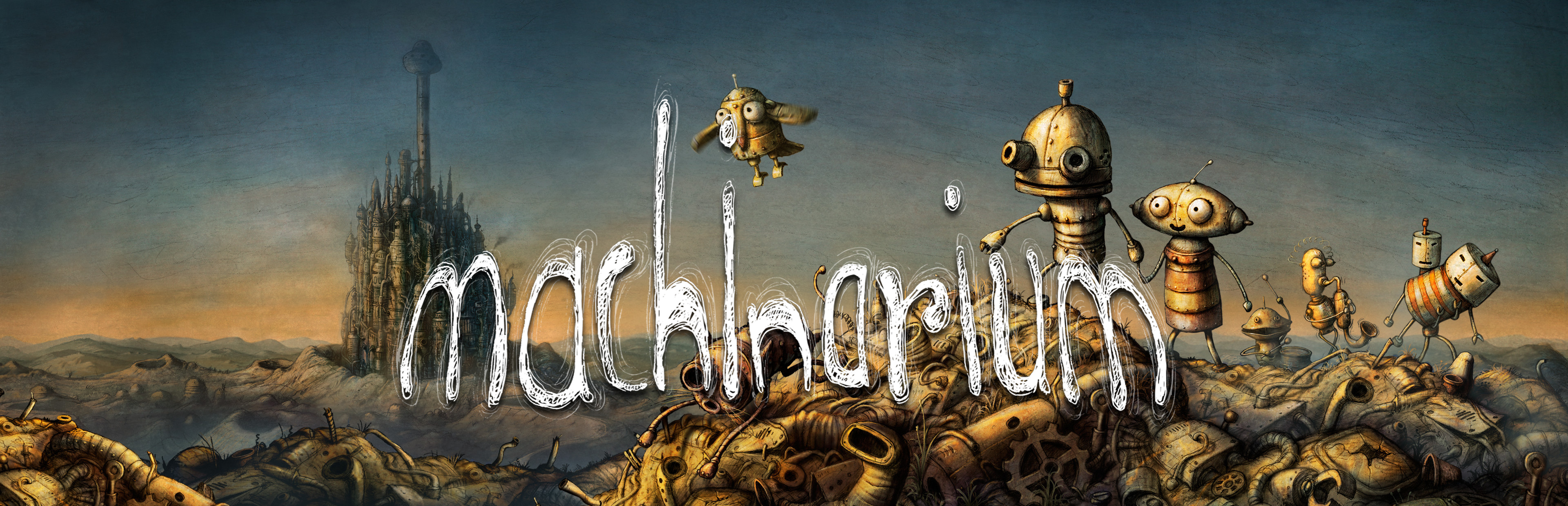
About Machinarium
A small robot named Josef is discarded on a scrapheap outside the city. He reassembles himself and works through a hand-drawn world of machines, wordless characters and environmental puzzles to return to Machinarium, rescue Berta and confront the Black Cap Brotherhood. Point-and-click exploration combines object problems, logic puzzles, arcade diversions and visual storytelling.
Machinarium follows Josef, a little robot discarded on a scrapheap outside the city that bears the game’s name. He reassembles himself and makes his way back inside, where the Black Cap Brotherhood has kidnapped Berta, his robot girlfriend. The adventure also asks him to help the city’s head and oppose the gang. There is no spoken dialogue: characters express thoughts and desires through gestures, animations and illustrated thought bubbles. The player learns what is happening by watching reactions and connecting the images to objects in the current scene. The story is straightforward in outline, but it is pieced together through visual episodes rather than a written quest log or conversations that explain every step. The player begins outside the city, and Josef’s first task is to put himself back together before attempting to return. That physical recovery introduces the game’s interest in small mechanical details. The conflict with the Black Cap Brotherhood then gives the route a clear purpose, while scenes with other robots build the story through small visual episodes.
The city is a hand-drawn industrial world of rusting robots, pipes, crooked buildings and intricate machines. Josef moves through a sequence of scenes from the scrapyard into streets and enclosed spaces, meeting residents whose gestures reveal their worries or requests. The background is not simply scenery: machines, furniture and small environmental details help establish where Josef is and what kind of problem a room presents. The inhabitants show human reactions such as frustration, affection and boredom through movement and expression, while the wordless presentation leaves room for visual comedy. The city’s worn appearance contrasts with the care in its animation, making each area feel like a place occupied by machines with routines and relationships. A guard caring for an inoperable teddy bear and a resident searching for help show how small character details make the industrial setting feel lived in. These moments are conveyed through animation and objects, not conversation. Another street scene brings together three robot musicians and an unhappy resident above them, turning a small dispute into a readable visual exchange. Elsewhere, a woman shelters under an umbrella and waits for a taxi, another example of how a single gesture supplies a character need without dialogue. The backgrounds include machinery that appears to have accumulated over time, so the city’s story is suggested by its worn surfaces as much as by Josef’s immediate objective.
Josef’s height can be changed so he can reach objects above his normal range or fit into spaces that require a shorter form. The exact input depends on the edition: the PlayStation Vita version uses the right stick for this adjustment, while other versions use their own controls. Position also matters. Josef must be close enough to an object before it can be selected, and he walks to defined points within a scene. This makes the body itself one of the tools available in a puzzle. A high ledge, low passage or object near the edge of a scene can require both choosing where to stand and adjusting how tall Josef is before the interaction becomes possible.
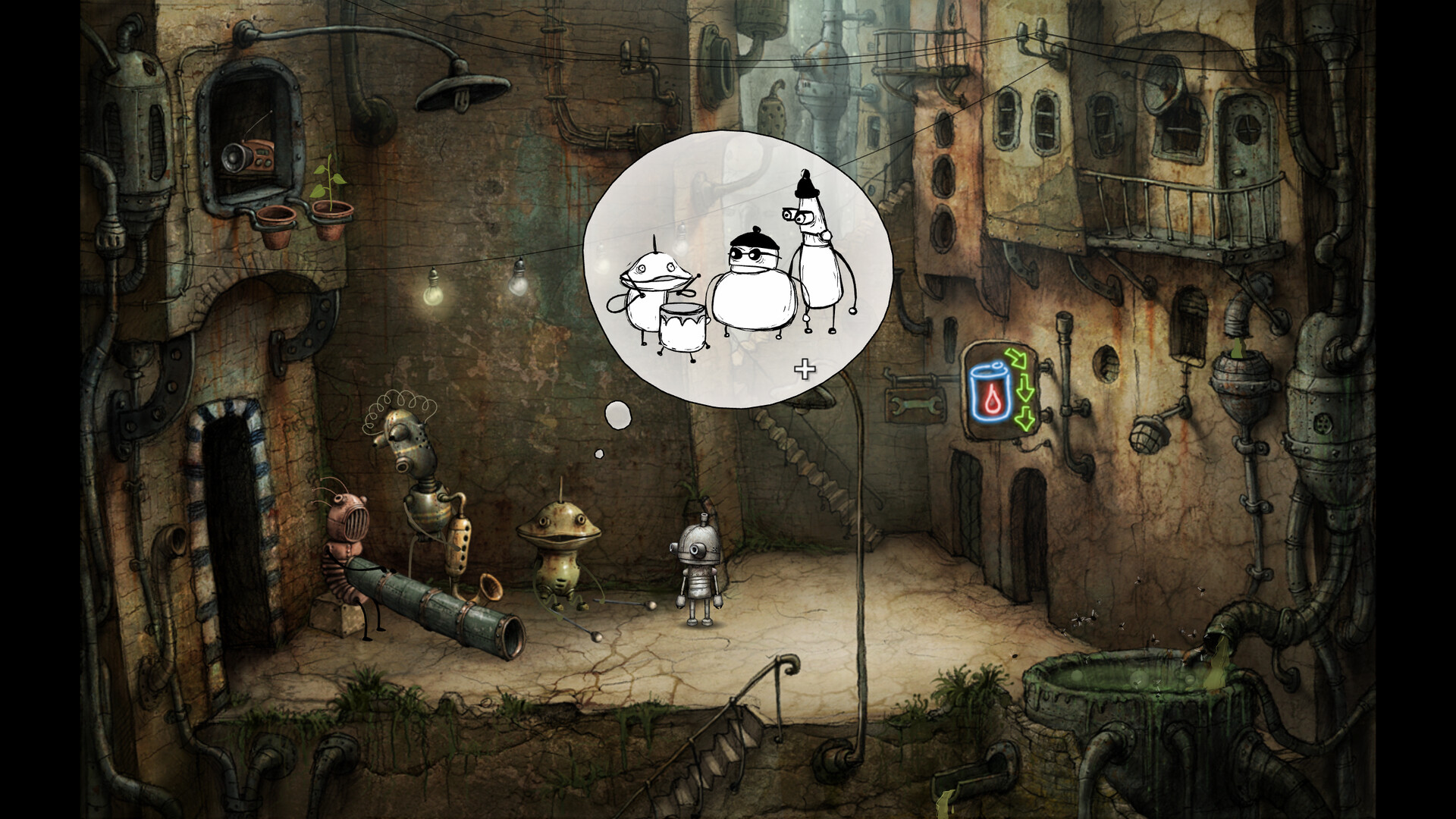
The inventory supports practical, object-based problems. Josef collects items, uses them with devices or gives them to residents, and discards them once they have served their purpose. A character’s need may be shown in a thought bubble; finding the relevant item and working out how to use it links the silent story to the puzzle. Some solutions involve a sequence of actions rather than a single obvious match, so players must inspect the room, move Josef within reach and test how objects relate. The inventory remains manageable, and visual feedback helps show whether an action worked. One puzzle connects the umbrella-carrying woman to a mechanical dog: moving an oil drum and using oil to draw the dog into reach turns several objects and a resident request into one chain of reasoning. The example shows how a screen can contain a visible goal while the route to it depends on arranging the environment. This structure connects small personal requests with the broader route through the city, as helping a resident can clear the way forward.
Environmental logic puzzles provide a second major kind of challenge. Instead of applying an item to a character or object, the player may manipulate shapes, follow a wire path, recognize a pattern or work out how a mechanism operates. These puzzles are usually contained within a device or a few screens, creating a compact problem with its own visual rules. Some are straightforward once the player understands the goal; others require patience and careful reasoning. Their instructions are communicated by the pieces, diagrams and consequences of an action rather than paragraphs of text. Moving between object problems and logic boards changes the kind of attention required while keeping both activities grounded in the machines Josef encounters. Examples of the logic boards include sliding pieces, tracing a path through wires and drawing a shape without lifting the line. Their rules differ, so players must study the board instead of applying an inventory solution. When the player succeeds, the mechanism itself shows the result, and the scene can return to object-based exploration.
Hints are available in two levels. A lightbulb gives a general nudge about what the player should try to accomplish, while a book provides a fuller illustrated solution. The more complete guide is gated behind a short side-scrolling shooter game. That condition makes the assistance itself a small diversion, rather than an always-open menu of answers. Other arcade sequences appear during the adventure as brief breaks from the slower object and logic puzzles. These moments ask for more direct control, but they do not create a lasting combat system: Josef gains no weapon build, character statistics or fighting abilities. The minigames are separate activities woven into the linear journey through the city. A later arcade segment sends a tiny avatar through a two-dimensional maze while it shoots at other moving points, asking for a different kind of attention from the logic boards. The detour is brief in the wider adventure, yet it makes clear why the city is not navigated only by clicking inventory items.
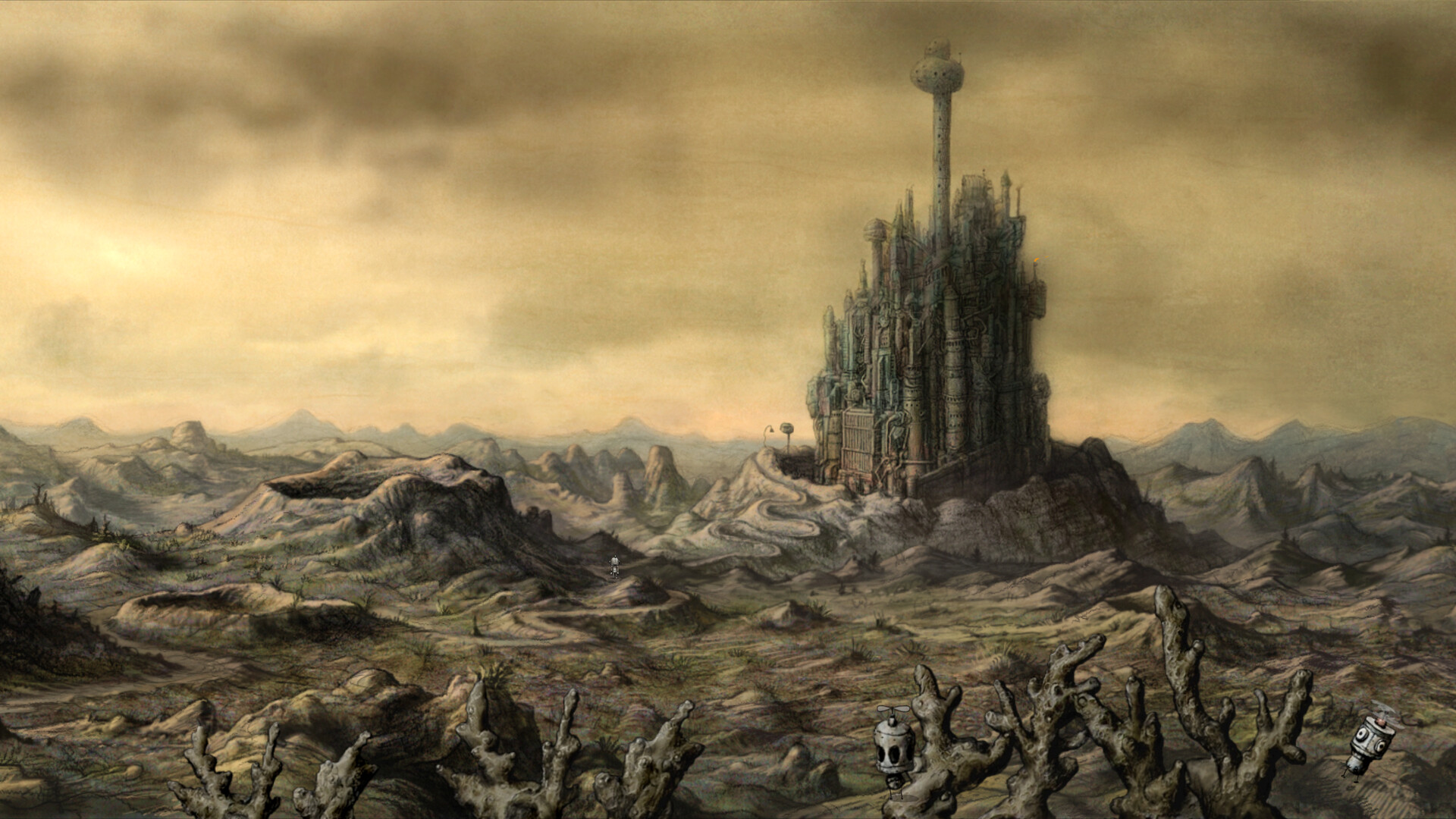
The wordless storytelling depends on small visual cues. A thought bubble can depict an object or imagined event, giving the player a clue about what a character wants or remembers. Josef’s posture and other robots’ gestures establish how they feel, while changes in a scene show the result of an action. Some areas restrict what can be seen and reveal more of the surroundings as Josef explores, making the screen itself part of the presentation. These shifts can make a confined room feel larger as information appears. Hand-drawn 2D art and an original mechanical soundtrack reinforce the setting, while sparse sound effects give individual robots personality without spoken lines.
Machinarium is a single-player adventure developed and published by Amanita Design. The Steam edition is the PC release; additional editions are available for GOG, Epic, Nintendo Switch, Xbox, PlayStation, iOS and Android. Control details differ, especially where touchscreens or gamepads replace a mouse. The broad progression takes Josef through connected city scenes, with local tasks combining movement, inventory objects, logic mechanisms and occasional arcade diversions. There is no character-level progression: advancement comes from solving the immediate obstacle and opening the next part of the route. The full adventure centers on Josef's return, Berta's rescue and the Black Cap Brotherhood, with the city's inhabitants and visual clues filling in the connections between those goals.
- Developer
- Amanita Design
- Genre
- Point-and-click adventure / puzzle adventure