
About Lorelei and the Laser Eyes
Lorelei and the Laser Eyes sends a woman to a secluded Central European hotel at the invitation of an eccentric man. Its rooms, documents and devices form a non-linear puzzle mystery about identity, memory and perception. Players unlock the building by connecting clues across spaces, taking notes and working out ideas rather than relying on fixed codes.
A woman arrives at an old hotel in central Europe because an eccentric man has summoned her to take part in a project. That is the deliberately narrow premise of Lorelei and the Laser Eyes. Simogo lets the building and its contents do much of the explaining: a room may offer a locked cabinet, a strange document, an unfamiliar machine or an image whose meaning only emerges after a later discovery. The hotel is a place to inhabit and investigate, not simply a corridor leading from one numbered puzzle to the next. The visitor becomes caught in a game of illusions whose danger and strangeness increase as she moves deeper into it. The central mystery concerns what she is doing there and how the people and events suggested by the evidence fit together. An apparently useful clue may belong to several possible stories. A document can be both an object in the world and a way of questioning the story the player has begun to construct. The game asks the player to live with that uncertainty for a while rather than clearing it away in a prologue.
The hotel opens in a non-linear fashion. Solving one problem can give access to another area, but the player can encounter several unresolved threads at once and return to them with information found elsewhere. Simogo cites the gradual unlocking of a world in Metroid, The Legend of Zelda and early Resident Evil as a structural influence. Here the locks are mostly intellectual: recognising a pattern, interpreting a page or realising that a clue from one room belongs to a device in another. The developers describe the puzzles as handcrafted but also explain that some elements are scrambled for each playthrough. That distinction matters. The point is to understand the idea behind a solution, not memorise a single answer from someone else's route. A notebook can become a practical extension of play, helping the player keep track of names, numbers, symbols and rooms that have not yet yielded their meaning. Simogo even made a companion notebook that nudged readers toward ways of thinking without printing solutions. The game itself remains the source of the clues; the act of recording them makes a sprawling hotel more navigable. This open structure gives a locked door a different meaning from a simple stop sign. It can be a reminder that a clue is still missing, a prompt to inspect another floor or a reason to reconsider something previously filed away as background detail. Returning to it after a different discovery is part of the design. Simogo wanted each player to find a route through overlapping threads, so knowing where a puzzle is located is often a separate problem from knowing how to solve it.
This is a puzzle mystery with many forms of interaction rather than a sequence of identical combination locks. The developer traces its final form to classic escape rooms and adventure games, but describes a production process that also produced systems for documents, text commands, shifting render settings and multiple camera views. Those systems allow a clue to be presented as a physical object, a screen, a passage of writing or a change in the way a space is seen. Optional mini-games, stories and collectibles create further reasons to examine places closely. They are part of the texture of the hotel, not evidence that every object is required for the main path. The controls deliberately keep movement and interaction simple, using directions and one action button. Simogo wanted the complexity to come from understanding the place rather than demanding quick fingers. There is no combat system to master before reaching the next clue. Progress depends on attention, on revisiting an earlier question and on recognising when a new piece of information changes the meaning of something already seen.
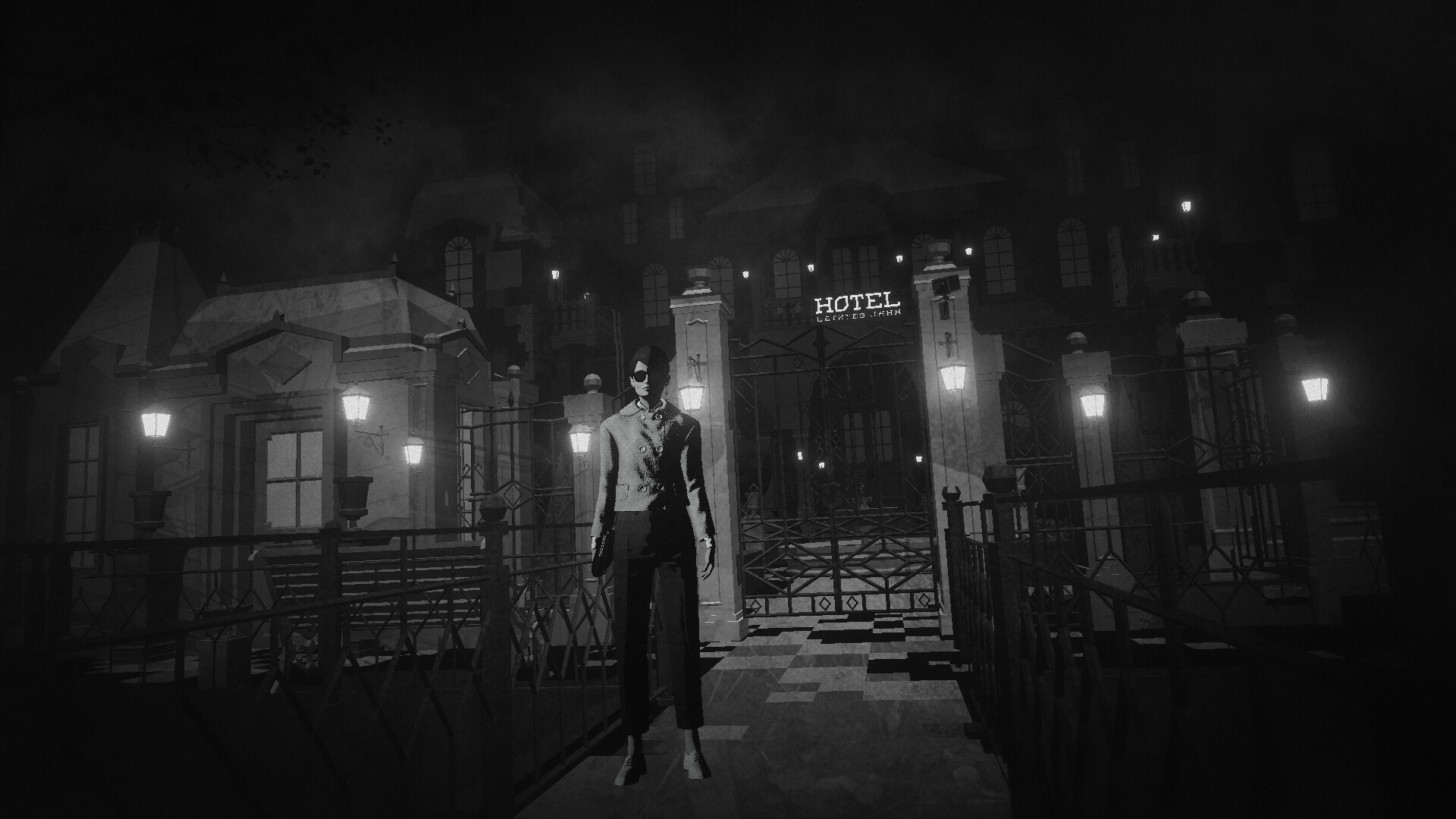
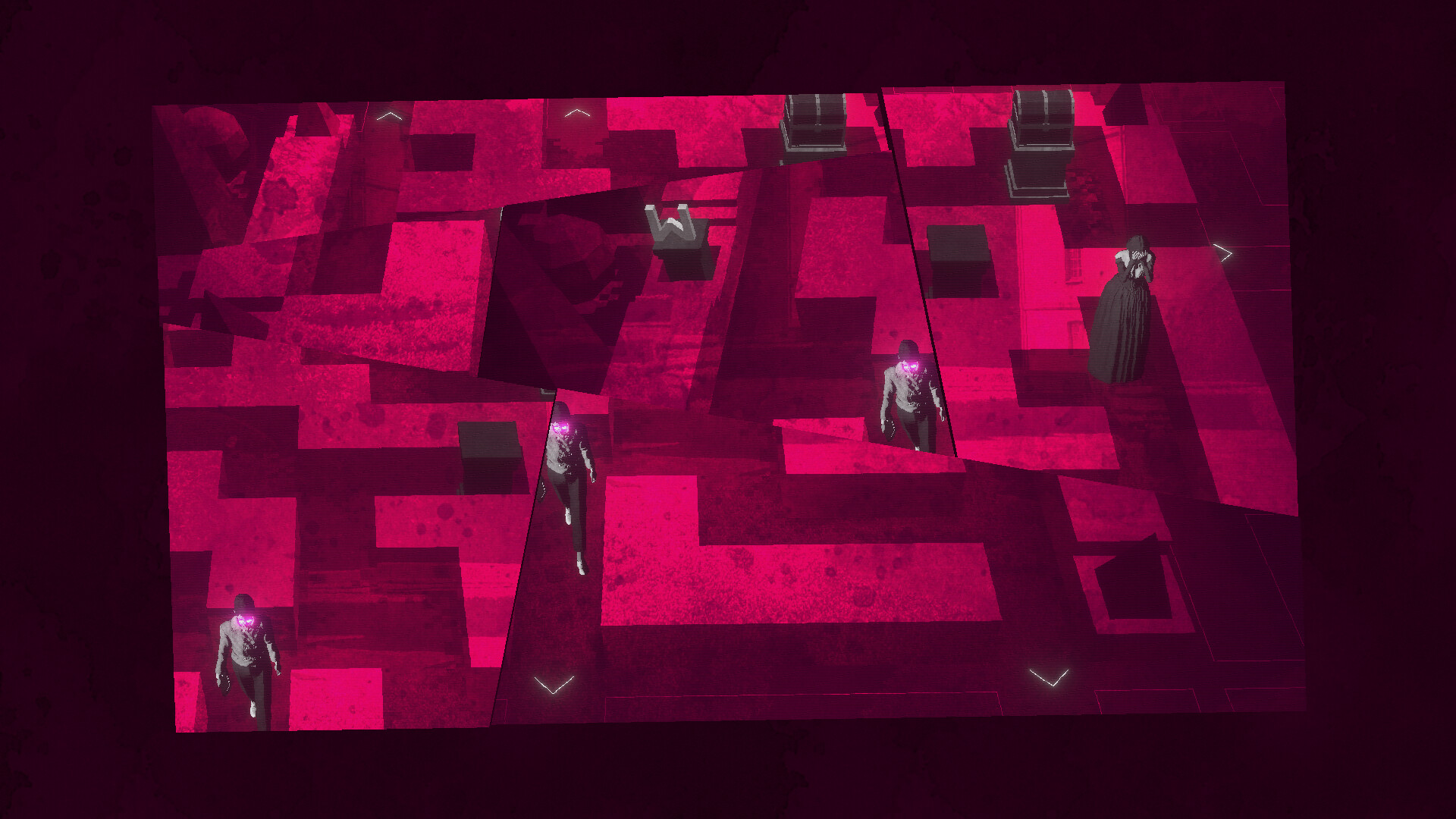
The visual language makes that attention more difficult and more interesting. The main spaces are largely black and white, built from low-poly geometry, projected photographs, toon-shaded figures and fine wireframe-like lines. Red or pink cuts through the restraint when it needs to matter. Simogo photographed real places, including Kronovalls Slott and the Palladium in Malmö, for textures after plans to license images from other works proved impractical. The result is a hotel that can feel like a collage of photographed surfaces and digital memories rather than a seamless simulation of a real building. Its apparent age does not settle when the story is taking place. At moments the game also changes its visual grammar: an embedded game may resemble a one-bit adventure or a PlayStation-era survival horror scene, while a book excerpt or another document demands its own way of reading. These shifts are clues to the experience's interest in stories within stories. They also make it important to notice whether a visual convention belongs to the hotel, to a document found inside it or to another work contained within the game. The developer describes this collage as an attempt to evoke wandering among memories. That design choice helps explain why the same setting can appear to contain several eras and kinds of media at once. The red accents deserve attention precisely because the surrounding rooms are so restrained; they are a visual interruption, not a replacement for reading the many quieter details.
Sound gives the building a different kind of structure. Simogo did not want continuous music to distract from solving puzzles, so it placed record players around the hotel. A phonograph can provide a recognisable musical location, while quieter ambient versions of the same material continue beneath the apparent silence. The music and the low-level sound therefore help distinguish spaces without turning each room into a loud set piece. Piano became central to the score, with Daniel Olsén composing and arranging most of it alongside work by Linnea Olsson and Jonathan Eng. The restraint suits a place where a faint change can be as suggestive as a written clue. Combined with the camera experiments and the fragments of text, it gives the player more than one way to remember a location: its shape, its contrast, its sound and the unresolved question it contained. The hotel can be learned gradually even while the mystery resists a straightforward explanation.
Lorelei and the Laser Eyes was developed by Simogo and published by Annapurna Interactive. It first released on Steam and Nintendo Switch in 2024, with PlayStation 4 and 5 versions following later that year; Simogo subsequently released a distinct Switch 2 edition. Those versions share the central puzzle mystery, though the developer identifies platform-specific controller effects on PlayStation and display support for the later Switch 2 edition. The important distinction for a new visitor is between the game's welcoming physical controls and its demanding interpretive work. A single button can open a cabinet; deciding why the contents matter may take a much longer chain of observation. The story does not hand over the identity of every figure or the chronology of every event at the entrance. Its rooms and documents invite the player to build, revise and sometimes discard a theory as the hotel opens up. This overview leaves the solutions and the mystery's resolution inside the game, where the connections between them are the substance of the journey. On PlayStation, the controller audio, rumble and haptics are used when handling devices such as padlocks, and the lightbar echoes the changing sunglasses of the protagonist. These touches translate the same clue-seeking activity into a different physical feel without turning the game into a new story or a separate sequel.
- Developer
- Simogo
- Genre
- Non-linear puzzle mystery