
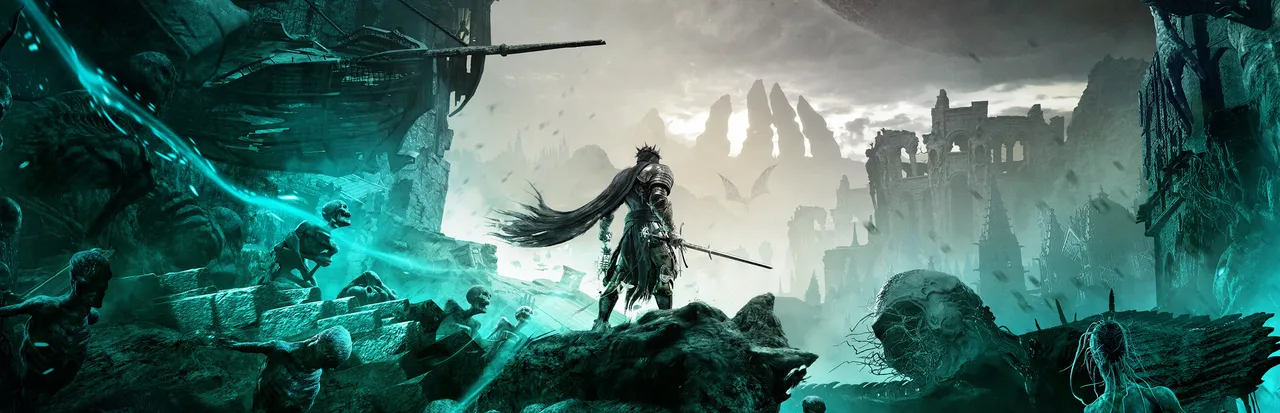
About Lords of the Fallen
The 2023 Lords of the Fallen casts the player as a Dark Crusader tasked with stopping the demon god Adyr’s return. Its interconnected dark fantasy world has two overlapping realms, and the Umbral Lamp turns exploration, combat, death and checkpoint planning into connected parts of the journey.
This Lords of the Fallen is the 2023 action RPG developed by HEXWORKS and published by CI Games. It is distinct from the 2014 game that shares its name. The story takes place after Adyr, a demon god who once ruled through tyranny, was defeated and imprisoned. As that threat begins to rise again, the player takes the role of a Dark Crusader and travels through Mournstead to oppose Adyr. The setting’s central conflict crosses between the living world and a hostile and dangerous realm of the dead.
The Umbral Lamp is the tool that makes those realms part of ordinary navigation. In Axiom, the living world, the player can raise the lamp to look into Umbral and reveal paths, objects or platforms that are otherwise hidden. Holding the lamp in place can expose a route without committing to it; entering Umbral fully changes the surrounding dangers and possibilities. A blocked passage in one realm may have an alternate route in the other, so inspecting both views can turn a dead end into a way forward.
The lamp also affects combat. Soulflay can pull an enemy’s spirit away from its body, leaving the exposed target open to attacks that deal wither damage. The same tool can interact with certain Umbral objects, move platforms or reveal hidden resources. These uses give exploration a physical action: the player must aim the lamp, choose a target and decide whether there is time to act before an enemy closes in. The lamp’s charges and the danger of lingering in Umbral make each use a small tactical decision rather than a free scan of the environment.
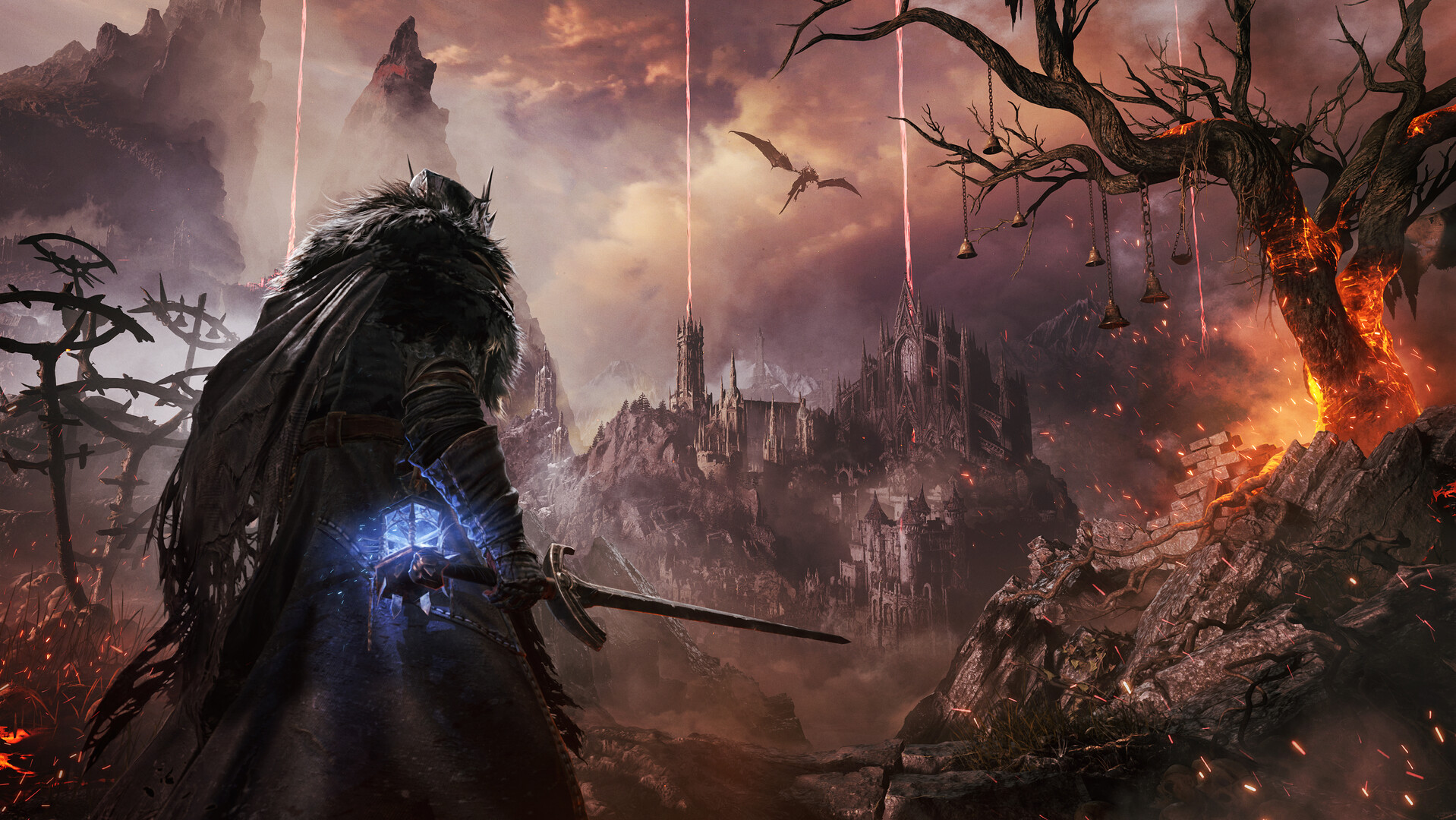
Umbral is not simply a second map that can be explored at leisure. It contains its own enemies and risks, and being pulled into it or entering voluntarily places the Lampbearer in danger. If the character falls in Axiom, the lamp offers one additional chance to continue in Umbral; falling there ends that recovery opportunity. That second life can rescue a failed push, but it also means the player must find a way back to safety while the dead realm remains hostile. The Lampbearer can use the lantern to cross voluntarily when a route or barrier requires it, but doing so is a commitment: enemies can close in while the player searches for a way out. Survival therefore involves both combat skill and an exit plan.
Wither damage gives blocking and healing their own timing. Some damage taken in Umbral or while guarding becomes temporary withered health. Landing attacks can restore that portion, but an unblocked hit removes it, making a counterattack valuable after a defensive mistake. Dodges and parries remain central ways to avoid or answer attacks, and the player can also use ranged weapons or magic to interrupt an enemy before it reaches melee distance. Different tools help control a crowded encounter or create space to heal.
The world is interconnected, with routes that loop back toward earlier spaces and useful points of rest. Permanent Vestiges act as stable checkpoints, while Vestige Seeds can create a temporary resting point in an Umbral flowerbed. Only one temporary seed checkpoint can remain active at a time, so choosing where to make a checkpoint matters. Resting provides a moment to recover and prepare for the next route. Vigor gathered from defeated opponents feeds character development, connecting successful combat to long-term growth. A seed placed before an unfamiliar stretch can shorten a return journey, but spending it too early may leave fewer options later. The route itself is therefore a resource the player learns to manage, not just a line between bosses.
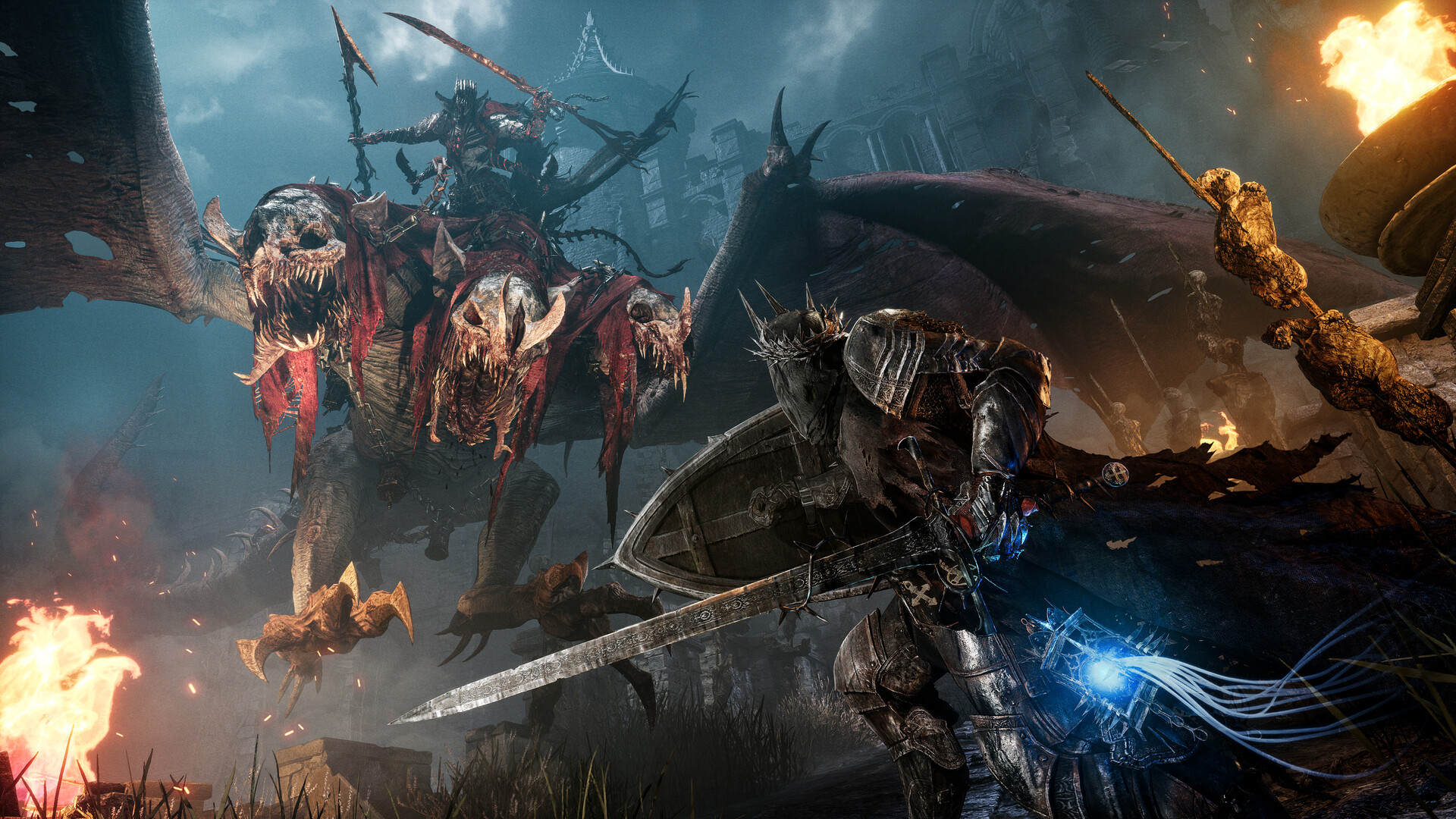
Character development supports a range of approaches. Players customize the Lampbearer, choose from nine starting classes, and develop attributes, weapon upgrades, armour loadouts and spell choices as they gather Vigor and equipment. The class sets a starting path, but later upgrades let the player build around a preferred style rather than remain confined to that initial choice. Weapons and magic provide distinct ways to handle threats, while ranged attacks can draw a dangerous foe away from a larger group. Sanguinax serves as the main healing item, and discoveries across the world can help improve it. Preparation is especially useful before bosses, where recognizing attack patterns and choosing when to spend healing or magic can shape the result.
The journey moves between combat and exploration as the Lampbearer follows the crusade against Adyr, returns to safe points to recover and chooses when to risk another step into Umbral. Maps found along the route can point toward beacons whose fate matters to the crusade. Because both realms occupy the same broad geography but obey different rules, familiar routes can change meaning when viewed through the lamp. Progress comes from using that dual-world system to reach the next area and survive its enemies.
Released on 13 October 2023 by Hexworks, published by CI Games, and sharing nothing but a name with the 2014 game by Deck13. This is a complete reimagining, and the one idea it brings of its own is worth the trip.
The lantern is the whole argument for it
You carry a lamp that opens a window into Umbral, the spirit layer sitting underneath the world. Step through and you're in a rotting mirror of the same place — different layout in places, different rules, and considerably more hostile. It solves a problem the genre has had for years, which is what to do with a map once you've memorised it. Here, the route you know is only one of two routes, and the one you don't know is where the optional paths, the treasures and the shortcuts are hiding.
It's also the game's risk system, and this is the part that's been thought through properly. Dying doesn't send you back to a checkpoint — it drops you into Umbral, alive, with a second chance and a worse situation. You don't get your health back, the things that live there have noticed you, and the longer you linger the more of them arrive. Getting out means finding a shrine. That's a far more interesting consequence than the genre's usual walk of shame, and it's the reason this game stands out in a crowded field at all.
Then it starts borrowing
Everything that isn't the lantern is FromSoftware with the serial numbers filed off, and not subtly. The first proper boss after the tutorial is a winged woman who fights in sweeping arcs, sprouts scarlet wings and rains down projectiles — close enough to the most famous encounter in Elden Ring that the resemblance becomes the conversation rather than a detail. The looping world, the bonfire analogues, the item descriptions carrying the plot: it's all present, and it's all competent, and almost none of it is Hexworks' own.
Competent is the fair word, though. The combat works, the world is built with real attention, and if you want more of a thing you like, this delivers it at length. The problem is that the areas where it deviates are the areas where it stumbles, and the deviations are mostly in the direction of being harsher rather than smarter.
Where the cruelty stops being fun
The difficulty here tips from testing into unfair in a few specific places, and the worst offenders are memorable for the wrong reasons. There are moth creatures disguised as item pickups that kill you instantly on contact, tucked behind a sight puzzle obscure enough that one reviewer had to ask the studio for an explanation. There's a threshold past which a hard game becomes a chore, and this one crosses it — the platforming is weak, the atmosphere is oppressively dark to the point of hurting readability, and several encounters are tuned by adding enemies rather than adding depth.
The pulse
Reception split in a way that's genuinely informative rather than noisy. The positive reading — that this is one of the most inventive Soulslikes around, a game that iterates on the formula rather than photocopying it — is honest, because the Umbral mechanic really is that good, and the death-to-the-spirit-world loop is the best version of a second-chance system anyone has built. The negative reading is equally honest: it looks and plays like a FromSoftware game and does almost nothing better, with performance problems and technical roughness on top. Both readings are about the same game. What nobody disputes is that the dual-world idea is the standout and the cruelty is the flaw.
Should you play it
Yes, if you have run out of the games it's imitating and want a long one with a mechanic that genuinely hasn't been done to death. The lantern earns the price on its own, and the world underneath it is more carefully made than the game's reputation suggests.
Skip it if you're already tired of the genre's house style, because you'll spend most of this recognising furniture. And go in warned about the mimic creatures and the darkest stretches, which are the two things most likely to end a session early.
Go deeper with V4mp
- Developer
- CI Games
- Genre
- Dark fantasy action RPG
Explore Lords of the Fallen further
Explore the wiki for detailed reference pages on the game's world, systems, items and locations.