

About Loco Motive
Aboard the 1930s Reuss Express, Lady Unterwald is murdered and three passengers become suspects. Loco Motive follows lawyer Arthur Ackerman, amateur detective Herman Merman and undercover operative Diana Osterhagen as their investigations cross through a train full of eccentric travellers. Its point-and-click puzzles, voiced comedy and optional telephone hints turn a classic locked-carriage mystery into an adventure across several perspectives.
The Reuss Express was supposed to carry its passengers through a glamorous journey, but the murder of its wealthy owner, Lady Unterwald, turns every carriage into part of an investigation. Her impending speech, the business she leaves behind and the number of people with access to the train make the situation more complicated than a single locked-room question. The player does not arrive as an outside detective who can interview everyone from a position of authority. In Loco Motive, the playable characters are among the suspects and need to prove their innocence while working out what happened. The setting makes that urgent without requiring a chase across a vast map. A train is a contained world: passengers share corridors, rooms and routines, while the vehicle keeps moving regardless of whether its occupants trust one another. A conversation in a dining car can change the meaning of an object found elsewhere; someone seen in one compartment may have a reason to avoid another. The game takes the familiar ingredients of a period murder mystery and gives them a deliberately comic cast. Suspicion remains the engine of the story, but the people caught up in it are capable of foolish decisions, awkward encounters and slapstick trouble as well as serious concealment.
The three playable perspectives keep the case from belonging to one kind of investigator. Arthur Ackerman is a straight-laced lawyer whose instinct to put things in order meets a situation that does not cooperate. Herman Merman is a crime novelist trying to act as a detective, a useful source of genre expectations and a possible source of misjudgment. Diana Osterhagen is an undercover operative with a very different reason to notice what the other passengers are doing. Moving among these characters lets the mystery unfold through overlapping pieces of knowledge. Each brings a role, a personality and a different social position to the same train. A clue meaningful to one of them may look like a nuisance to another, while a passenger willing to speak casually with one suspect might be cautious around someone else. Robust Games describes the adventure as interlinking rather than three entirely separate stories. The player is asked to connect what the characters learn, not simply repeat the same journey with different faces. That gives the train a wider sense of life. Its carriages do not become new places every time a viewpoint changes, but their significance can change when the person entering them has another question to ask.
The investigation is built as a point-and-click adventure. Players examine the Reuss Express, speak to its eccentric passengers, collect items and use them to resolve obstacles that stand between a suspicion and the next piece of evidence. The puzzles are part of the story's comic machinery. A useful object may be in the wrong person's possession, or an apparently straightforward plan may need several unlikely steps to work. The game's marketing promises twists and sharp humour rather than an austere simulation of police procedure. Yet the basic task remains readable: identify what you need, look for a plausible way to get it and consider which person or place can supply the missing part. The train setting helps bind those puzzles together. Carriages and corridors establish routes the player can remember, while the same small community of passengers provides repeated reasons to revisit an area. This differs from a sequence of unrelated rooms that exist only to hold one solution each. The player can build a mental map of who is aboard, where a conversation took place and what changed after a discovery. The logic of item use can be playful, but its purpose is to move the three suspects closer to an account that clears them.
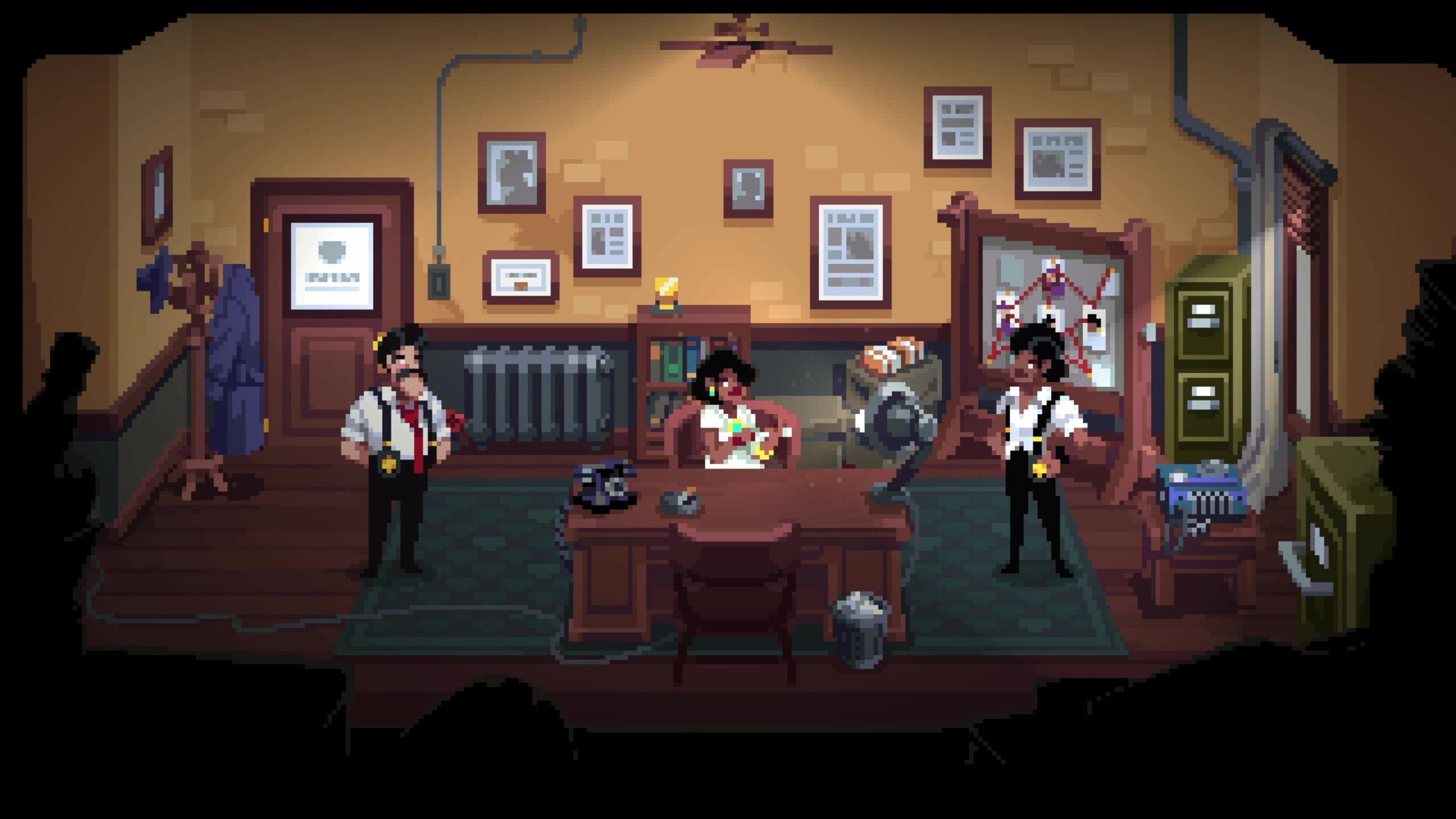
Loco Motive offers more than one way to control that search. Mouse and keyboard support the familiar point-and-click method, while controllers allow direct character movement and selecting nearby points of interest. Technical director Joseph Riches described the latter as a way to make the adventure feel natural on Switch without imitating a mouse cursor. That choice matters for a game whose humour depends on timing and expression as well as selecting the right object. A player can move through the train and remain focused on its characters rather than fighting the interface. When a puzzle does stall progress, the Dirk Chiselton Hotline provides optional guidance as a telephone call inside the fiction. The hint is meant to nudge the player without simply replacing the investigation. Framing help as a service the characters can use keeps the story's playful tone even when the player needs a practical reminder. None of this turns the mystery into a combat game or a timed arcade challenge. The actions that advance it are observation, conversation and the inventive handling of objects. The controller options and hotline acknowledge that the genre's older habits can be adapted while keeping the pleasure of finding an answer yourself.
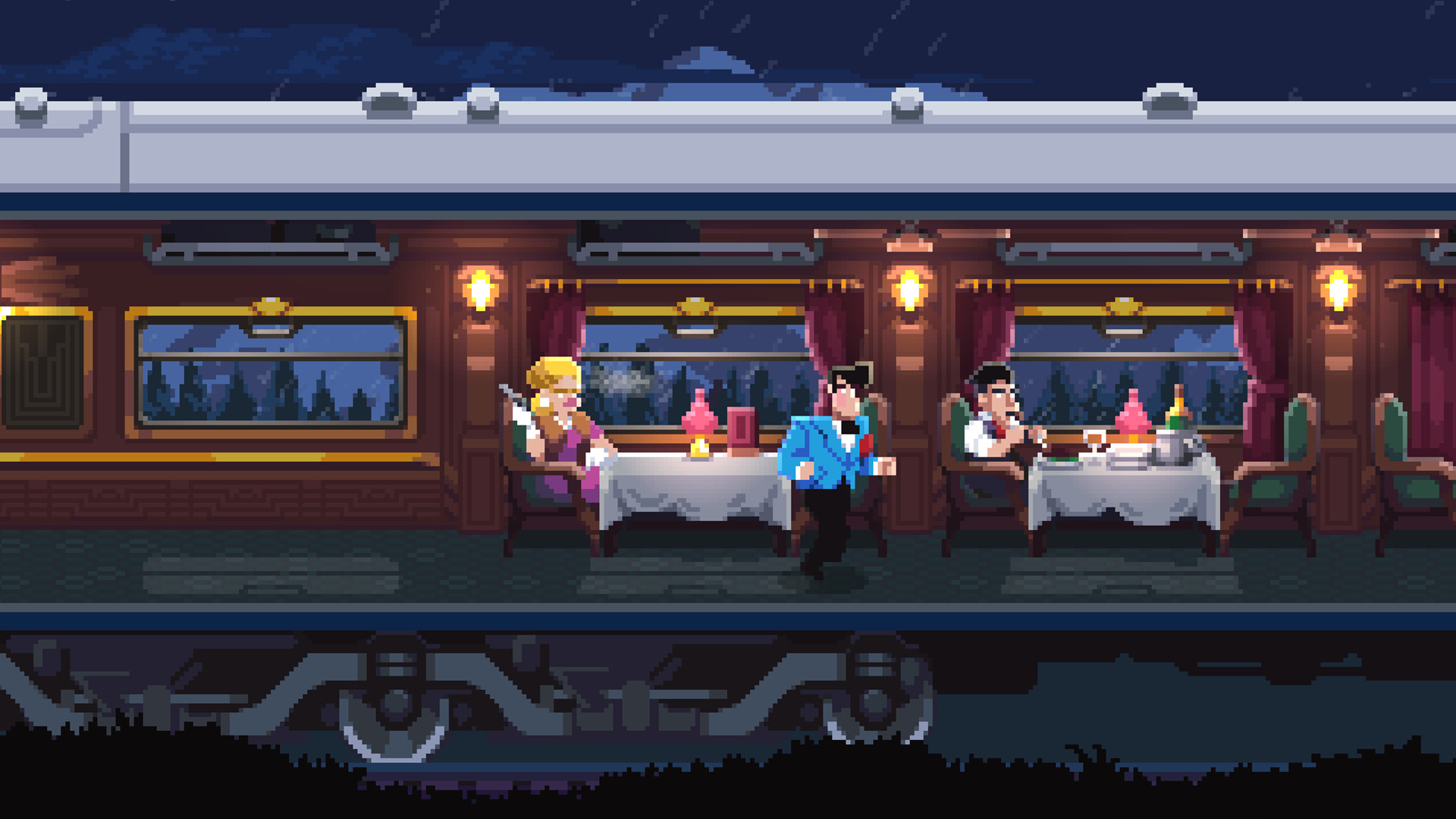
The artwork makes a compact train feel theatrical. Detailed pixel characters move through decorated carriages, while modern lighting, weather effects and shadows give the 1930s setting more atmosphere than its small pixels alone could supply. Adam and Joseph Riches have spoken about growing up with classic graphic adventures and wanting to make one together. Their first version was a short game-jam piece; the completed Loco Motive expanded the idea into a voiced, multi-character story. The final game uses a full cast, with spoken performances lending shape to jokes and suspicion alike, and an original score by Paul Zimmermann. Comedy is not confined to an occasional line between grim scenes. It is built into how these characters respond to danger and how the game plays with expectations of a grand train mystery. Adam Riches has cited both classic adventure games and the tradition of detective fiction as influences. The result is a setting that treats its murder seriously enough to motivate the investigation while giving its suspects room to be flustered, boastful or absurd. The presentation helps each carriage feel like a stage on which a new misunderstanding or revelation might occur.
Robust Games developed Loco Motive and Chucklefish published the finished release in 2024 for PC and Nintendo Switch. That game is distinct from the earlier game-jam prototype and prerelease demonstrations, which show where the idea began without defining the full story. The completed adventure asks the player to stay with Arthur, Herman and Diana as their pieces of the case start to connect. A train is a strong place for a mystery because escape, privacy and movement are all constrained; it is also a strong place for comedy because the characters cannot easily avoid one another after an embarrassing encounter. Even a routine trip between compartments can bring a suspect back into contact with someone whose earlier explanation no longer sounds convincing. Every passenger is close enough to seem relevant, and every object found in a carriage might later matter to a different suspect. The optional hint line, multiple control schemes and voiced cast make the old point-and-click structure approachable without discarding its item-puzzle heart. The attraction of the premise is the gap between what these three people think they know and what actually happened to Lady Unterwald. This overview leaves the culprit and the train's later turns behind the carriage door for the player to uncover.
- Developer
- Robust Games
- Genre
- Comedy point-and-click murder mystery