
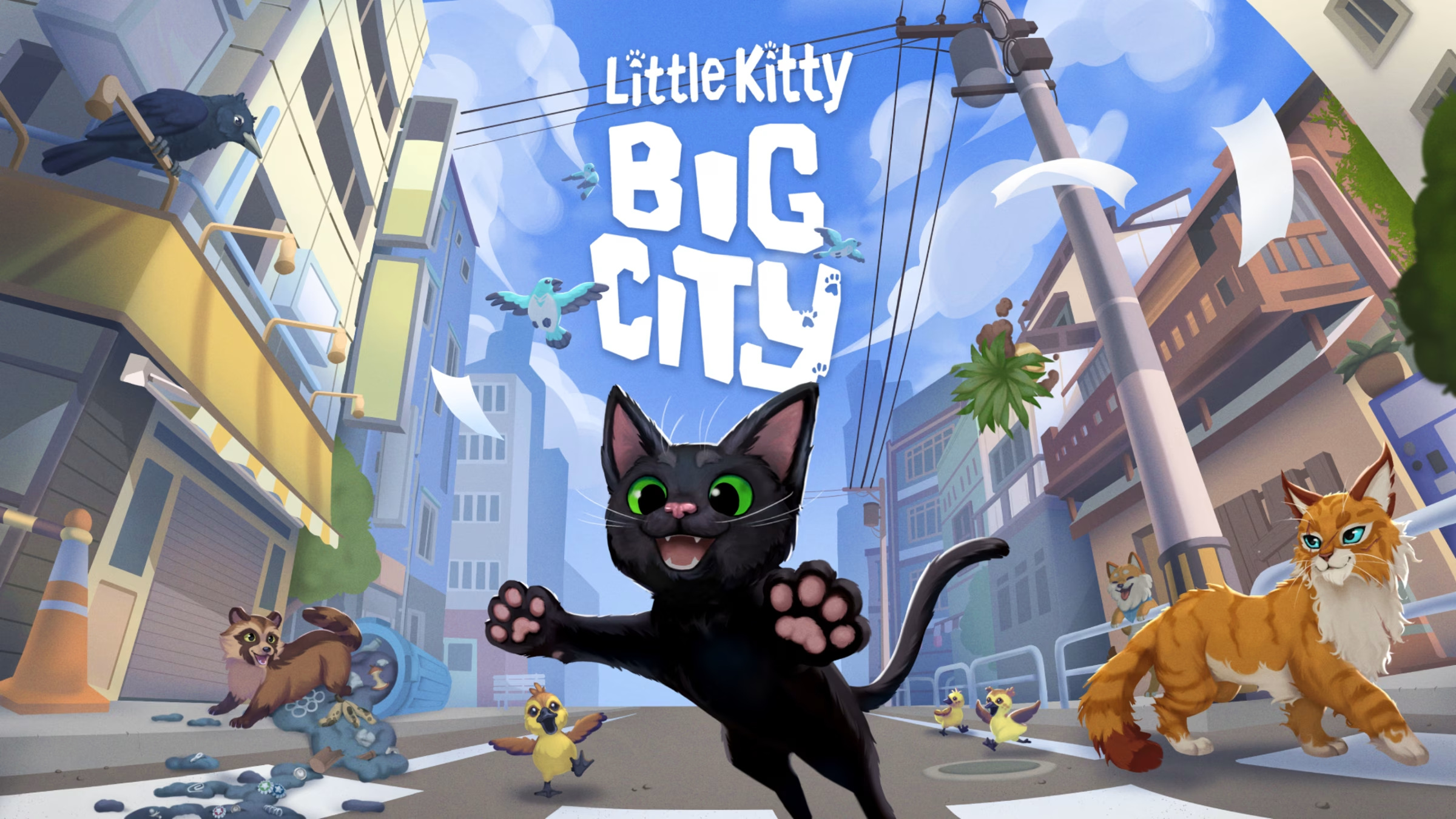
About Little Kitty, Big City
After falling from a high apartment window, a small black cat finds itself at street level in a dense city and must work out how to get home. Along the way, Kitty can meet chatty animals, take on their requests, climb into tucked-away corners, collect hats and toys, and turn ordinary urban objects into a playground.
Little Kitty, Big City begins with a peaceful nap interrupted by an accidental fall from the apartment where the cat lives. Kitty lands in a neighborhood far below home, and the route back is a long climb through streets, yards, and rooftops. That simple destination supplies a through-line, while the city constantly presents reasons to wander: a ball near a goal, a narrow gap behind a fence, an animal with a request, or an object just within paw's reach. The player controls a small black cat and encounters a stylized Japanese-inspired urban setting, with compact streets, shops, gardens, alleys, and apartment spaces arranged as a connected playground. The main task never demands a hurry, and the side activities are not framed as urgent detours. The result is an exploration adventure where getting home and being sidetracked coexist: a new path may help Kitty progress, but it can also lead to an optional interaction or a small piece of mischief. Humans are simplified figures in the background, while the animals Kitty meets have more distinct personalities and conversational roles, keeping the world oriented around the cat's point of view.
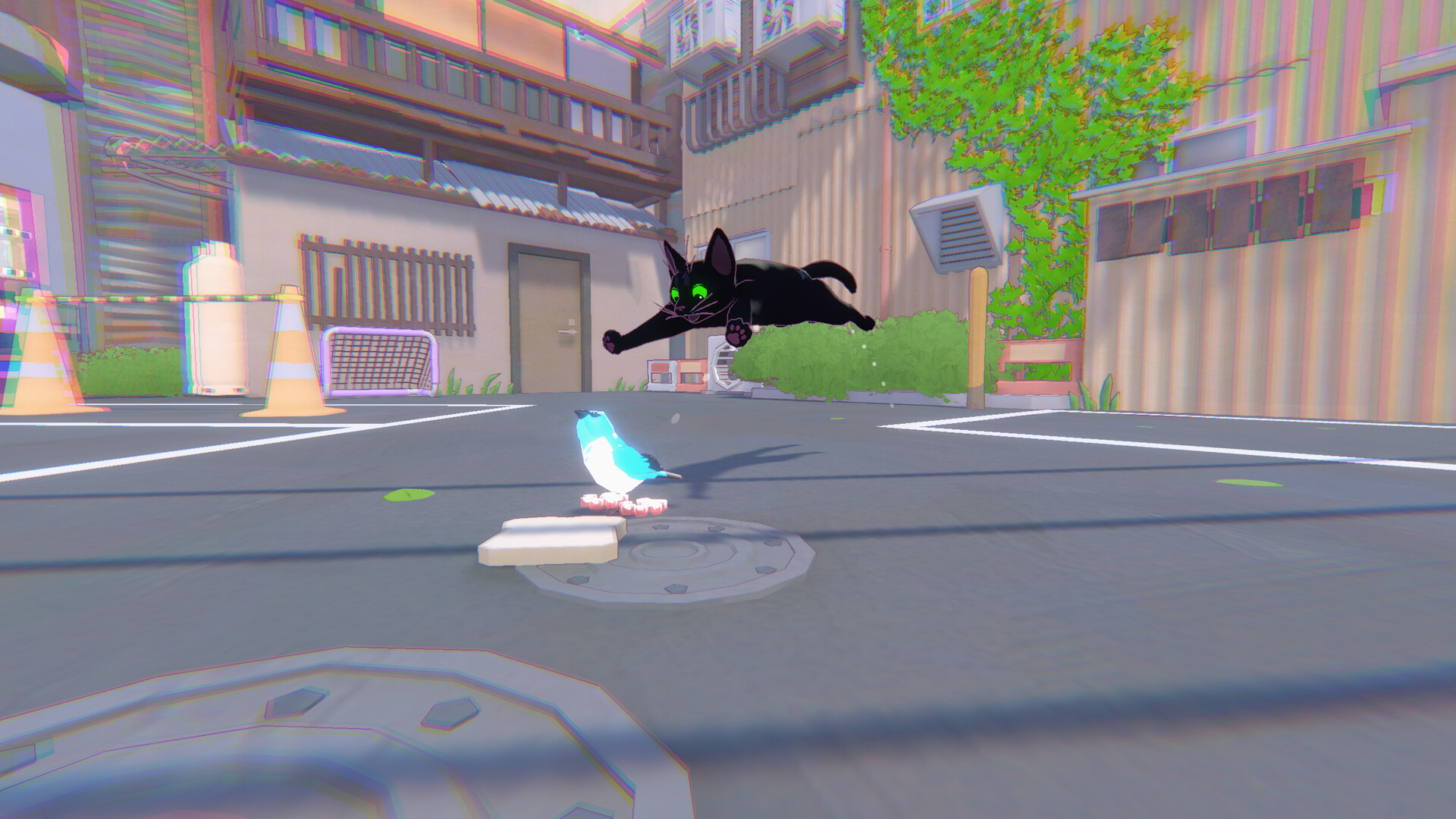
Movement is built around cat-sized navigation rather than combat or survival. Kitty walks, runs, jumps, squeezes through low passages, climbs, and gets into the kind of small interactions that make the neighborhood feel like a playground. A targeted pounce helps make gaps and raised surfaces readable: the player can use a deliberate aiming arc for a jump, while a quicker version handles much of the targeting automatically. This makes movement useful both for reaching ledges and for playing with the environment. Kitty can create a little disruption around people and objects, while optional activities give that curiosity a goal; one example is moving a ball toward a nearby goal. The animation combines authored motion with dynamic movement so Kitty can bend around turns, stretch, and react in ways that convey a cat's body without requiring precise platform-game inputs at every step. There is no combat loop, health bar, or conventional enemy encounter; the play comes from working out how to get around and seeing what happens when Kitty explores. Small optional challenges reward curiosity without turning the neighborhood into a high-pressure obstacle course.
The city is compact but layered. Streets and courtyards give Kitty room to roam at ground level, while fences, terraces, ledges, and climbing routes reveal routes above or behind familiar spaces. Some destinations are visible before they are reachable, giving the neighborhood a gradual, interconnected structure: progress opens access to new sections and a climbing ability that makes previously impassable ivy usable. Returning through earlier areas can therefore reveal routes that were present all along but beyond Kitty's earlier reach. The design rewards looking upward and checking the edges of spaces as much as following the obvious path. A ball or loose object may be part of a small environmental activity; a ledge may overlook a shortcut; a sheltered nook may hold something to collect or somewhere to rest. Kitty can also nap in sunny spots, making pauses part of the everyday city rhythm. This mixture of short routes, tucked-away spaces, and visible future paths gives exploration a light sense of discovery without relying on a large map or a long chain of combat encounters.
Animals give the wandering a social structure. Kitty encounters a cast of chatty neighborhood creatures, including a crow, a duck family, a tanuki, dogs, and other small residents. Their requests turn local curiosities into quests: the duck father has lost track of his ducklings, for example, so Kitty can search nearby spaces and help bring the family back together. Other conversations and activities lead to small rewards or open additional things to do. These interactions are optional in tone even when they connect to the route home; they make the city feel like a collection of overlapping routines rather than a sequence of anonymous levels. Kitty can also make trouble around people, who function more as part of the environment than as fully voiced characters. There is no hostile faction to fight, and the animals' requests do not become a combat system. Instead, meeting someone can introduce a practical objective, a new corner to investigate, or an item that encourages another lap through the neighborhood. The game supports following those threads at an unhurried pace, then returning to the broader goal when the player chooses.
Finding a way back to the apartment is the main progression thread. Fish found around the city let Kitty develop the stamina needed to climb ivy for longer, connecting exploration and route access to the climb home. The fish are scattered through the environment, and reaching them can involve following side paths or helping with other activities. This gives the central objective a concrete relationship to the city: a new fish extends Kitty's climbing capacity, which in turn makes higher routes and later sections possible. The developer has described the fish as a progression gate, while also noting that the homeward climb can be completed with fewer than all of them under ordinary play; the game does not require exhaustive completion of every optional task before reaching home. Returning home is therefore a clear destination, but the rest of the neighborhood remains available as a playground for side quests and discoveries. An official update later added a portal that lets Kitty return to the apartment after completing the climb, giving players a direct way back to that space.
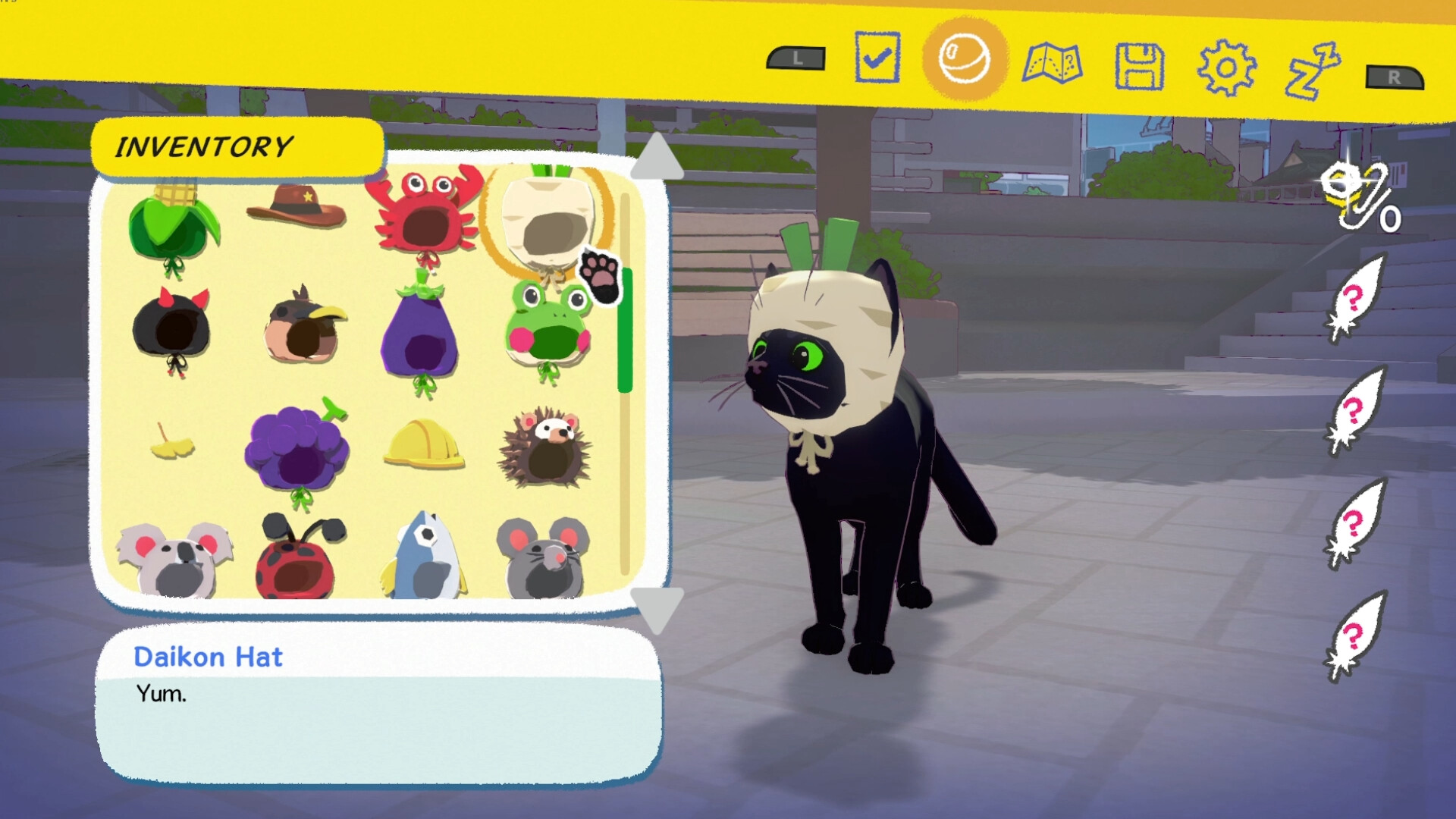
Collecting and customization provide another set of goals alongside the climb. Hats change Kitty's appearance, and the game offers a broad collection of wearable designs to discover. They let players personalize Kitty without building a combat loadout. The city also contains small collectible surprises and objects that can be carried or played with; official updates have added toys and interactable items to Kitty's apartment and neighborhood. A photo mode lets players frame Kitty in the neighborhood, and customization options allow changes to the cat's coat colors and markings. Later official updates added the ability to begin a playthrough as a custom cat, expanding the role of those appearance options beyond a mid-game menu. The collection systems support discovery and expression: a player can look for new designs, gather what appears naturally during exploration, or ignore the cosmetics and continue toward home.
The presentation reinforces the cat's scale and point of view. The city uses bright, readable shapes and a stylized look, with human faces deliberately simplified so attention stays on Kitty and the animal characters. The soundtrack, composed by Riley Koenig, uses light jazz to accompany the relaxed pace, while small animation details emphasize Kitty's reactions and physicality. It is a single-player adventure centered on exploration, simple environmental challenges, quests, and collection; there is no multiplayer campaign or combat mode. The Steam release is the PC version associated with app ID 1177980, and Nintendo lists the game for Switch, including compatibility with Switch 2. The common premise and core city adventure are presented across these platform listings. Updates have also expanded the home area and added interactions, a new apartment resident named Turt, photo features, and custom-cat options; those additions sit within the same game rather than forming a separate campaign. The neighborhood remains the central space: reaching the apartment resolves Kitty’s journey home, while its animals, hidden corners and small playful tasks give the city reasons to explore beyond that main climb.
- Developer
- Double Dagger Studio
- Genre
- Single-player exploration adventure with light platforming, quests, and sandbox interactions