
About Left 4 Dead 2
In this cooperative action horror shooter, four survivors travel through the infected Deep South, trying to reach safety across a linked series of campaigns. Choose weapons and supplies, fight through common and special infected, revive teammates and reach each safe room together. The game also includes competitive and survival modes built around its infected encounters.
Left 4 Dead 2 is set during a viral outbreak that has left the southeastern United States overrun by infected. The original campaign follows four survivors—Coach, Nick, Ellis and Rochelle—from Savannah, Georgia, through the bayou country toward New Orleans. They are strangers brought together by the need to escape, and their dialogue records the new group’s journey through an unfamiliar crisis. The five named campaigns are Dead Center, Dark Carnival, Swamp Fever, Hard Rain and The Parish. Each is divided into chapters that lead from one temporary refuge to another. The goal is practical and immediate: cross hostile ground, keep the group together and reach extraction. The setting shifts through city streets, rural roads, swamps and cemeteries, with each area showing a different part of a region disrupted by the outbreak.
Each campaign is designed around four-player cooperation. Players can join friends or fill the other survivor roles with computer-controlled teammates, and the survivors share a route rather than pursuing separate objectives. Chapters end at safe rooms, where the team can close the door and prepare for the next leg. Health, ammunition and weapons carry forward between chapters, so damage taken during one stretch affects the next. Safe rooms offer a chance to restock from available supplies, but the group still has to decide who needs healing and which items should be carried. A survivor who falls behind or is pinned by an infected can quickly become a rescue problem for everyone else. The group’s progress depends on watching one another, clearing threats from teammates and making space to revive someone under pressure.
Most enemies are common infected that arrive in groups and can overwhelm survivors who stop moving or become separated. Special infected interrupt the group in distinct ways. A Smoker can pull a survivor away with its tongue, a Hunter can pounce and pin someone, and a Boomer’s bile can draw a wider horde. Left 4 Dead 2 adds threats such as the Charger, which rushes through the group, the Spitter, which denies an area with corrosive spit, and the Jockey, which can steer a survivor into danger. These roles make target priority matter: shooting the infected that has disabled a teammate may be more urgent than thinning a crowd. The game combines these threats with environmental alarms and events that can attract attackers, requiring the group to coordinate movement and cover while completing a local objective.
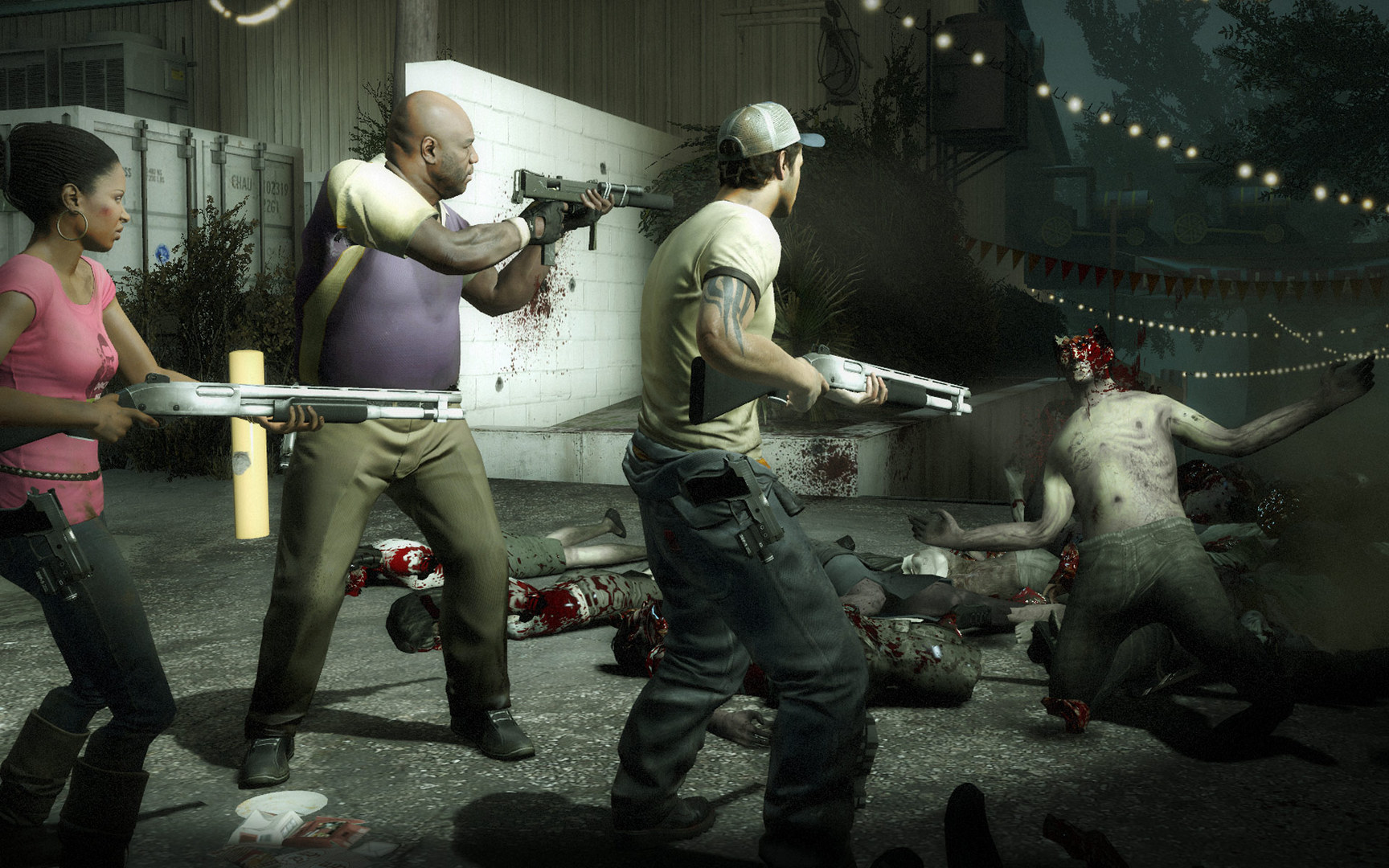
Weapons are gathered along the route and include firearms, pistols, explosives and melee weapons such as an axe, frying pan or chainsaw. Survivors carry a primary weapon and a secondary option, with melee giving a close-range response when infected crowd in or ammunition runs low. Ammo and useful equipment are found in rooms, safe houses and other points along the route, so the team continually weighs detours against the danger of spending more time outside. Explosive objects such as gas canisters can be thrown and shot to affect a cluster of infected. Throwables provide other tactical options: a pipe bomb draws infected toward its beeping before detonating, while a bile container can pull them toward a chosen point. The game’s inventory is intentionally limited, which makes sharing supplies and choosing when to spend them part of the cooperative rhythm.
Health management links individual survival to team support. First-aid kits restore lost health, while pain pills and adrenaline provide temporary boosts; adrenaline also speeds actions such as healing and reviving. When a survivor is incapacitated, a teammate can help them back up, but the rescued player remains vulnerable until properly healed. A defibrillator can bring back a fallen teammate, and some campaign chapters provide opportunities to rescue missing survivors. These systems create a chain of decisions rather than a simple health refill: spend a scarce medical item now, carry it for a later emergency, or give it to the teammate who is struggling to keep pace. The group also has to make room to revive someone while infected continue to attack, so controlling nearby threats and communicating the next move matter as much as aim.
The Director system shapes the pacing of a run. It adjusts infected populations and the placement or timing of encounters in response to how the survivor team is doing, while Left 4 Dead 2’s Director 2.0 can also vary environmental conditions and aspects of the route. The result is a campaign structure that retains its broad chapter goals while changing the pressure around them. Teams may have to cross a street under a horde, search a building for the next route or trigger an event that opens a path while infected converge. Because players’ condition and position affect the experience, the same campaign can demand different decisions across separate runs. Safe rooms provide chapter boundaries, but they do not remove the accumulated consequences of damage, ammunition use and team rescues carried forward from earlier sections.

Beyond cooperative campaign play, Left 4 Dead 2 offers modes that reuse its survivor and infected roles in different ways. Versus pits a survivor team against human-controlled special infected, so familiar encounters become contests over timing, positioning and coordinated attacks. Survival asks survivors to withstand a threat in one location and see how long they can hold ground with limited space and resources. Scavenge is a round-based contest in which players collect gas cans, bringing the campaign’s supply objectives into direct competition. Across these formats, the recognizable infected abilities and survivor tools provide shared rules, while the objective changes from reaching an extraction point to controlling, enduring or resupplying during an encounter. The campaigns remain the route through the story of four survivors moving toward New Orleans.
- Developer
- Valve
- Genre
- Cooperative action horror first-person shooter