
About L.A. Noire
In post-war Los Angeles, LAPD detective Cole Phelps investigates murders, conspiracies and arson cases amid a city’s boom and corruption. Search crime scenes, record evidence in a notebook, question people of interest and travel with a partner as Phelps moves through a career shaped by street crimes, action and investigation.
L.A. Noire follows Cole Phelps, a former Marine who joins the Los Angeles Police Department after serving in the Pacific during the Second World War. The game places his cases in 1947, when the city’s post-war growth and Hollywood glamour sit alongside a drug trade, corruption and violent crime. Phelps works through investigations involving murders, arson and racketeering, and his attempt to advance through the department brings him into conflict with both the city’s criminal underworld and people inside the police force. The setting is a fictionalised version of Los Angeles, built around period streets, landmarks and vehicles; the cases draw inspiration from real crimes but are presented as fiction. Rather than treating the city only as a backdrop for action, the game makes it the space in which evidence, witnesses and competing accounts have to be connected.
Each assigned case gives Phelps a central investigation to complete before the next assignment arrives. He and a partner travel between crime scenes, addresses and interviews, with new leads and objectives recorded in the notebook as they emerge. At a scene, the player searches the area, examines objects and records clues; people of interest and locations are added alongside the case notes. The notebook can be reopened at any point to review what has been found and to follow an address or waypoint. The partner is part of the working rhythm rather than a separate combat unit: Phelps can ask for assistance nearby or let the partner drive for a particular journey. Cars can be commandeered, but police vehicles provide access to sirens and dispatch radio, tying movement around Los Angeles to the LAPD role.
Interviews turn gathered information into a judgement about what a witness or suspect is saying. The notebook presents questions, which can be asked in any order, and the player listens to the answer while watching the speaker’s face for signs that something is wrong. Phelps can accept an answer as truthful, press it as doubtful, or accuse the person of lying; a lie accusation requires selecting evidence already recorded in the notebook. The manual stresses that not every answer has equal importance, so a missed or incorrect response does not necessarily prevent the case from yielding its essential information. Facial performance is central to the exchange: hesitation, discomfort or a reaction to a challenge supplies context, while the evidence provides the concrete basis for an accusation.
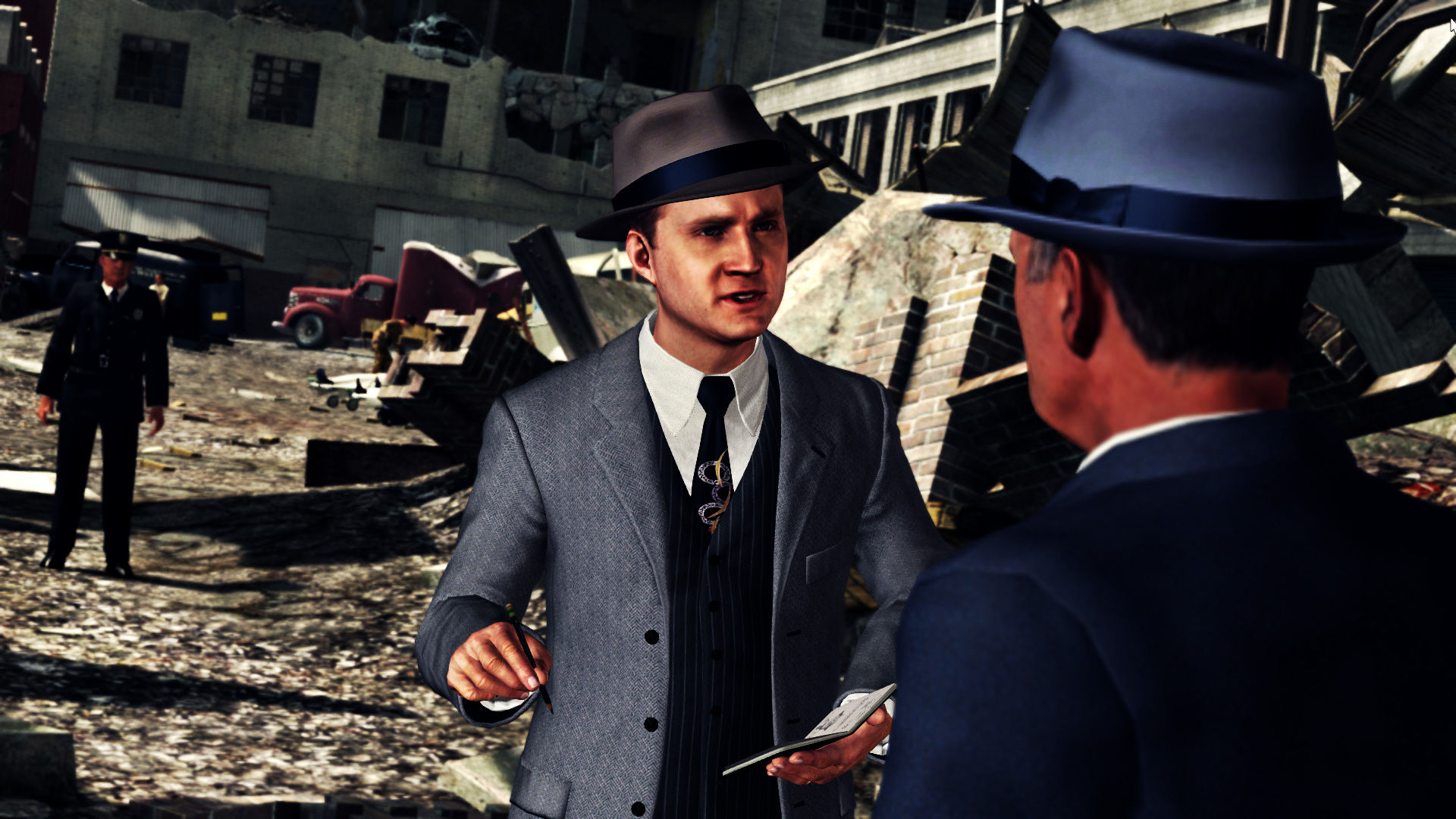
Crime-scene investigation is about locating and identifying details rather than simply clearing a checklist. Clues, persons of interest, addresses and objectives accumulate in the notebook, giving the case a record that links physical finds to later questioning. Intuition points can assist when a search or interview stalls: one option can reveal all remaining clues on the mini-map, while another removes a wrong answer and unsuitable evidence from an accusation. These assists spend a limited resource, so they support the investigation at moments the player selects instead of functioning as an unlimited hint system. The notebook remains available in interviews, allowing the player to compare a person’s account against what the case has established.
Between major case steps, Phelps can respond to dispatch calls about street crimes and encounter additional details around the city. The manual identifies these incidents as one way to earn experience, alongside successful interview responses and finding hidden objects or landmarks. Experience advances Phelps’s law-enforcement rank and grants intuition points, which can be saved up to a cap of five or spent on the investigation tools. A dispatch call can be accepted while driving; ordinary vehicles allow travel, while LAPD cars add the siren and radio link to headquarters. These diversions sit beside the assigned case rather than replacing it: the current case remains the main progression gate, and completed cases can later be replayed from the main menu.
Cases also move beyond observation and conversation into pursuits and confrontations. Phelps drives through the city, follows targets, and can enter foot chases, fistfights or gunfights when an investigation turns physical. In a vehicle, steering, acceleration, braking and the handbrake are separate controls; on foot, the PC manual lists cover, aiming, reloading, grappling and dropping a found weapon among the available actions. The same case structure can therefore shift from examining evidence to moving quickly or surviving an armed encounter. These action scenes remain part of Phelps’s police work, framed by leads, partner support and notebook records that connect the immediate pursuit back to the investigation.
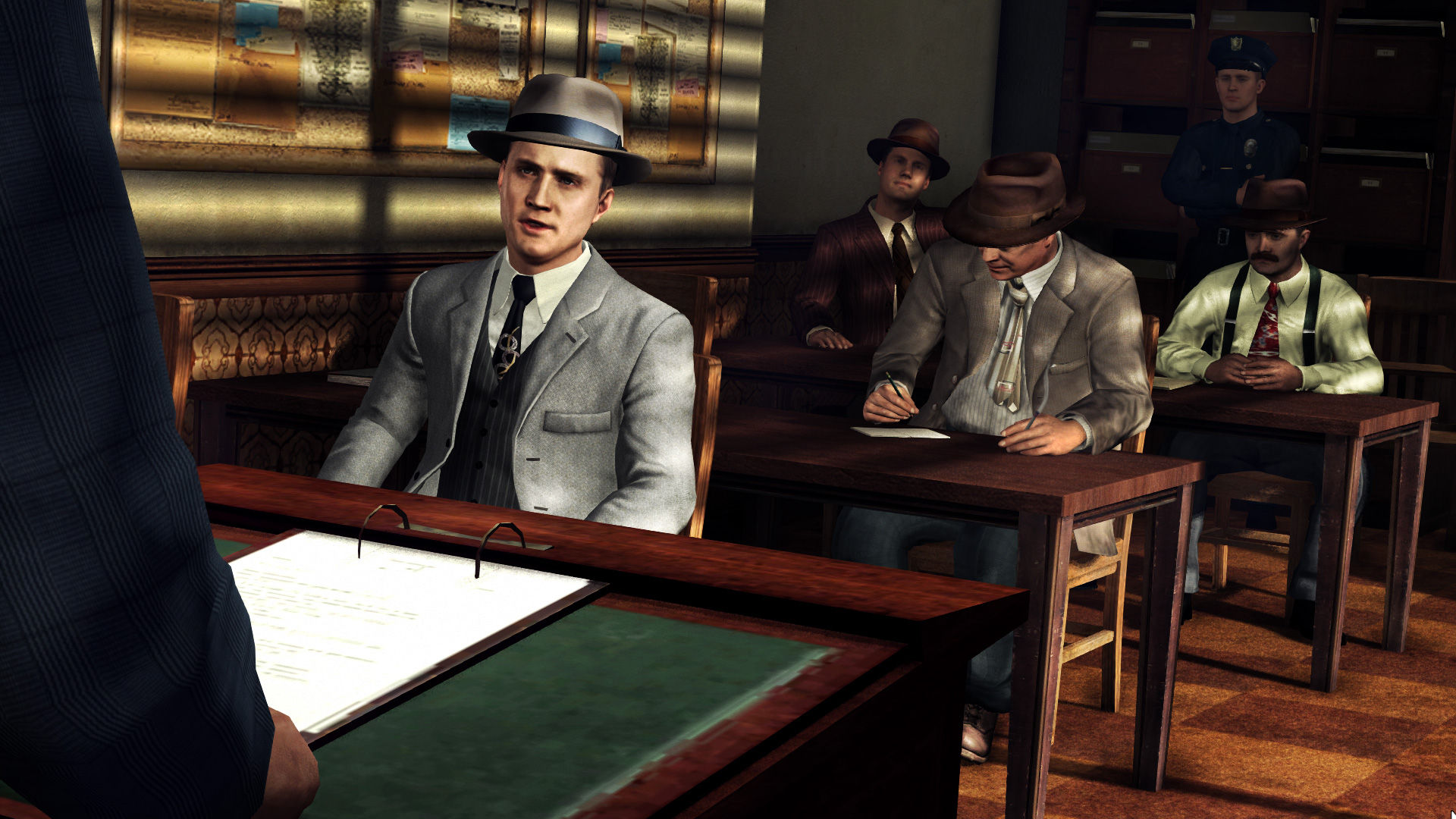
Phelps’s survival during the action scenes has its own visual cue. As he takes damage, colour fades from the picture toward black and white; it returns as his health recovers. That keeps a chase or gunfight readable without adding another case-management gauge to the notebook. The mini-map separately marks enemies, the current destination, Phelps’s partner, nearby street crimes and landmarks, so the city’s investigation routes and sudden incidents remain visible while travelling. A dispatch call can divert him from a case, but the case record stays in place until the assignment is finished. Completed cases can be replayed from the menu, letting the player return to an investigation after moving forward through the department.
- Developer
- Team Bondi; Rockstar Leeds
- Genre
- Adventure, strategy