
About Kentucky Route Zero: PC Edition
In Kentucky Route Zero: PC Edition, an aging delivery driver searches for a customer along Kentucky backroads and discovers a secret highway beneath the state. Across five acts and interludes, conversations, quiet exploration and shifting perspectives follow Conway and a growing circle of companions through communities marked by debt, displacement and the search for connection.
At twilight, antique-furniture driver Conway is trying to complete one last delivery for a shop that is close to closing. He stops at Equus Oils, where the directions he needs are tangled with the station keeper’s stories, then learns that the address lies somewhere along Route Zero: a highway that cannot be found on an ordinary map. The route runs through caves beneath Kentucky, and its entrances appear amid familiar roads, abandoned businesses and places where the past seems to overlap the present. The delivery gives the journey a concrete starting point, while its destination keeps receding behind detours, debts and encounters with people whose lives are tied to the region.
The world is built from sharply composed scenes rather than a continuous open landscape. Players guide characters through gas stations, homes, roads, mines and other interior or exterior spaces, moving between points of interest and speaking with residents. Directions can be oblique, and travel itself can feel like a jump between stage sets: the road, a ferry route on the Echo River, or the subterranean Zero each has its own visual and musical character. These places make a network of communities rather than a checklist of landmarks. A closed business, an obsolete machine or a half-remembered local history can be as relevant to the scene as the person standing in front of Conway. The route is not laid out as a string of map pins; getting oriented depends on following what people say and interpreting where those directions lead. Movement between scenes can preserve the uncertainty of traveling through an unfamiliar county, even when the immediate task sounds straightforward.
Conway is the first point of view, but the cast gradually widens. Shannon Marquez is a young television repairwoman whose work concerns devices that have become obsolete; Ezra, a boy, travels with Julian, his enormous eagle companion. The journey also brings in Junebug and Johnny, robot musicians, alongside other residents and travelers. The group is not simply a party assembled for combat or equipment management. Instead, the changing circle gives the story more voices and lets it move between people with different histories, worries and ways of describing the same world. Some scenes follow a companion without Conway, and later conversations can give the player control over more than one speaker.
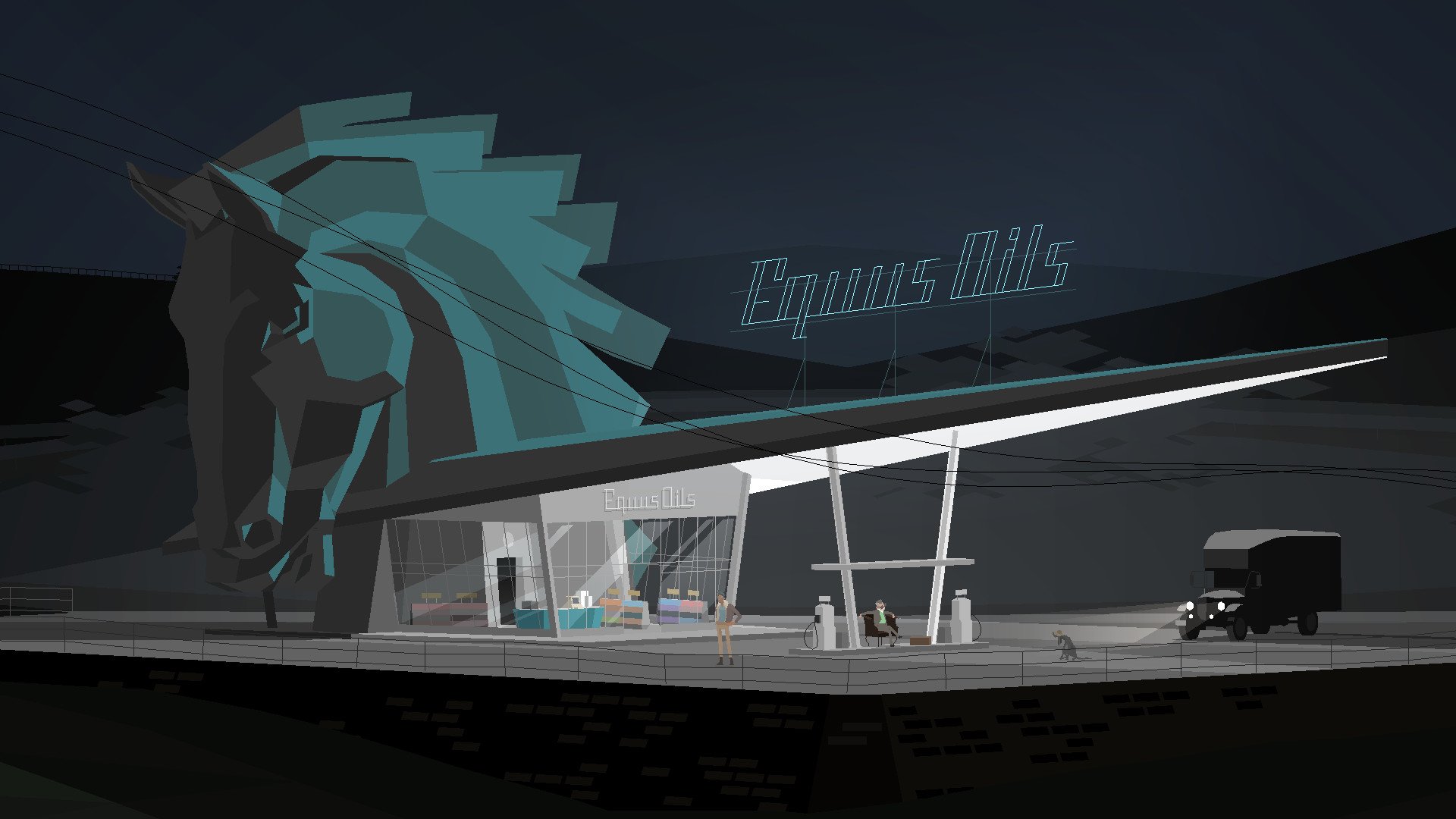
The main interaction is reading and choosing dialogue, with point-and-click movement and contextual interactions connecting conversations to places. Players select where a character goes, which person or object to approach, and which available line or response to express. The scenes sometimes ask for an interaction to advance, but the experience does not revolve around an inventory, combat, dexterity tests or conventional puzzle chains. Small details can reward attention: a radio broadcast, a conversation with someone who is not central to the delivery, or an object in a room may add context about a place or a character. Early on, a power failure sends Conway into the station’s basement to work with circuit breakers, while another nearby activity remains partly outside his awareness; a simple practical task opens onto an unexplained parallel scene. Progress is therefore as much about listening and noticing as it is about finding the next exit.
Dialogue choices are framed as a way to shape characterization and perspective. A response can establish how Conway or another character feels, what they remember, or how they interpret an event; the options can also read like stage directions that describe what a character does. The broad journey is not a branching route in which a correct answer wins a different ending. As the cast expands, the player may choose who speaks, and in some exchanges can select lines for both sides of a conversation. That structure shifts attention from solving a dialogue tree to composing a scene: the player weighs which thought gets voiced, how a relationship is presented, and what emotional register accompanies the next step.
The five acts and accompanying interludes form the PC Edition’s complete episodic journey. The story’s recurring concerns include unpayable debt, work made obsolete, damaged homes and the way an impersonal power company reaches into everyday life. These pressures sit beside moments of cooperation among people who have few dependable institutions to turn to. The visual language supports that tension: geometric figures and angular settings can make a road or workplace feel spare and exposed, while shifts in light, perspective and theatrical staging give ordinary rooms an uncanny scale. Rather than explaining every mystery, the scenes let economic hardship and magical realism occupy the same space.
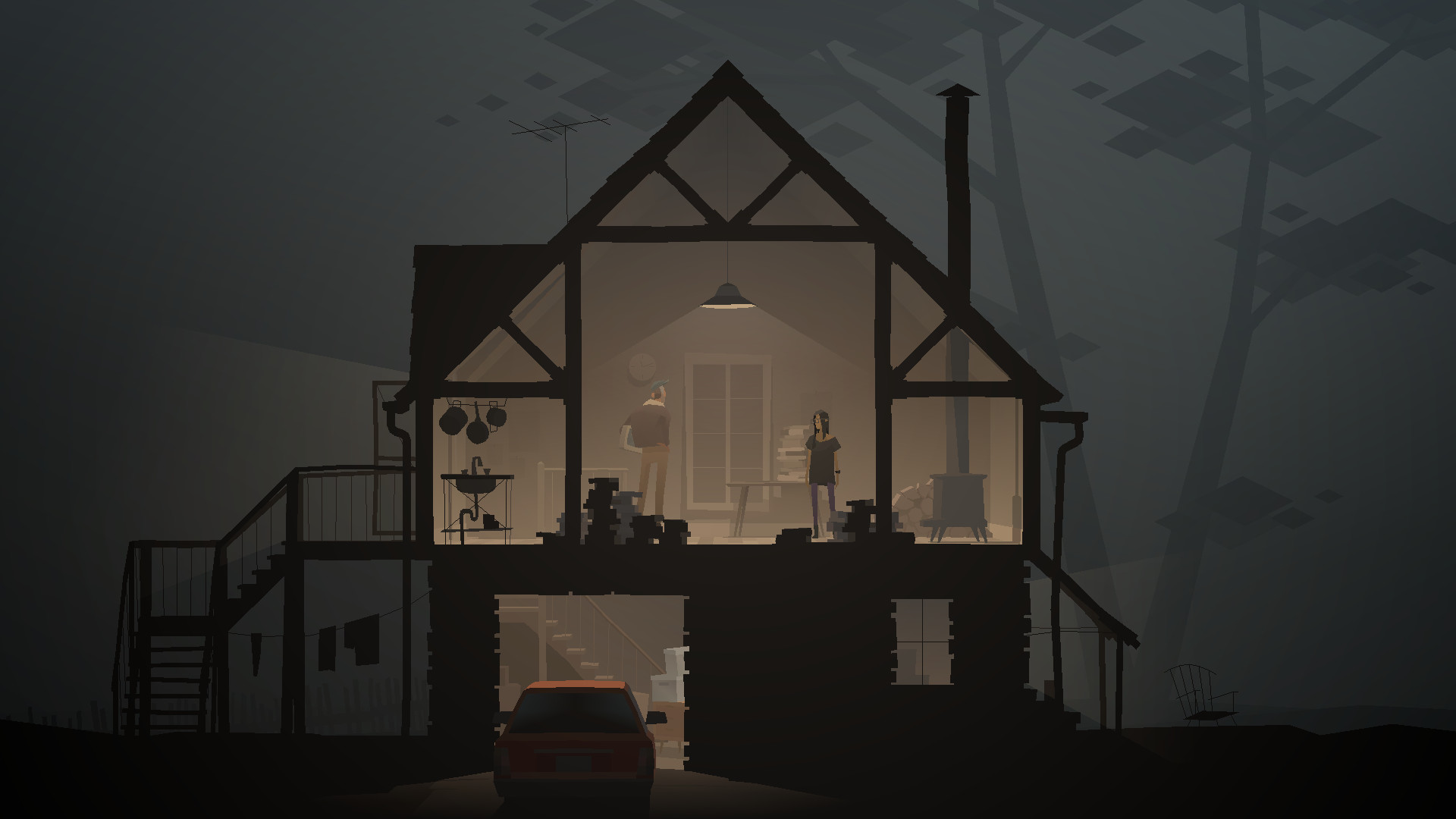
Music and performance are part of how the journey changes from act to act. Ben Babbitt’s electronic score sits alongside hymns and bluegrass standards recorded by The Bedquilt Ramblers, giving the road a sound that moves between synthetic unease and familiar communal song. Some interludes use distinct forms and viewpoints, extending the world between the main acts rather than functioning as a conventional level or challenge. The result is an adventure paced by travel, pauses and conversation: players follow the cast through connected places, choose how its members speak, and assemble their understanding from scenes that leave room for uncertainty.
- Developer
- Cardboard Computer
- Genre
- Magical-realist adventure