
About Keeper
In a distant post-human future, an awakened lighthouse sets out across an island toward a mountain peak, accompanied by Twig, a curious seabird. This wordless atmospheric adventure combines exploration and puzzles as their light and birdlike abilities interact with an uncanny landscape threatened by spreading Wither. The journey follows an unlikely partnership through surreal transformations.
Keeper opens on an island in a long-lost sea, where a lighthouse has stood dormant for ages beneath a distant mountain. Its familiar masonry begins to crumble, then the structure reassembles itself in a new form: it grows legs, rises, and starts learning how to walk. A mysterious sense of purpose draws it inland toward the mountain at the island’s center. This is a post-human setting, a world long after people have disappeared, where old traces remain but no human guide explains what happened. The lighthouse is both the central character and the player’s means of moving through this unfamiliar place, giving the adventure an unusual perspective from its first steps.
The lighthouse does not make the journey alone for long. A spirited seabird named Twig joins it after encountering the creeping presence spreading across the island. Their relationship is the story’s central connection: the lighthouse is newly awakened and physically unsteady, while Twig is curious and dexterous, able to reach and interact with mechanisms that the larger companion cannot. They travel as a pair rather than as a conventional human hero with a sidekick. Their different bodies and abilities shape how they respond to the environment, and their companionship gives the wordless narrative a readable emotional thread. The game tells this tale without spoken dialogue, asking the changing movement, gestures and shared actions to carry the relationship.
Exploration and puzzle solving form the adventure’s main activity. The island’s paths move through ravines, caves, coastlines, valleys and other strange spaces on the route toward the mountain. The landscape is not a realistic wilderness: it combines recognizable remnants with unfamiliar plants, creatures and ancient structures, then shifts into imagery that bends ordinary expectations. The lighthouse's beam can affect flora and fauna and help ward off the withering tendrils. Looking at a place is therefore part of understanding it; the player follows visual clues, notices how the light changes what is nearby and works out how the pair can continue. Its beam can reveal a response in a living thing before the route forward becomes clear.
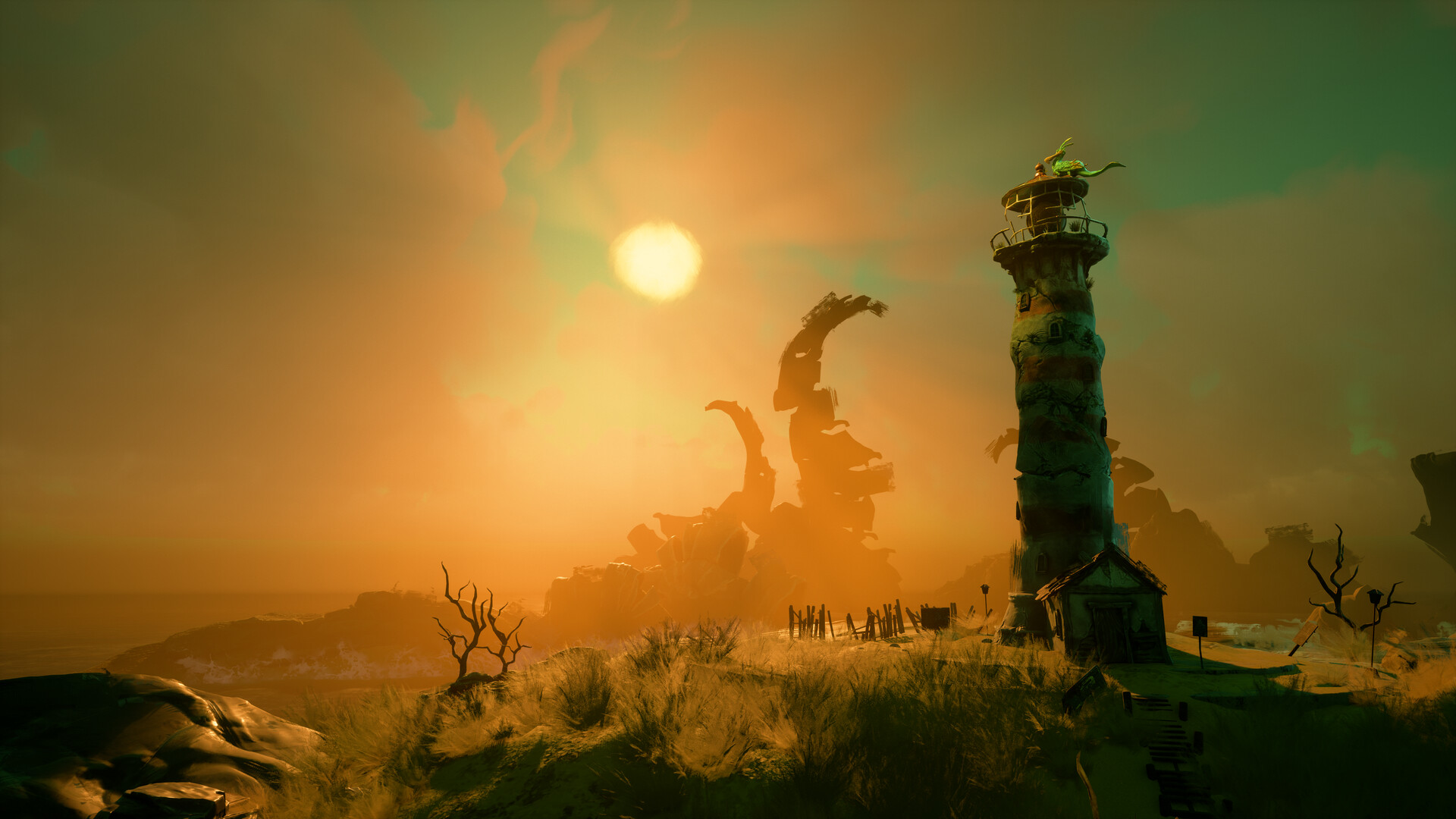
The beam of light is more than a visual signature for the lighthouse. It can influence living things and seems to keep the Wither at bay, tying the character’s identity to the island’s immediate problems. Dark, spreading tendrils appear throughout the journey, so illumination gives the player a way to engage with the encroaching threat without turning the adventure into a fight. Plants can respond to light, and the surrounding terrain includes routes or objects that draw attention when illuminated. The player must notice what reacts and consider how that reaction could change the path ahead. Light becomes a tool for observing and affecting an unfamiliar ecosystem, not simply a weapon or a key with one repeated use.
Twig contributes a complementary kind of interaction. The bird can maneuver into places the lighthouse cannot and work with strange, old mechanisms encountered along the way. Their abilities make exploration cooperative even though Keeper is a single-player game: the player controls a pair whose different capacities need to be brought together. A mechanism may belong to the bird’s dexterity, while the lighthouse’s light or movement changes the larger space around it. The studio presents their teamwork as the basis for solving puzzles and navigating the island. The exact outcome of each encounter depends on the environment, so the partnership is expressed through action rather than explanatory dialogue or a list of abstract character statistics.
Keeper’s tone combines stillness with surreal change. Creative lead Lee Petty has described its world as a far-future island shaped by isolation, the possibility of new forms of life and the need to connect; the game turns those ideas into a landscape of unusual forms rather than a conventional account of human society. The route includes recognizable natural settings as well as dreamlike, psychedelic images and beings that are difficult to classify. The distant peak offers a clear direction, but the places between the shore and the mountain repeatedly unsettle what seems ordinary. Double Fine characterizes the experience as exploration without combat or failure, so tension comes from the strange world, the Wither’s spread and uncertainty about what the companions will encounter.
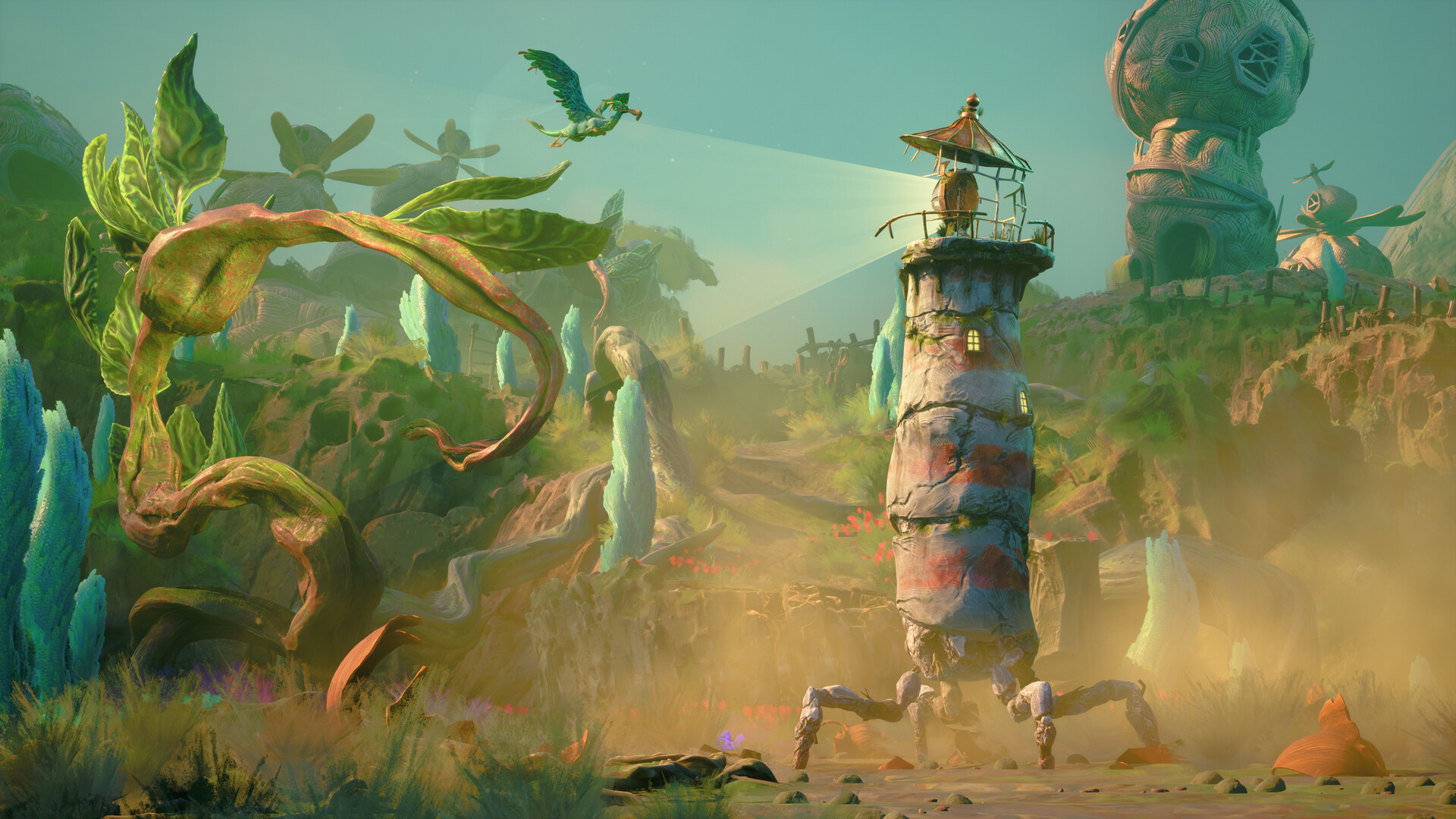
The journey is structured around movement, observation and environmental puzzles instead of combat encounters. The lighthouse learns to walk after awakening, and that change makes locomotion part of its identity as well as a practical way to travel. Traversing a ledge, entering a cave or approaching an ancient device can reveal a new use for the characters’ abilities or a new transformation in the surrounding world. The bird can reach mechanisms, the lighthouse can direct its beam, and both continue toward the mountain together. Double Fine has described the full adventure as roughly six to eight hours, though that is a studio estimate rather than a fixed completion time. Its short, self-contained journey is built to preserve the island’s surprises rather than explain every mystery in advance.
- Developer
- Double Fine Productions
- Genre
- Third-person atmospheric puzzle adventure