
About Kathy Rain 2: Soothsayer
In 1998, private investigator Kathy Rain takes a cash-reward case involving the Soothsayer, a serial killer terrorizing Kassidy. Riding her motorcycle between locations, questioning people and recording evidence in her notebook, she works through a citywide investigation that connects individual murders to a larger mystery.
Kathy Rain 2: Soothsayer is the direct sequel to Kathy Rain, following the private investigator into a new case rather than retelling the first game. In 1998, Kathy is broke, facing an empty fridge and the threat of eviction; a public reward for solving a string of murders gives her a reason to take a dangerous job. The killings have unsettled Kassidy, a large metropolitan city, and the unknown perpetrator has acquired the name the Soothsayer. Kathy is an outsider to the official investigation, approaching the case as a working detective whose livelihood depends on finding results. That personal pressure sits alongside the risk of pursuing a murderer who may turn the hunt back on her. The sequel brings back familiar faces from the earlier story while introducing a new cast around the investigation. Its premise shifts the series from the first game’s small-town mystery to an urban thriller, with Kathy moving between city locations as she follows evidence. A short recap of the first game appears at the start, so this case has its own entry point while remaining part of Kathy’s continuing story.
Kassidy is presented through separate interiors and streets rather than as a continuous open-world map. Kathy rides her motorcycle, nicknamed the Katmobile, to travel among places relevant to the current lead. Her route includes working locations such as her office and newspaper offices as well as public sites where she can consult records or speak with people. The selection of destinations shifts with the time of day and stage of the investigation, so checking the city map and revisiting a contact can matter after new information arrives. Conversations are a practical part of searching: Kathy asks people about names, events and objects, and an answer may establish a connection that points toward a different person or place. The cast includes people she already knows and new persons of interest, and their testimony is one strand of the case rather than a verdict on its own. This structure makes travel and questioning part of a repeated investigative rhythm. The city’s distinct settings serve as evidence spaces and social contexts, showing different corners of Kassidy through which the murders and Kathy’s paid assignment reach.
The central interaction is a point-and-click adventure loop built around inspecting scenes, speaking with characters and keeping track of clues. The player moves Kathy through fixed environments, selects objects or points of interest, and uses inventory items where a puzzle calls for a practical action. Dialogue options let her raise relevant subjects with people; the important work is noticing which facts need to be carried into the next conversation or checked against a location. The notebook gives that evidence a more active role than a simple record of completed objectives. Findings gathered from the environment and objects in Kathy’s inventory can be connected there, helping the player consider how separate strands fit together. The interface supports both close inspection and synthesis: discovering a detail is only the first step if its meaning depends on another clue. Rather than building a detective through levels or statistics, the game advances through observations, conversations and deductions. Fixed scenes keep attention on the case’s named people, documents and objects, while the notebook makes relationships among them visible as the investigation expands.
A library sequence illustrates how the game turns information into an investigation. Kathy consults newspaper records and uses dates, publication details and a calendar to reconstruct the order of earlier victims. A clipping refers to an issue of a weekly paper; working backward from the date on the issue identifies when a relevant edition appeared. Other dates are linked to a book’s publication anniversary, a full moon or a civic observance. The puzzle is not solved by repeatedly trying inventory objects against scenery. It asks the player to notice what a document says, retrieve a fact from a computer or another record, and apply that information to a calendar and microfilm archive. This makes research within the game world a practical skill: clues supply fragments that must be checked and ordered before they reveal the next step. Kathy’s notebook also offers comments on recorded notes, helping the player think about a lead without replacing the process of using evidence. Computer access, documents and physical locations each play different roles, and their combination gives the investigation a procedural texture grounded in the 1990s setting.
Not every obstacle is solved by historical records. The case also involves computerized systems, coded information and conversations that require Kathy to approach a topic from the right angle. One puzzle sequence has her hack into a computer, while other tasks ask the player to interpret messages or combine clues that have already been gathered. These actions remain embedded in point-and-click exploration: Kathy finds the relevant object or information, then applies it through the scene or interface. Evidence progression is cumulative, with earlier findings becoming useful when later testimony or a new location supplies context. The notebook is especially important because it connects details from the room and the inventory, giving the player a place to compare evidence rather than treating every clue as a separate lock-and-key token. Dialogue can expose a fact or topic, but the player still has to decide how it fits the broader pattern. The murder investigation remains central across puzzle forms, from filing and calendar research to digital access and decoding. Progress primarily depends on reading and connecting information.
Kathy’s case unfolds across distinct days and changing access to Kassidy’s locations. Depending on the time and story stage, some destinations are unavailable, which gives the daily itinerary a role in progression and encourages the player to consider who can be reached now. This timing creates a bounded form of freedom: there are places to inspect and leads to pursue, but the game directs Kathy through the sequence that moves the case forward. Conversations can prompt a return visit after she learns a new name or obtains a document, so a location may have a different purpose on a later pass. The player follows the Soothsayer investigation while also handling Kathy’s immediate circumstances as a private eye trying to keep a roof over her head. Her financial trouble explains why the cash reward matters, but the case is not a business-management simulation. Progress comes from accumulating and interpreting evidence, with locations, interviews and puzzles opening as the investigation develops. Returning characters tie the new plot to the earlier game, while the new supporting cast makes Kassidy’s case broader than a single suspect interview.

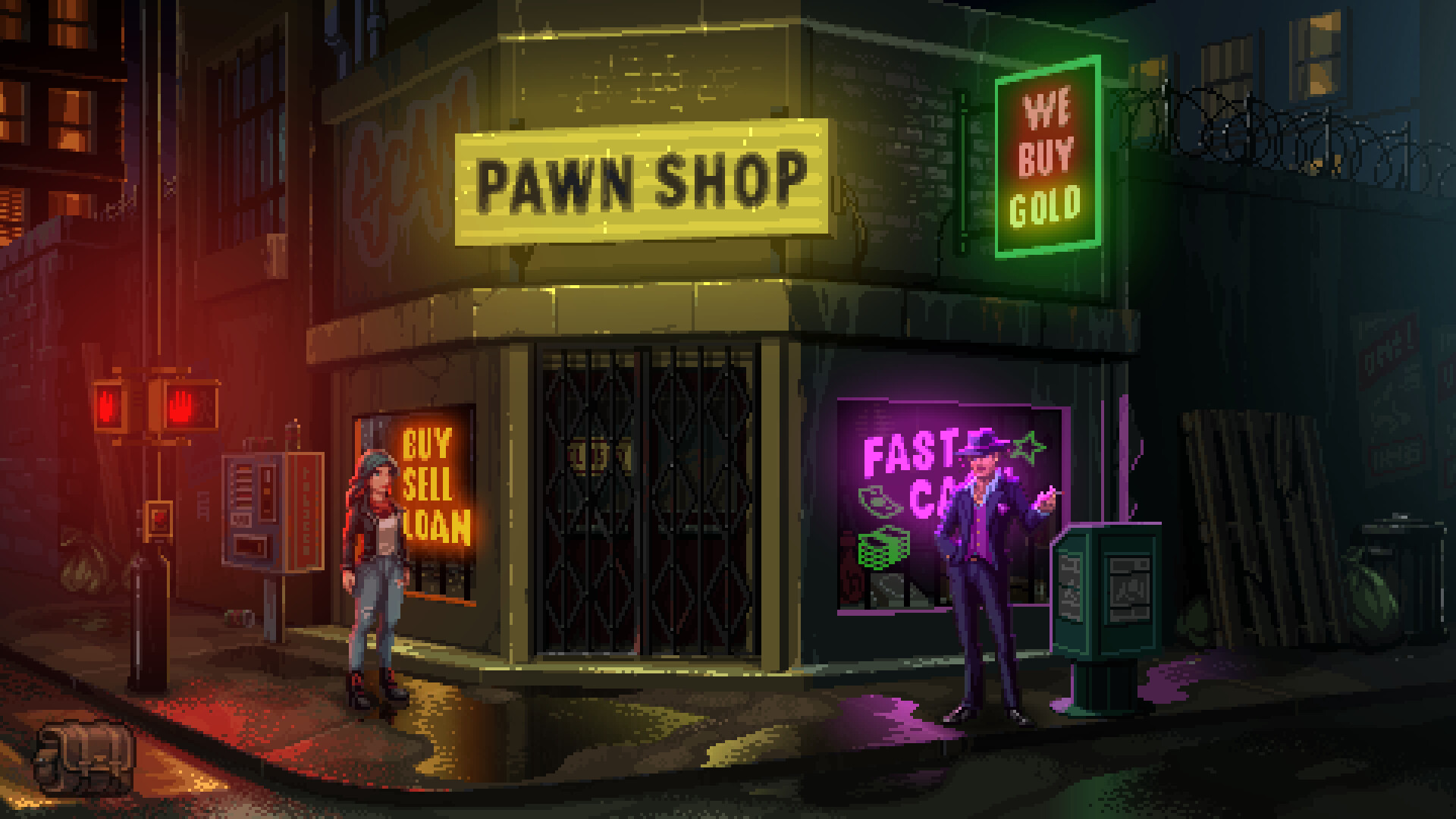
The presentation uses detailed pixel-art backgrounds and character portraits, with hand-drawn cinematic sequences, dynamic lighting and surface reflections adding visual distinction to the city’s environments. The look is higher-resolution than the original Kathy Rain, but remains based on pixel art and a 1990s visual vocabulary. Character art and voiced dialogue give returning contacts and new interview subjects clear identities, while music and scene composition support the shift toward a metropolitan thriller. Kassidy’s varied locations carry atmosphere and provide the visual details players must inspect for clues. The game is a single-player point-and-click adventure developed by Clifftop Games and published by Raw Fury. It is available for Windows, macOS and SteamOS/Linux on Steam; platform descriptions identify it as the second case with Kathy Rain and a direct sequel, while also noting that a first-game summary appears near the start. This profile concerns the full game’s premise and general systems rather than a particular demo segment. Its investigation loop is to travel to a lead, question people, inspect what is present, and link the resulting facts in Kathy’s notebook.
- Developer
- Clifftop Games
- Genre
- Point-and-click adventure; urban thriller