
About Just Cause
Rico Rodriguez arrives in the island nation of San Esperito as an Agency operative tasked with helping the People’s Revolutionary Army challenge President Salvador Mendoza’s government. Story assignments, rebel and Rioja cartel work, province liberation, vehicle commandeering, a parachute and a grappling gun shape this 2006 open-world action game.
San Esperito is a fictional Caribbean island nation caught between an authoritarian government, an armed resistance and competing criminal interests. In the 2006 original, Rico Rodriguez is sent in by the Agency to help overthrow President Salvador Mendoza, whose regime is linked to the Montano drug cartel. Rico works alongside Agency figures Tom Sheldon and Maria Kane, while the People’s Revolutionary Army of San Esperito and the rival Rioja drug cartel provide local allies. The setup gives the campaign a specific regime-change frame: the Agency’s assignment runs through a domestic uprising, and the Rioja operation is also directed against the Montano organization. The story’s named groups matter to play because they offer separate mission contacts, safehouses and rank rewards rather than serving only as background names.
The story missions form the central line of progress. Rico receives orders from his commanders and is sent to objectives such as attacking officials, disrupting transport or destroying equipment. These operations move through checkpoints and can include several active objectives, so the PDA and map help orient the player across the island. Completing a main assignment opens an Agency safehouse; a newly opened safehouse also destabilizes its province and makes liberation activity available there. Safehouses maintained by the Guerrilla and Rioja factions provide places to collect weapons, recover health and store unusual vehicles. The campaign therefore links its linear orders to a wider territorial layer: each assignment pushes Rico to another part of San Esperito and creates a new opening for resistance activity around it.
Liberation is a province and settlement activity built around starting an uprising against government forces. In a government-controlled settlement, Rico can attack the defenders and then connect with a Guerrilla contact to turn the clash into a liberation. Taking part earns rewards and prestige, while the political map marks provinces as government-run, unstable or under Guerrilla control. This makes local conflict legible as a changing map state, rather than a single global progress bar. The resistance side missions are also how the player develops standing within the rebel army. Rank gained through that work unlocks access to additional weapons and military vehicles, giving repeated local operations a practical payoff for the larger campaign.
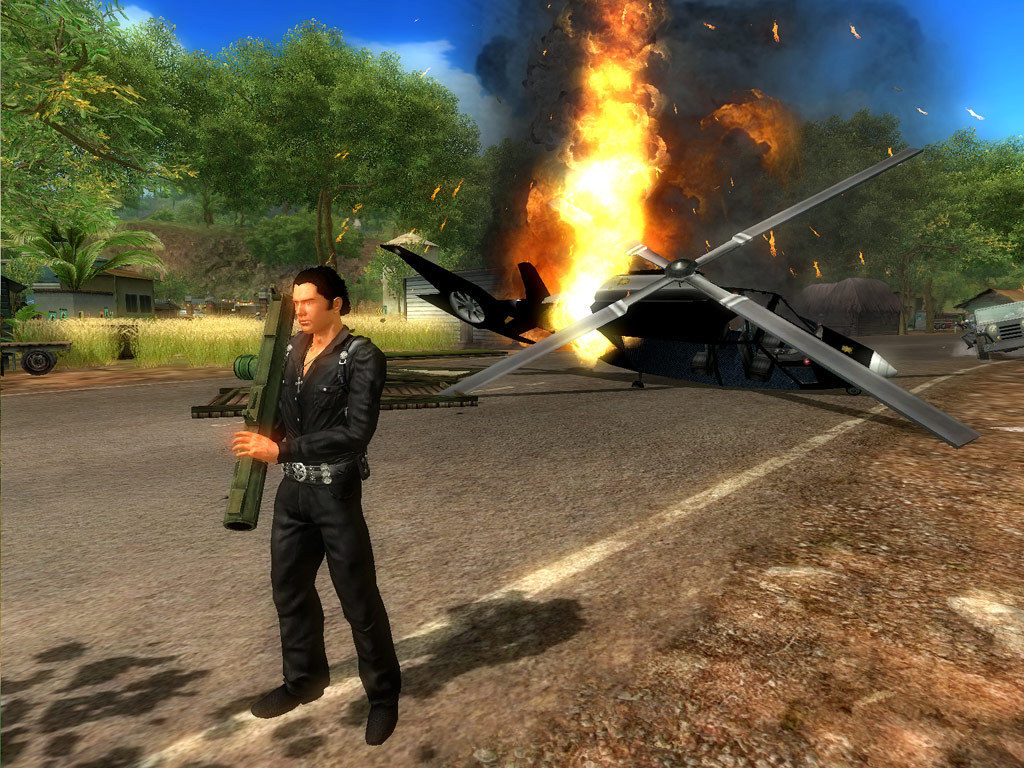
Rioja offers a distinct parallel track. Its members can give Rico side and bonus jobs, and successful work raises his rank with the cartel. The reward path differs from the Guerrilla relationship: Rioja rank unlocks luxury vehicles, while rebel prestige opens military equipment. These are not three interchangeable sides of one liberation mechanic. The Revolutionary Army opposes Mendoza’s government directly; Rioja is a drug cartel pursuing its own interests and fighting the Montano cartel. The contrast shapes the kinds of support available to Rico as he moves between main assignments, provincial unrest and faction jobs. The game also places races around the islands, with checkpoint courses in fast cars, boats or aircraft offering another optional activity tied to Rioja prestige.
Movement is built around vehicles, a deployable parachute and the grappling gun. Rico can commandeer cars, boats, aircraft and helicopters, then use a vehicle’s stunt position to leap between nearby rides or deploy his parachute. The grapple is a carried weapon that locks onto vehicles; from a stunt position, Rico can hook a target and pull himself onto it. Connecting the hook to a moving vehicle automatically opens the parachute, creating a parasail tow that can carry him across open ground. It also lets him reach aircraft in flight and take them over. These actions make changing transport part of traversal: a road vehicle, a passing aircraft and a parachute descent can become consecutive stages of one route without returning to foot travel between each one.
The PDA supports that roaming loop with extraction and vehicle drops. Rico can mark his position with a flare, choose an available safehouse and call a support team to extract him there; he can also request Agency vehicles be dropped at a selected landing zone. Faction rank and story progress determine which support locations, weapons and vehicles become useful, so the map is more than a navigation screen. It tracks mission objectives, faction standing and political control while pointing out side jobs and settlements. The game’s open-world structure comes from combining these systems: the campaign changes which provinces become vulnerable, faction work changes which equipment Rico can call on, and the grapple-parachute-vehicle chain gives him several ways to reach the next objective.
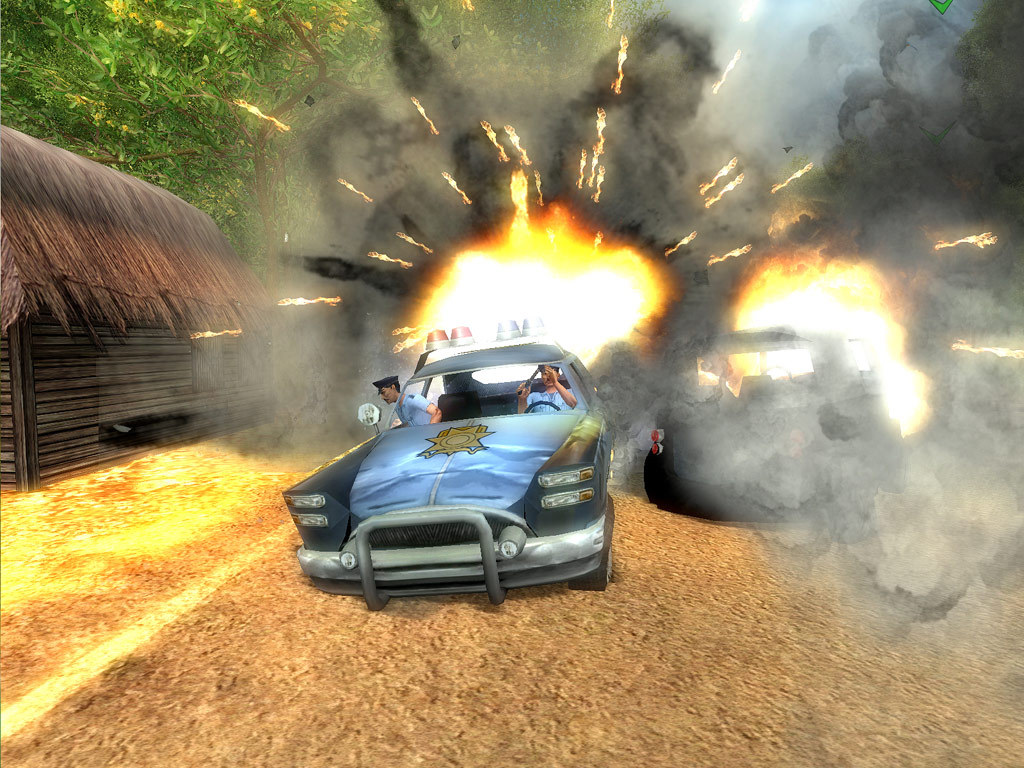
Exploration also feeds into smaller practical rewards. The islands contain towns and villages, marked points of interest, collectible objects and race starts, while the minimap includes an altimeter for tracking height during flight and freefall. A wanted indicator shows how actively the police are hunting Rico, and the political map gives each province a visible status. These layers support different moods of play: the player can follow a commander’s next briefing, seek a faction contact, look for equipment away from a settlement or enter a timed race. They also explain why liberation is not just a story cutscene: a province’s status changes after an uprising, and the map communicates that change as the player continues travelling through it.
- Developer
- Avalanche Studios
- Genre
- Third-person open-world action-adventure