
About Just Cause 3
Rico Rodriguez returns to his Mediterranean homeland of Medici, where dictator Sebastiano Di Ravello rules through military force and propaganda. Working with old friends in the rebel movement, Rico attacks the regime’s strongholds, disrupts its control of settlements and moves across the islands by grappling hook, parachute and wingsuit.
Rico Rodriguez comes back to Medici, the Mediterranean island nation where he grew up, after its people have fallen under the control of General Sebastiano Di Ravello. Rico’s return is personal as well as political: Di Ravello’s coup left his family dead and forced him into exile. He joins the resistance and reunites with his childhood friend Mario Frigo, who helped him escape Medici years earlier. His former Agency mentor Tom Sheldon remains part of the wider operation. Mario links Rico to the local rebellion, while Sheldon connects the campaign to the Agency that Rico left behind. Their different ties to the conflict give the story both a personal return and a wider operation against the regime. The main objective is to weaken Di Ravello’s military hold and restore Medici to its people.
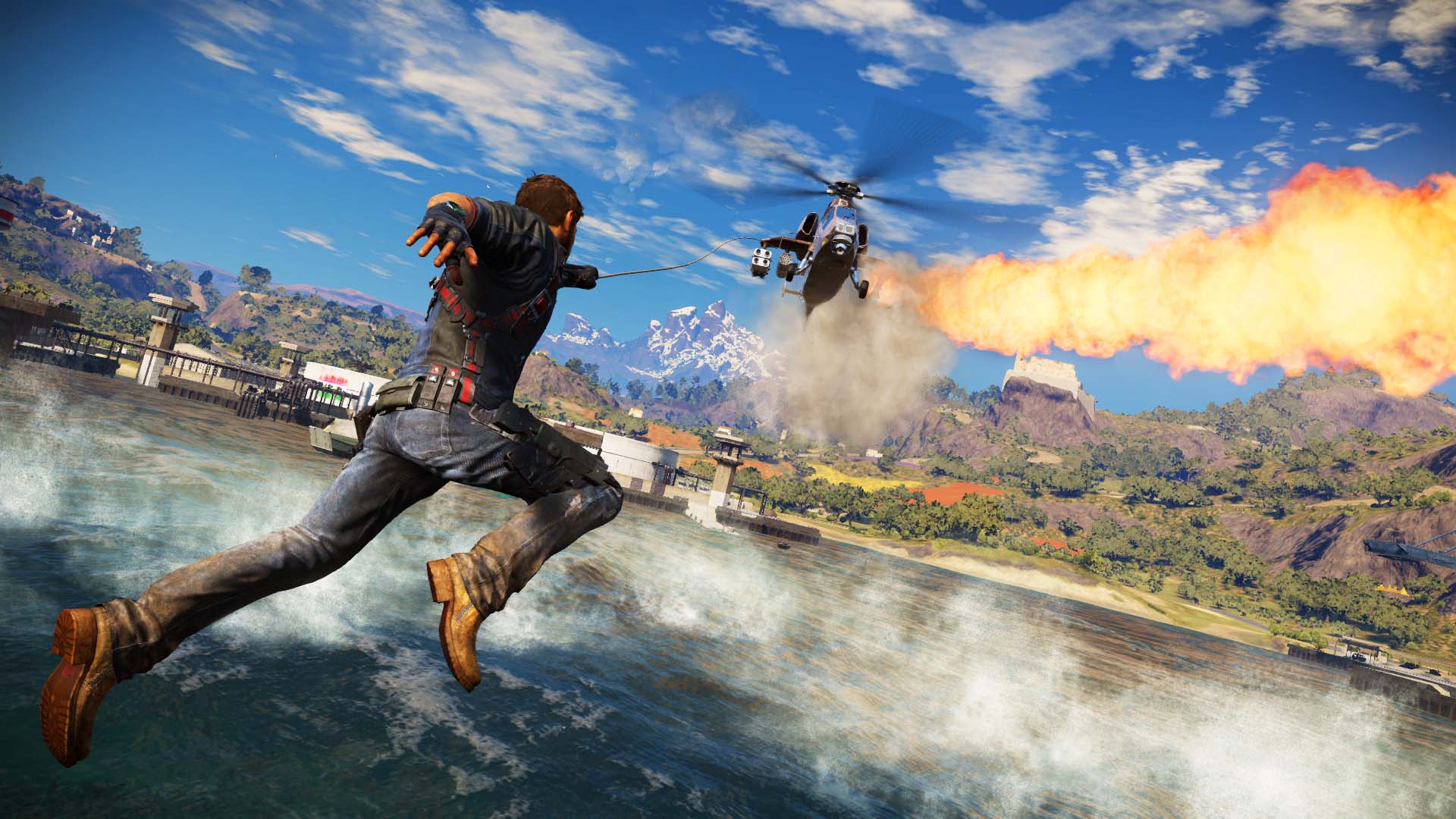
Medici is presented as three island regions, with towns, villages, military bases, airfields, radar installations and other settlements spread between coastlines and inland terrain. Rico can approach these spaces by road, boat or aircraft, but his personal equipment makes vertical travel central to the action. A grappling hook pulls him toward surfaces and lets him attach objects to one another; opening the parachute turns a grapple into a way to gain height or redirect a fall; the wingsuit lets him travel forward while skimming above the landscape. Combining the three is a practical way to cross gaps, reach rooftops and move from an attack into a rapid escape. Helicopters and other vehicles supply different ways to reach distant targets, while the open island layout lets a mission route pass through places the player has already explored.
The grappler also turns ordinary enemy infrastructure into connected parts of a physics problem. Rico can tether a fuel tank to a vehicle, join two objects and pull the line tight, or attach equipment to enemies and other targets. The player controls when a tether retracts, which allows a setup to be arranged before the pull starts; fuel containers, generators, vehicles and structural objects can then collide or explode. A separate remote explosive can be placed on a target and detonated, providing a more direct option when a carefully arranged tether would take too long. Challenges award upgrades that expand how many cables Rico can use together and how strongly they pull. This progression changes the possible scale of a contraption: a limited early setup can grow into several linked objects or a forceful connection between heavier targets.
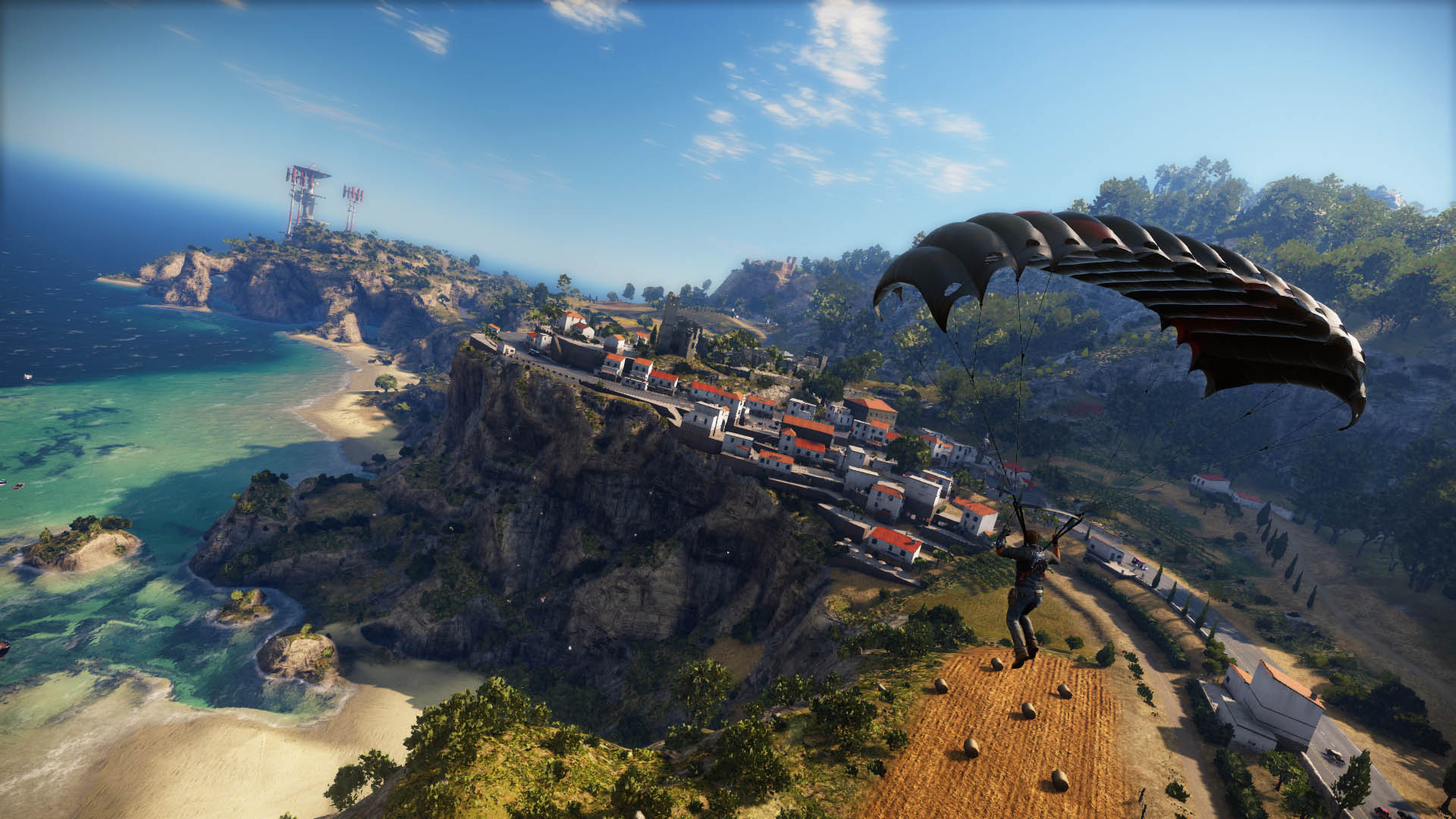
Liberation happens at the settlement level. The regime’s signs, statues, speakers, billboards and military hardware mark the objects that Rico can destroy to undermine its presence. Towns add tasks that can include disabling a monitoring system, while police stations have their own security objectives: raise the local Havoc Meter by wrecking military property and open the gates so rebel fighters can enter. A settlement is not considered liberated until its required objectives are completed and the rebel flag is raised. The details vary by location, so a small outpost can focus on destroying a compact group of installations while a larger residential area can combine propaganda targets, surveillance equipment and a defended police station. This gives the campaign a repeating loop of reaching a place, reading its remaining objectives and using weapons, vehicles or tethers to clear them.
Bases are more heavily defended and may bring reinforcements or a commander into the fight. Airbases add aircraft and surface-to-air defences, while some large compounds function as regional command centres for Di Ravello’s forces and research. Taking these sites can make new activities available, including races, wingsuit courses and destruction challenges; some liberations also unlock a weapon or vehicle for the rebel supply system. The story campaign uses this map activity as part of its broader structure: progress can depend on freeing a required number of provinces in a region before the next major operation becomes available. A liberated location also changes the map from an enemy-held target into a point connected with rebel activity, giving the player reasons to return as the resistance spreads.
Challenges provide a separate way to test Rico’s equipment and add upgrades. Land, sea and air races ask the player to guide a vehicle through timed checkpoints, while wingsuit courses reward controlled gliding through markers above the terrain. Destruction Frenzy sets a short window for damaging as many designated objects as possible, and Crash Bomb sends the player across a route in a vehicle rigged to explode if it slows too much. Other activities use tools for different tasks, such as a giant magnet that attracts valuable ore. Their results feed into equipment improvements, including stronger or more numerous grappling cables, so these diversions connect movement and destruction practice to the main sandbox. They also give liberated bases and towns a second function beyond clearing military objectives: each can lead to a new challenge, supply option or route across Medici.
- Developer
- Avalanche Studios
- Genre
- Open-world action-adventure