
About Journey
A lone, robed traveler crosses a vast desert toward a distant mountain, uncovering traces of a vanished civilization along the way. Move through ruins and shifting sands, use a responsive scarf to jump and glide, and call to nearby cloth creatures. Another anonymous traveler may appear online, offering silent company without making cooperation necessary.
Journey opens on a broad desert with a mountain visible on the horizon. The player controls a small, red-robed traveler whose destination is clear, while the route between the starting dunes and that peak is revealed gradually through movement. The landscape shifts from open sand and wind-shaped slopes to the remains of a once-populated world, with architecture and painted imagery hinting at the people who lived there. The story has no spoken dialogue or conventional quest text; brief visual scenes and environmental details provide its context. There are no named companions or factions to manage. Instead, the traveler’s surroundings, the changing terrain and the distant summit establish the pilgrimage, leaving the history of the civilization to be pieced together from what the journey shows.
Walking and running carry the traveler across the sand, but the central movement system is the scarf. A short call, shown as a symbol in the air, activates or attracts nearby pieces of animated cloth. When the scarf is charged, the traveler can leap into the air and glide; each burst consumes its available energy, so the length of the glowing scarf indicates how long flight can continue. Floating cloth fragments recharge it, and some larger cloth forms can be animated with calls to make bridges, lift the traveler, or reveal a route onward. These interactions are also the game’s main environmental puzzles: notice a cloth structure, call to it, and use the change in the space to reach a ledge, cross a gap, or continue through a ruin.
Glowing symbols hidden throughout the levels extend the scarf, increasing the amount of flight energy available during that journey. Finding them is optional exploration rather than a separate inventory or equipment system. A longer scarf makes it easier to stay airborne and cover larger stretches of terrain, while the short scarf at the start encourages the player to use nearby cloth and choose places to land. The game’s progression is principally spatial: new areas introduce different arrangements of sand, cloth, architecture and hazards, and the player learns how those elements work by interacting with them. There are no conventional combat upgrades or branching skill trees. The traveler’s growing reach comes from discovering these symbols and using the environment’s renewable cloth energy as the route changes.
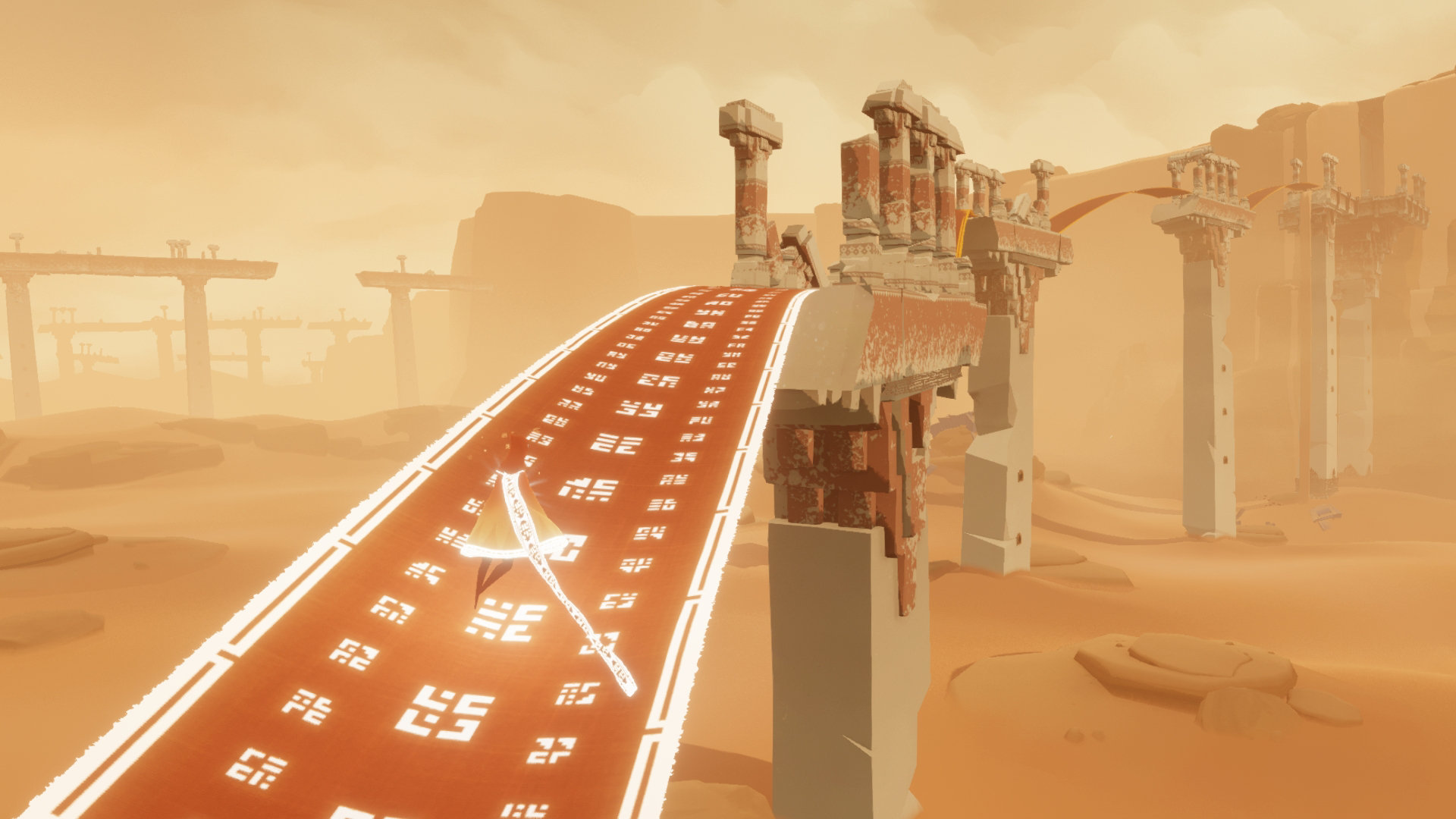
The desert’s cloth creatures form a second kind of movement support. Small fabric-like beings drift or swim through the air and can help replenish the scarf when the traveler approaches or calls. Red cloth banners and long strips embedded in the landscape respond to the same call, sometimes unfurling into paths or carrying the traveler upward. The player does not manipulate objects with tools or hands; the call is a simple, consistent action that works as communication with the world. Learning to scan ahead for a floating creature, a loose ribbon, or a glowing symbol gives the open spaces a readable rhythm. The traversal loop alternates between moving under one’s own power, finding cloth energy, and gliding toward the next visible piece of architecture or terrain.
Online encounters place Journey’s quiet cooperation inside this otherwise solitary crossing. A second player can join without a username or text chat, and the two travelers communicate only through their calls. Each call produces a brief visual mark, and nearby travelers can recharge one another’s scarves by staying close. That creates a practical reason to travel together: either person can help the other remain airborne or draw attention to an interactive cloth feature. The system does not require a partner to solve the levels, and players can keep moving independently. If both reach a transition together, they may continue onward as a pair; a player who moves ahead can be matched with someone else later. The encounter is temporary and anonymous, with no competitive score or formal party management.
As the pilgrimage leaves the bright open desert and passes into enclosed ruins and colder terrain, movement asks for more care. The player still relies on the same call, scarf and glide, but must read the space before committing to a jump, find cloth that can restore flight and avoid hostile remnants that can damage the scarf. Those encounters are presented through the environment rather than a combat interface: the traveler cannot equip weapons or fight back, so timing and choosing a route are the relevant responses. Ancient murals and structures add more pieces to the setting’s history as the traveler advances. Their arrangement encourages observation and inference, while the destination remains the mountain that has been visible since the beginning.
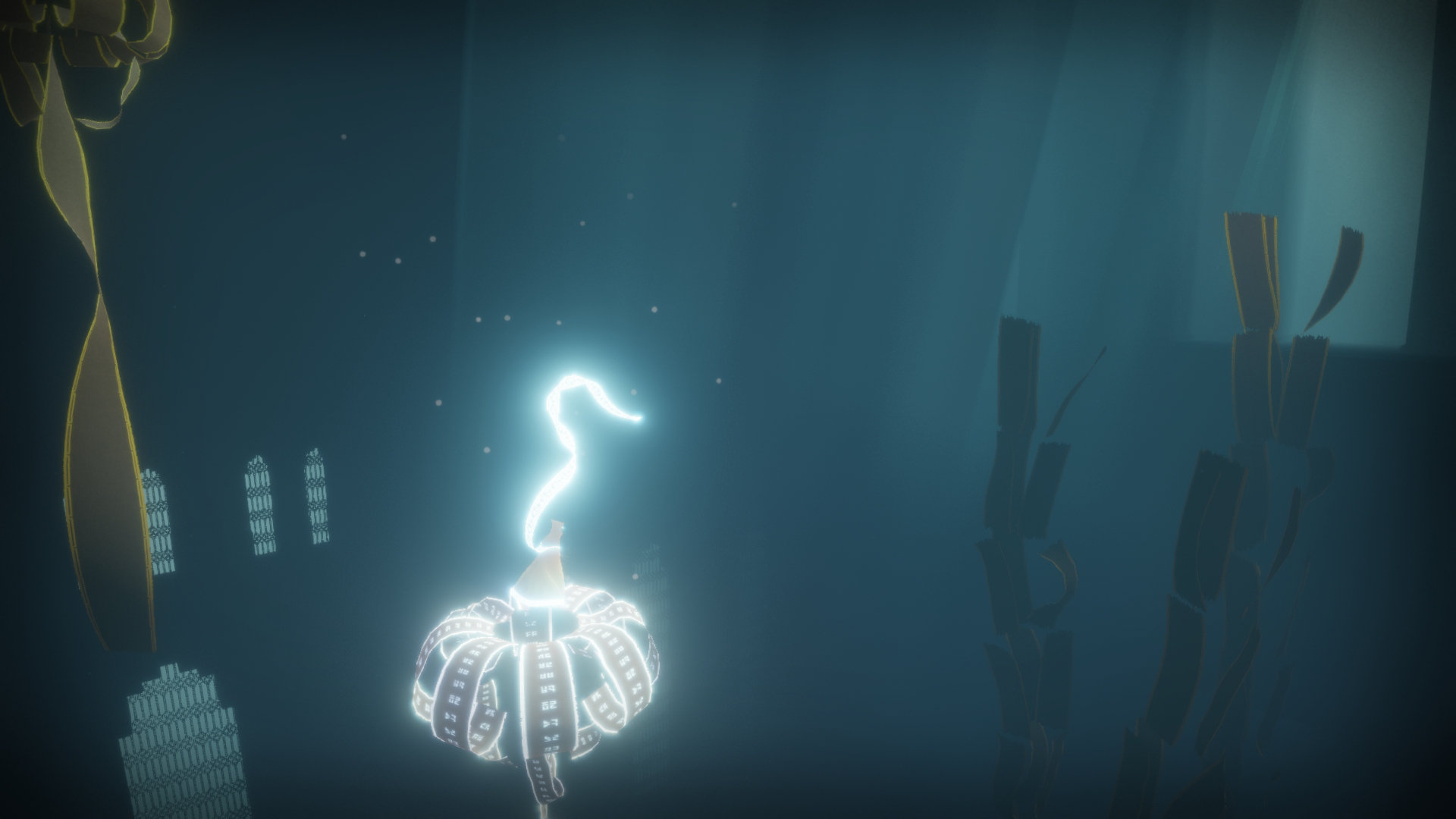
Journey’s final progression remains tied to reaching new places rather than accumulating a checklist of mandatory tasks. The winding route reveals additional scenes, mechanisms and environments, and each transition changes the scale or character of the landscape. The soundtrack also responds to the player’s company: the score can gain instrumental layers when another traveler is nearby, linking the multiplayer system to the same act of moving and calling that powers traversal. After completing the journey, chapter selection allows areas to be revisited, and a later trip can begin again with the scarf’s ordinary starting state. This keeps the game’s systems focused on movement, discovery and optional companionship, while the mountain and the ruins supply the story’s forward momentum.
- Developer
- thatgamecompany
- Genre
- Adventure