
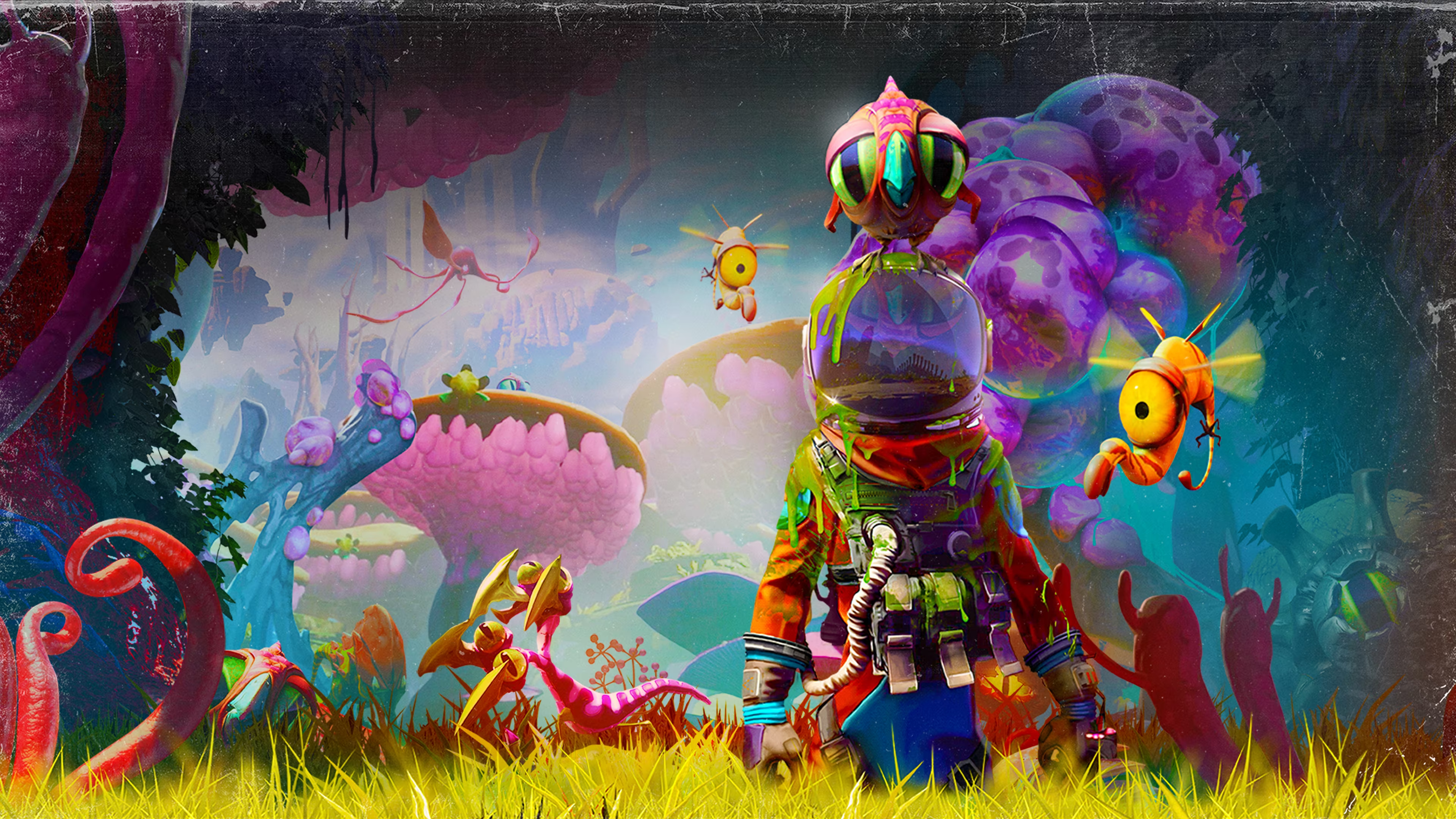
About Journey to the Savage Planet
As a new Kindred Aerospace recruit, you land on AR-Y 26 to judge whether it can support human life. Scan its wildlife and strange structures, gather materials, and turn scavenged resources into tools and upgrades that open new routes. Explore, jump, grapple and fight alone or with an online partner while the company’s irreverent mission briefings frame the expedition.
Journey to the Savage Planet casts the player as a new recruit in Kindred Aerospace’s Pioneer Program, sent to AR-Y 26 to decide whether the planet could become a home for humanity. The company calls itself the fourth-best interstellar exploration company and provides what it considers the minimum equipment required for the assignment. The mismatch between the grand corporate mission and the recruit’s sparse kit frames the expedition: the player must learn the terrain by moving through it, studying the life there and collecting useful materials. The objective is not simply to reach a distant destination. Kindred expects a survey of the planet, while the route toward that survey’s conclusions leads through dangerous wildlife, unfamiliar plants and alien structures. The first-person view keeps the explorer’s hands, scanner and tools close to the action, so investigation, movement and combat share the same immediate space.
AR-Y 26 is built as a set of connected environments with different terrain and ecological pockets, rather than an empty expanse to cross in a straight line. The expedition’s objectives point toward larger questions about the planet and the structures found across it, but the path between them invites detours to inspect a new creature, gather resources or test an unusual route. Company communications and ship-based videos add a satirical corporate voice to the fieldwork, presenting the survey as an ordinary assignment even when the recruit encounters hazards. The game’s narrative is tied to investigation: completing quests and examining tucked-away parts of the world can reveal further messages, videos and answers to the questions raised by the mission. This makes environmental curiosity serve two purposes. It helps the player discover the practical resources and passages needed to continue, while also filling in more of the context around Kindred’s plans and the planet’s history. The broad survey goal remains understandable even as individual discoveries complicate what the assignment seems to be.
Scanning turns observation into a main activity. The recruit can catalogue the planet’s flora and fauna, from strange spherical birds to hallucinogenic plants, building a record of creatures that may be passive, likely to flee or actively predatory. A scan is a way to learn what is present before deciding whether to approach, avoid or fight it; the cataloguing task also gives the expedition a purpose beyond extracting materials. The landscape contains useful plants and alien life as well as hazards, and some species behave differently when disturbed. That variety matters when collecting: the quickest way to obtain certain crafting elements may involve shooting local fauna, but a nearby predator can turn that task into a fight. Exploration therefore asks the player to read a small area before acting. Scanning can identify a subject of interest and document it, while the recruit’s other tools let them test whether it is a source of resources, an obstacle or a threat. The survey objective and the survival loop are linked because the planet’s inhabitants are both things to study and part of the material economy.
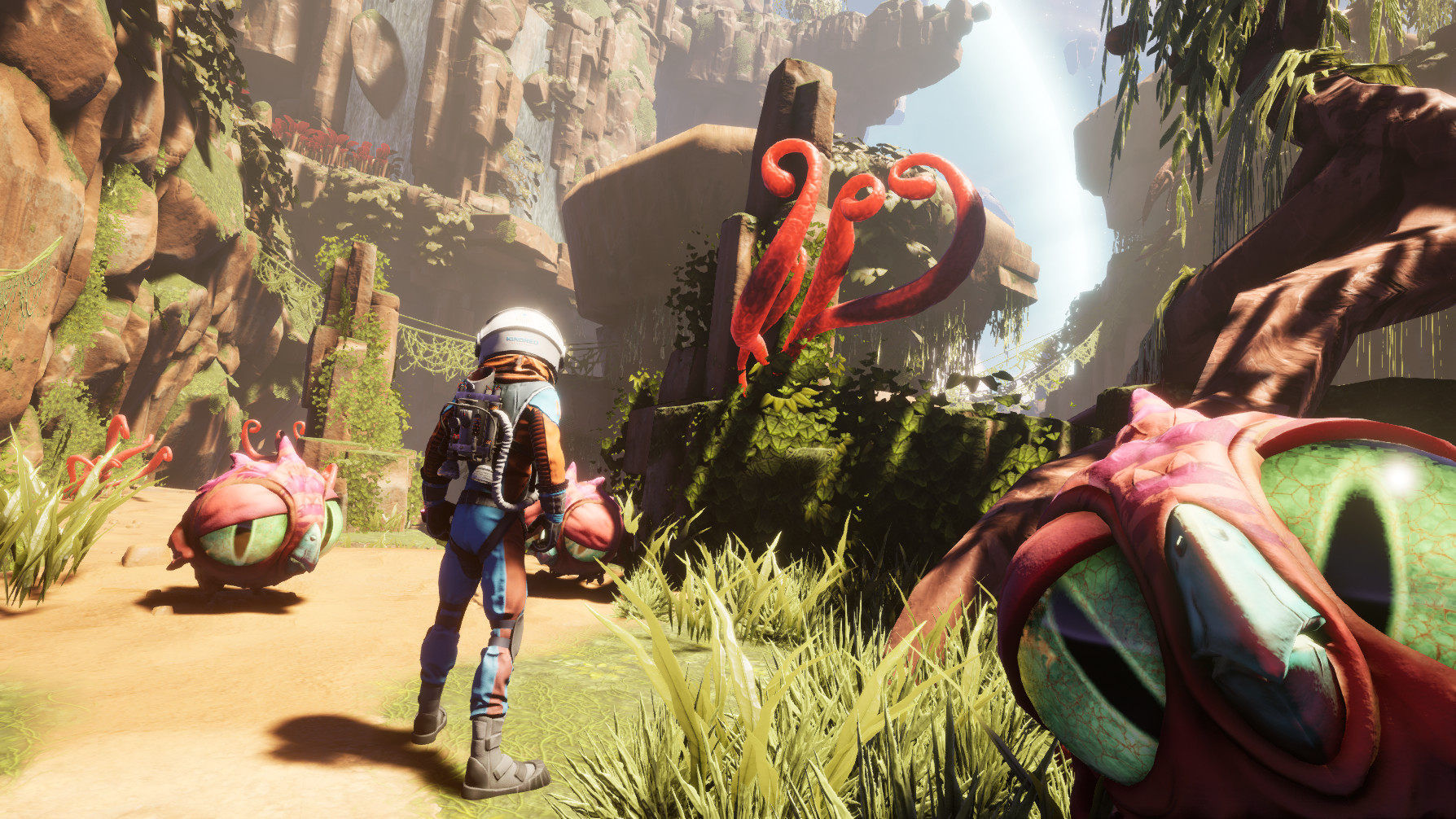
Traversal develops as the recruit fabricates new equipment. At first, ordinary jumps and the rocket booster pack provide the basic means to cross gaps and reach elevated ground. Later movement upgrades include additional consecutive jumps, boost jumps, a stomp and a grapple gun, so familiar spaces can be approached with a wider set of options. The grapple in particular turns distant anchor points into reachable routes and can expose paths that were inaccessible earlier. The player can also carry and throw different objects with the free hand; these can open doors, dissolve resin or trigger explosions, giving the same tool slot practical uses in traversal and environmental problem-solving. Movement is therefore part of progression rather than a fixed ability set: returning to a previously seen ledge or blocked passage with a new capability can change where the player can go. The connected regions encourage looking upward and across gaps as well as following the most obvious ground route. New tools make backtracking purposeful, because each unlocked action can reveal an alternate passage or shortcut through terrain already encountered.
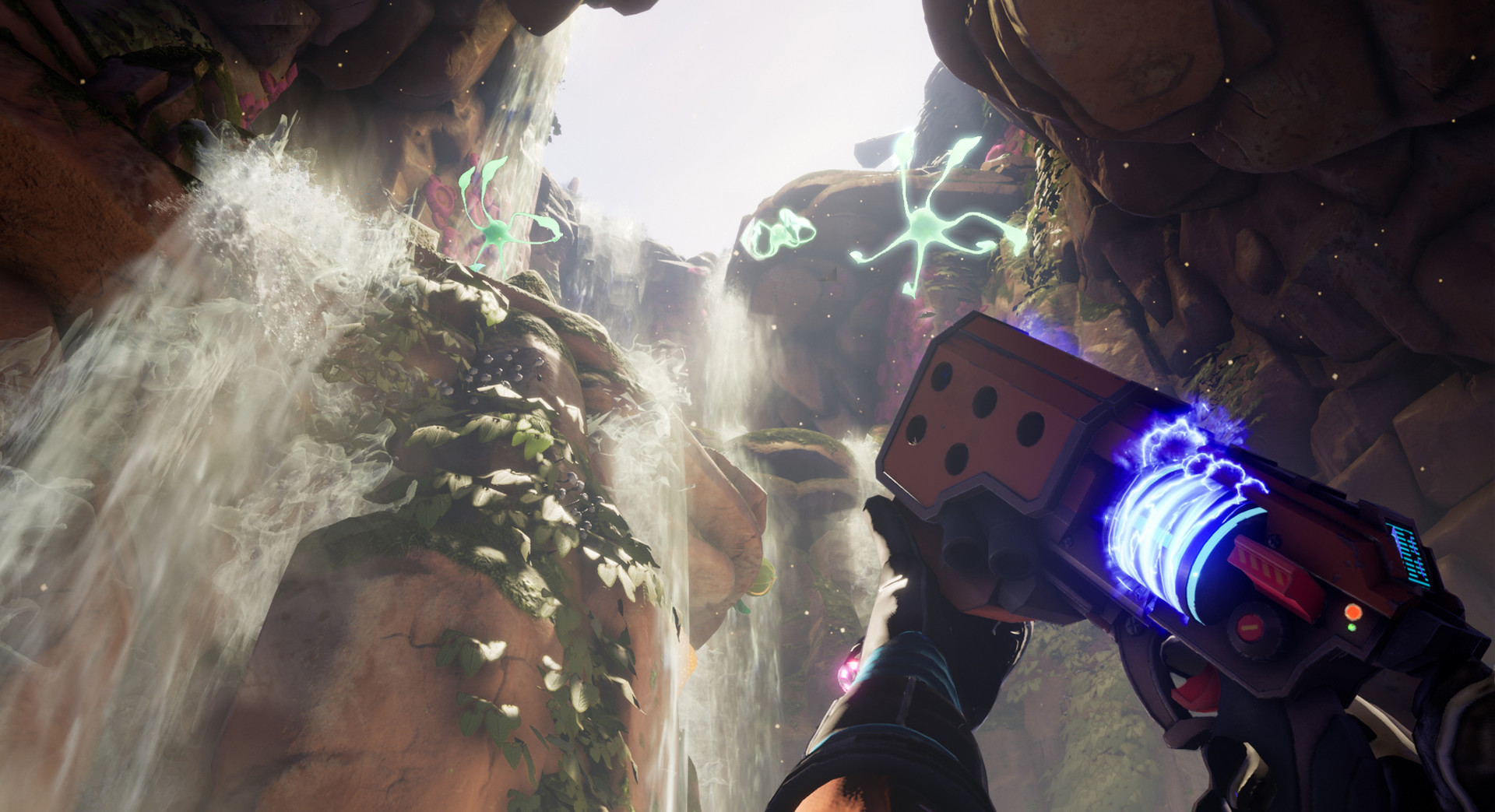
Scavenged materials feed a 3D printer that converts space trash and planetary resources into gear. The player gathers elements from the environment and its wildlife, then uses those supplies to build new equipment and improve existing tools such as the laser pistol. This creates a direct loop between surveying and capability: exploring a patch of terrain finds materials; the printer turns them into a tool or upgrade; that tool can then help reach another area or handle a later hazard. Some upgrades improve mobility, while others make combat equipment more capable, so the order in which a player pursues resources can shape which problems feel manageable. The game also presents primary and secondary objectives that give direction to the expedition without making every moment a march from marker to marker. A player can follow a stated task, pause to collect crafting ingredients, or spend time cataloguing nearby life. Because the objectives and the resource hunt sit alongside one another, optional discoveries can strengthen the recruit’s kit as well as fill out the survey. The 3D printer gives collected junk a clear function instead of leaving it as a detached score.
Combat is one part of the expedition, but the planet’s creatures do not all behave like interchangeable targets. Typhoon described ambient animals that ignore the player unless attacked, prey that flee and predators that pursue; there are flying and ground-based forms among these broad behaviours. That distinction affects when it is useful to fire and when it is better to keep moving. The laser pistol is the basic weapon, and upgrades improve its performance as the player gathers materials. The recruit can also kick or slap nearby creatures, actions that can interrupt or displace them, while thrown objects and crafted gear add other ways to deal with a threat or clear a route. Some wildlife is dangerous enough to make an unplanned encounter costly, and falls or environmental hazards can also interrupt a trip across the terrain. The result is a survival loop built around awareness and improvisation: identify what is nearby, decide whether it can be bypassed or must be confronted, and use the available tools to get back to exploration. Combat supports the survey and movement systems rather than replacing them as the sole purpose of the mission.
The expedition can be played solo or online with one friend. In co-op, another player can join the exploration, help handle difficult encounters and participate in the same open-ended approach to objectives; the publisher notes that a guest’s departure lets the host continue in single-player, and that only the primary player’s progress is saved. Kindred’s corporate videos and the setting’s bright, colourful alien forms provide the game’s distinct presentation, placing absurd company messaging beside unfamiliar organisms and hazardous terrain. The original expedition is distinct from the releases that followed. Hot Garbage is a separate paid expansion that adds the DL-C1 biome, additional wildlife and alien rings that grant flight in some areas. Employee of the Month is a separate console edition that bundles the original game with Hot Garbage and adds presentation and photo-mode features; it is not the Steam app’s base-game scope. Revenge of the Savage Planet is the later sequel, with a different expedition and broader multi-planet setup, rather than an edition or chapter of this game.
- Developer
- Typhoon Studios
- Genre
- First-person action-adventure and exploration game